
















 Duc Nguyen (Dwight)
Learn how hallucination evaluation metrics measure factuality, groundedness, and unsupported AI claims, with a practical framework for enterprise.
Table of Contents
Toggle Relying exclusively on hallucination evaluation metrics creates a false sense of security if the underlying retrieval architecture feeds low-quality context to the model.
Groundedness, factuality, and faithfulness measure distinct failure modes; an output can score perfectly on groundedness while being factually incorrect.
LLM-as-a-judge systems scale evaluation but introduce a recursive risk of models validating their own structural biases.
Enterprise implementation demands calibrating automated evaluation scores against human-reviewed baselines to prevent silent data corruption in production workflows.
The term hallucination hides several technically different failures.
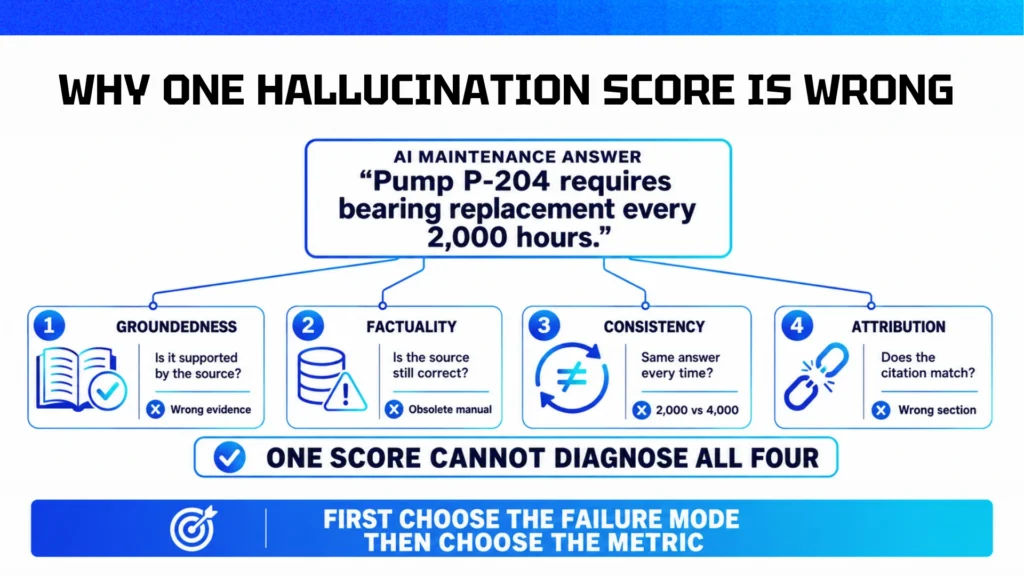
Consider an AI maintenance assistant answering:
“Pump P-204 requires bearing replacement every 2,000 operating hours.”
There are several ways this statement could fail.
The number may contradict the approved maintenance manual. That is a groundedness or faithfulness failure.
The manual itself may be an obsolete revision. The model could faithfully reproduce it while still giving the wrong current recommendation. That is a factuality or knowledge-quality failure.
The assistant may say 2,000 hours today and 4,000 hours tomorrow using identical evidence. That is a consistency failure.
The assistant may cite the maintenance manual, but the cited section discusses another pump model. That is an attribution failure.
One score cannot diagnose all four.
Current evaluation frameworks increasingly make this distinction. Groundedness tests support from supplied evidence, factuality tests correctness against a verified truth source, and consistency methods compare behavior across repeated generations.
The first design decision should therefore be the failure mode, not the metric library.
For a broader evaluation architecture, see Reference-Based vs Reference-Free Evaluation, which explains why enterprise systems often need both deterministic and model-based evaluators.
| Evaluation signal | What it asks | Best fit | Main limitation |
|---|---|---|---|
|
Groundedness / faithfulness |
Is each claim supported by supplied evidence? |
RAG, summarization, enterprise search |
A bad source can still support a bad answer |
|
Factuality |
Is the claim objectively correct against verified truth? |
Open-domain QA, research, external claims |
Requires reliable references or fact checking |
|
Entailment / contradiction |
Does the evidence logically support or contradict the claim? |
Policies, technical documents, compliance |
Domain shift can weaken NLI models |
|
Citation correctness |
Does the cited passage support the associated claim? |
Research assistants, enterprise RAG |
Citation presence alone proves little |
|
Consistency |
Do repeated generations reach compatible conclusions? |
Reference-free generation |
Models can consistently repeat the same error |
|
Semantic entropy |
How much does meaning vary across sampled answers? |
Questions with no gold answer |
Requires multiple generations and more compute |
|
Critical error rate |
How often does a material unsupported claim appear? |
High-risk enterprise workflows |
Requires a risk taxonomy and labelled cases |
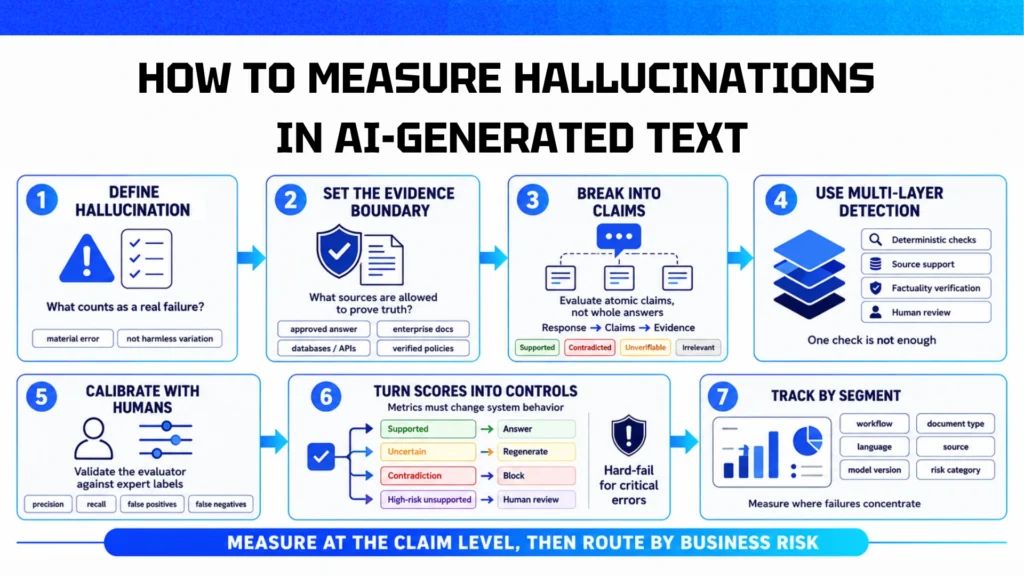
A production evaluation workflow should operate at the level of claims and business consequences.
Do this before selecting a metric.
For an internal HR assistant, an unsupported statement about annual leave entitlement may count as a material hallucination. A harmless paraphrase should not.
For a creative marketing assistant, external factual claims may need verification while stylistic variation does not.
The definition must follow the workflow.
Every evaluation needs an answer to: What is allowed to establish truth?
Possible sources include:
This is also where enterprise knowledge architecture matters. An evaluator cannot determine whether an answer is grounded if the organization cannot identify which information is authoritative.
AIQuinta’s Knowledge Management capability, for example, focuses on converting documents and expert knowledge into controlled, reusable knowledge with approval workflows.
Answer-level evaluation hides risk.
Suppose an AI generates ten claims. Nine are correct and one invents a regulatory requirement. A 90% aggregate result sounds strong, yet the response may still be unusable.
Instead:
Generated response → atomic claims → evidence → support status
For each material claim, classify it as:
A practical architecture might combine:
Layer 1: deterministic checks
Verify schema, required citations, numerical ranges, identifiers, prohibited statements, and tool parameters.
Layer 2: source-support evaluation
Use entailment, specialized hallucination classifiers, or a constrained LLM judge to test whether claims are supported by the supplied evidence.
Layer 3: factuality verification
For important external claims, check against a verified reference, database, API, or separate fact-checking process.
Layer 4: human review
Escalate high-risk failures and cases where evaluators disagree.
This follows the same broader principle behind Factual Consistency Metrics: lexical or semantic similarity alone cannot establish source support.
Do not choose a threshold because another benchmark uses it.
Build a labelled validation set from the actual workflow. Have domain reviewers classify outputs. Then measure the evaluator itself.
Useful detector metrics include:
False negatives deserve special attention when hallucinations can trigger financial, safety, compliance, or operational consequences.
A metric that ends on a dashboard creates observability. A metric that changes system behavior creates control.
For example:
Supported claim → answer
Uncertain claim → regenerate with stricter retrieval
Contradiction → block
Unsupported material claim → human review
Repeated critical failure → disable workflow or roll back release
High-risk errors should use hard-fail conditions. A strong style score should never compensate for an invented compliance rule or incorrect maintenance limit.
A global hallucination rate can conceal concentrated failures.
Track results by:
A 2% overall hallucination rate has limited meaning if 15% of regulatory questions contain unsupported claims while casual informational questions perform near perfectly.
A frequent mistake is treating every text-quality metric as a hallucination metric.
BLEU and ROUGE measure forms of lexical overlap. BERTScore measures semantic similarity. These signals can detect regression and coverage changes, but a sentence can remain highly similar to a source while reversing one material fact.
Consider:
Source: “The machine must not operate above 180°C.”
Generated text: “The machine must operate above 180°C.”
Most words match. The operational meaning has reversed.
AIQuinta’s existing comparison of BLEU, ROUGE, and BERTScore makes the same broader point: evaluation metrics should be mapped to the property being measured rather than treated as interchangeable quality scores.
Traditional similarity metrics still have value. They simply solve another problem.
The business impact changes once generated text feeds downstream actions.
An unsupported statement in a chatbot may confuse an employee.
An unsupported statement used by an agent could change a maintenance schedule, create a purchasing request, update a CRM record, classify a compliance case, or trigger another automated process.
Evaluation therefore belongs inside the agent control loop.
Retrieve → Generate → Extract claims → Verify → Gate → Act
The stronger the agency granted to the system, the stronger the verification requirement should become.
This also explains why enterprise AI memory and knowledge governance affect hallucination control. Persistent memory can improve contextual continuity, but storing incorrect or outdated information also creates a mechanism for errors to be reused across future decisions. AIQuinta discusses this trade-off in Building AI Memory: The Next Competitive Advantage.
Hallucination evaluation metrics should be chosen based on the specific business risks they are meant to detect, not how advanced the scoring method is. Groundedness checks if outputs are supported by provided evidence, factuality verifies truth against trusted sources, entailment detects contradictions, consistency finds unstable responses, and citation checks ensure proper provenance. Since each method has limits, no single metric is enough, and human review is still required for high-risk use cases. The goal is to prevent unsupported claims from affecting real business decisions.
What are hallucination evaluation metrics?
Hallucination evaluation metrics measure whether AI-generated claims are unsupported, factually incorrect, contradictory, or inconsistent. Different metrics address different failure modes, so hallucination evaluation usually requires more than one signal.
How do you measure hallucinations in AI-generated text?
First define the accepted evidence source. Then break generated text into material claims, compare each claim against that evidence, classify unsupported or contradictory statements, and aggregate results by severity. Automated scores should be calibrated against human-reviewed examples before production use.
Can ROUGE or BERTScore detect hallucinations?
Not reliably. ROUGE measures lexical overlap, while BERTScore evaluates semantic similarity. Both can support regression testing, but neither proves that each claim is factually supported.