
AlignScore vs SummaC vs QAFactEval: Factuality Metrics
- Publised August, 2026
-
Duc Nguyen (Dwight)
Compare AlignScore vs SummaC vs QAFactEval by method, accuracy, cost, failure modes, and enterprise fit for factual AI summary evaluation.
Table of Contents
Toggle
Key Takeaways
- AlignScore is the strongest general-purpose choice of the three when teams need one metric across varied factual consistency tasks. Its training combines 4.7 million examples from seven NLP tasks and was evaluated across 22 datasets.
- SummaC remains useful when teams want a relatively lightweight NLI-based screening layer for summary consistency, especially in controlled pipelines.
- QAFactEval offers a different signal because it tests facts through generated questions and answers. This can expose errors that entailment methods miss, but it introduces more pipeline stages where errors can propagate.
- Enterprise teams should choose the metric according to the failure they need to detect, the evaluation unit, source length, review budget, and business consequence of a false pass.
The Factuality Bottleneck in Enterprise Summarization
Before evaluating modern consistency metrics, it is necessary to address why traditional evaluation frameworks fail entirely in an enterprise context. N-gram matching algorithms like ROUGE or BLEU calculate the overlap of words between a generated summary and a reference text. They assume that text sharing the same vocabulary shares the same meaning.
This assumption breaks down when evaluating Large Language Models (LLMs). An LLM can generate a summary that shares nearly identical phrasing with the source document but flips a single negation or alters a critical subject, resulting in a severe factual error. For example, changing “Revenue did not meet expectations” to “Revenue met expectations” yields a high ROUGE score but constitutes a catastrophic failure in financial reporting.
To solve this, the industry shifted toward reference-free evaluation, directly comparing the generated summary against the source document. This gave rise to three distinct architectural approaches: Natural Language Inference (SummaC), Question Answering (QAFactEval), and Unified Alignment (AlignScore).
SummaC: The Limits of Natural Language Inference
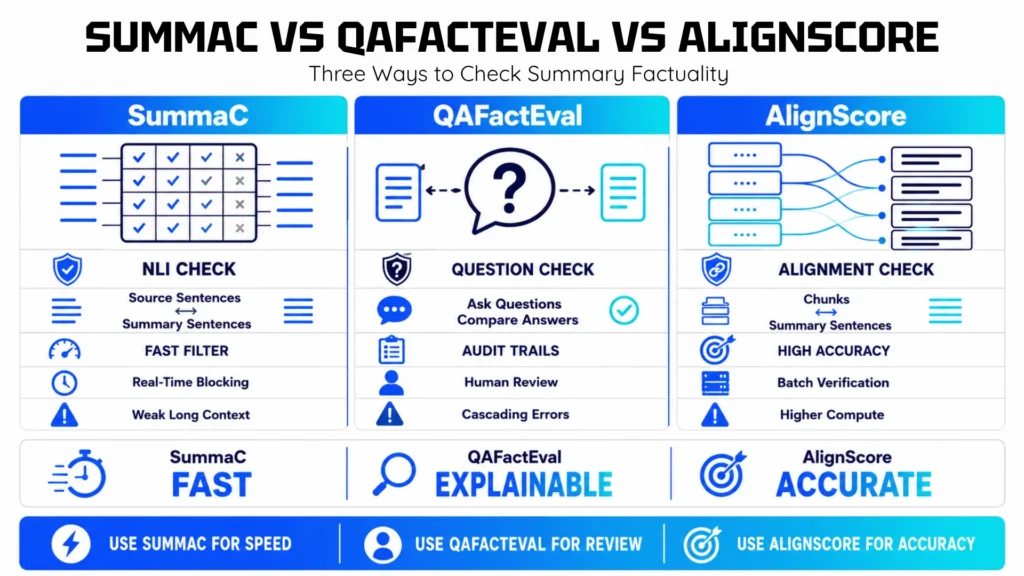
The strongest argument against deploying SummaC in production is its inability to maintain accuracy over long, complex contexts. SummaC relies on Natural Language Inference (NLI), treating the source document as a premise and the generated summary as a hypothesis. Because standard NLI models are trained on single sentence pairs, they experience severe performance degradation when asked to evaluate a summary against a 50-page legal contract.
Mechanism and Architecture
SummaC operates by breaking the source document into individual sentences and computing an entailment matrix against every sentence in the generated summary. The model calculates whether each summary sentence is entailed by, neutral to, or contradicts the source sentences. The SummaC-Conv variant applies a 1D convolutional layer over this entailment matrix to aggregate the scores into a final document-level factuality rating.
When SummaC Fails
SummaC fails predictably in two scenarios. First, it struggles with multi-hop reasoning. If a summary synthesizes information from paragraph 1 and paragraph 15, an NLI model evaluating sentence-by-sentence pairs will often flag the summary as unsupported, generating a false positive for hallucination. Second, NLI models are highly sensitive to domain shifts. A model trained on Wikipedia data (like MNLI) will misinterpret specialized terminology in medical or legal documents.
Enterprise Application
Despite its limitations, SummaC serves a specific operational purpose. Because the underlying NLI models are relatively small, SummaC executes with very low latency. Organizations running an agentic enterprise platform can use SummaC as a high-speed, first-pass filter. If SummaC detects a blatant contradiction in a real-time customer service summary, it can block the output instantly, routing the task to a more robust, slower evaluation layer.
QAFactEval: The Risk of Cascading Errors
Before adopting QAFactEval, engineering teams must account for the fragility of its multi-step pipeline. QAFactEval depends on three distinct models operating in sequence: a Question Generation (QG) model, a Question Answering (QA) model, and an Answer Overlap metric. If the QG model formulates a poorly structured question, the QA model will extract the wrong answer from the source text, causing the final evaluation to fail. This cascading error effect limits the metric’s reliability in highly technical domains where the QG model lacks the vocabulary to ask precise questions.
Mechanism and Architecture
QAFactEval evaluates consistency by testing information retrieval. The pipeline executes the following sequence:
-
The system extracts named entities and noun phrases from the generated summary.
-
The QG model generates questions based on those entities.
-
The QA model attempts to answer those same questions using the original source document.
-
An evaluation module compares the answers generated from the summary against the answers extracted from the source document.
If the answers match, the information in the summary is deemed factual. The developers of QAFactEval optimized this process by rigorously tuning the answerability classification step, yielding a substantial improvement over earlier QA-based metrics like FEQA.
When QAFactEval Fails
The primary failure mode of QAFactEval occurs with abstract or highly synthesized summaries. The metric relies on extracting concrete noun phrases to generate questions. If a summary captures the overarching sentiment or strategic direction of a document without using specific entities, the QG model cannot generate meaningful questions, leading to an artificially low factuality score.
Enterprise Application
QAFactEval is highly effective for human-in-the-loop workflows and audit trails. When an enterprise AI system summarizes compliance reports, QAFactEval does not just output a pass/fail score; it outputs the exact questions it asked and the divergent answers it found. This interpretability allows human reviewers to instantly locate the source of a hallucination, making it a valuable tool when choosing the right semantic metric for auditable operations.
AlignScore: The Computational Cost of Unified Alignment
The primary drawback of AlignScore is its computational overhead and reliance on arbitrary text chunking. To evaluate long documents, AlignScore splits the source text into rigid chunks (typically around 350 tokens) and the summary into sentences. This mechanical splitting can sever context; if a pronoun in chunk 2 refers to a noun in chunk 1, the model evaluates chunk 2 blindly, increasing the risk of inaccurate alignment scores. Furthermore, running a 355M parameter RoBERTa model for dense alignment calculations introduces latency that is often unacceptable for synchronous user-facing applications.
Mechanism and Architecture
AlignScore departs from strict NLI or QA constraints by utilizing a unified alignment function. The researchers trained the metric on 4.7 million examples across seven diverse NLP tasks, including natural language inference, fact verification, paraphrasing, and semantic textual similarity.
To calculate the final score, AlignScore computes the alignment between each source chunk $c_j$ and each summary sentence $s_i$. The model takes the maximum alignment score for each sentence, and then averages these maximums across the entire summary.
$$S = \frac{1}{N} \sum_{i=1}^{N} \max_{j} \text{align}(c_j, s_i)$$
This mathematical approach allows AlignScore to penalize specific hallucinated sentences without discarding an otherwise accurate summary.
When AlignScore Fails
AlignScore exhibits vulnerabilities to subtle adversarial perturbations. Research into model robustness (specifically the LIM-RA study) demonstrated that AlignScore can produce false positives when presented with minor character alterations or misspelled entities. For instance, altering a correct name slightly in the summary might still yield a high factual consistency score, meaning AlignScore can occasionally fail to catch precise data corruption.
Enterprise Application
AlignScore currently sets the benchmark standard, frequently outperforming both SummaC and QAFactEval on datasets like TRUE and the SummaC benchmark itself. For asynchronous batch processing—such as summarizing thousands of historical medical records overnight—AlignScore provides the most reliable verification. Organizations prioritizing accuracy over speed will find AlignScore superior to any learned metric for AI text quality currently available.
Despite its limitations, SummaC serves a specific operational purpose. Because the underlying NLI models are relatively small, SummaC executes with very low latency. Organizations running an agentic enterprise platform can use SummaC as a high-speed, first-pass filter. If SummaC detects a blatant contradiction in a real-time customer service summary, it can block the output instantly, routing the task to a more robust, slower evaluation layer.
Strategic Decision Matrix (Table)
Selecting between these three metrics requires mapping the algorithm to the specific enterprise constraint.
| Metric | Primary Advantage | Primary Limitation | Ideal Enterprise Use Case |
|---|---|---|---|
|
SummaC |
High execution speed, low compute overhead. |
Fails on long documents; struggles with domain shifts. |
Real-time guardrails; blocking obvious hallucinations before user delivery. |
|
QAFactEval |
High interpretability; provides exact error tracing. |
Cascading pipeline errors; fails on abstract summaries. |
Auditable workflows requiring human review (e.g., legal or financial summaries). |
|
AlignScore |
Highest overall accuracy; robust across task types. |
High compute cost; rigid chunking loses global context. |
Asynchronous batch processing; offline quality assurance. |
Metric disagreement is a signal, not a problem
Teams often try to eliminate disagreement between metrics.
That loses useful information.
Suppose a generated maintenance summary adds:
The shutdown resulted from operator error.
The source describes low inlet pressure and a blocked filter but says nothing about operator behavior.
SummaC may identify weak entailment. AlignScore may produce weaker source alignment for that sentence. QAFactEval will detect the issue only if its question-generation process probes the cause.
If the three metrics disagree, that disagreement identifies a case worth inspection.
A useful enterprise architecture therefore uses a metric cascade:
- Run a primary metric across all outputs.
- Identify low-confidence or borderline cases.
- Apply a second metric built on a different mechanism.
- Route high-risk disagreements to a stronger judge or human reviewer.
This is usually more defensible than averaging several metrics into one opaque score.
Do automatic factuality metrics really measure factuality?
Research accepted at NeurIPS 2025 stress-tested automatic factuality metrics and found that shallow text features could compete surprisingly well with sophisticated factuality methods in some settings. Some metrics reacted weakly to factual corrections, reacted strongly to benign edits, and could have their scores increased through irrelevant additions.
This does not make factuality metrics useless.
It changes their role.
Use them for:
- regression detection
- model comparison
- risk routing
- batch monitoring
- review prioritization
- anomaly detection
Avoid treating them as final proof that every claim is true.
Common mistakes when comparing factuality metrics
Avoid five common implementation errors.
- Choosing by leaderboard rank alone. Benchmark composition differs from your production data.
- Setting an arbitrary universal threshold. Calibrate against internal human judgments.
- Monitoring only averages. One severe false statement can disappear inside a strong document score.
- Using only one evaluation mechanism. Different architectures have different blind spots.
- Ignoring metric and preprocessing versions. Changes to segmentation, checkpoints, dependencies, or aggregation can change score distributions and break historical comparisons.
The goal is stable decision quality, not maximum metric accumulation.
The 2026 direction: From factuality scores to Evidence systems
The direction of travel is increasingly clear.
Factuality evaluation is moving away from the idea that one neural score can represent truth.
Newer research is focusing on robustness, long-context evaluation, domain-specific verification, better training data, claim decomposition, and evidence retrieval. Domain-specific work such as PlainQAFact also shows why a general factuality metric may struggle when valid summaries introduce explanations or knowledge that is absent from the source.
For enterprise systems, this points toward hybrid evaluation.
A future-ready stack will combine inexpensive automatic screening with structured evidence, deterministic validation, model-based judgment, and selective human review.
The metric becomes one control inside the system rather than the system itself.
Conclusion
Factual evaluation is the limiting factor for enterprise AI maturity. Scaling summarization models across a business is impossible if the business cannot trust the output. While QAFactEval offers the best interpretability and SummaC provides the lowest latency, AlignScore currently delivers the highest accuracy by unifying diverse training objectives. However, enterprises must stop viewing these metrics as standalone solutions. The optimal architecture deploys them in a tiered structure: fast NLI checks at the edge, comprehensive Alignment scoring for offline data pipelines, and QA-based extraction for human auditing.
FAQs
Can AlignScore, SummaC, or QAFactEval detect AI hallucinations?
They can detect some unsupported or contradictory claims, but none guarantees hallucination detection. Automatic factuality metrics have known robustness problems and can respond unpredictably to text changes. High-risk applications should combine multiple signals with source verification and human review.
What is the main difference between AlignScore and SummaC?
SummaC primarily uses NLI to evaluate entailment between segmented source and summary text. AlignScore trains a broader alignment function using data from several NLP tasks, including NLI, QA, retrieval, fact verification, semantic similarity, and summarization.
How does QAFactEval check factual consistency?
QAFactEval converts information from a generated summary into questions, answers those questions using the source document, and compares the resulting answers. Its performance depends on the quality of question generation, answerability detection, QA, and answer comparison.
Turn Enterprise Knowledge Into Autonomous AI Agents
Your Knowledge, Your Agents, Your Control
Your Knowledge, Your Agents, Your Control
Related Articles





Latest Articles