













 Duc Nguyen (Dwight)
Explore why proprietary AI memory structures offer the next competitive advantage, moving beyond stateless LLMs into long-term agentic AI workflows.
Table of Contents
Toggle AI Memory is not automatically a competitive advantage. If an enterprise stores inaccurate, outdated, biased, or sensitive information, AI systems may reuse the wrong context and create poor outcomes. This makes governance essential, ensuring that only relevant, trusted, and up-to-date information is retained and used.
Most large language models are stateless, meaning they do not remember business context unless it is provided again or stored in a dedicated memory layer. AI Memory allows systems to recall important information across interactions, reducing repeated work and improving decision-making. As AI models become widely accessible, an organization’s ability to capture and activate its unique knowledge is becoming a key source of competitive advantage.
AI Memory is the ability of an AI system to store and recall useful information from past interactions, documents, workflows, tool calls, decisions, and outcomes. It allows AI agents to use prior context instead of treating every request as new.
In enterprise settings, AI Memory can include:
This does not mean dumping every chat transcript into a database. Good AI Memory is selective. It stores what is useful, retrieves what is relevant, and removes what is outdated, wrong, or sensitive.
A simple way to understand it: context is what the AI sees now. Memory is what the AI can recall later.
A larger context window helps, but it does not solve enterprise memory.
A long context window allows a model to process more text in one session. That can be useful for reading a long document or reviewing a complex case. But it still has limits. It can be expensive, slow, noisy, and hard to control. More context does not always mean better reasoning.
Enterprise AI needs selective recall. The system should retrieve the right policy, the right past decision, the right customer fact, or the right workflow pattern at the right moment. It should not process every past interaction each time.
This is where AI Memory becomes distinct from simple document retrieval. Traditional retrieval answers, “What content matches this query?” AI Memory answers a deeper question: “What past context should shape the next action?”
For AI agents, this distinction matters. Agents do not just answer questions. They plan, call tools, update systems, coordinate tasks, and make recommendations. Without memory, they operate with limited continuity. With memory, they can adapt across time.
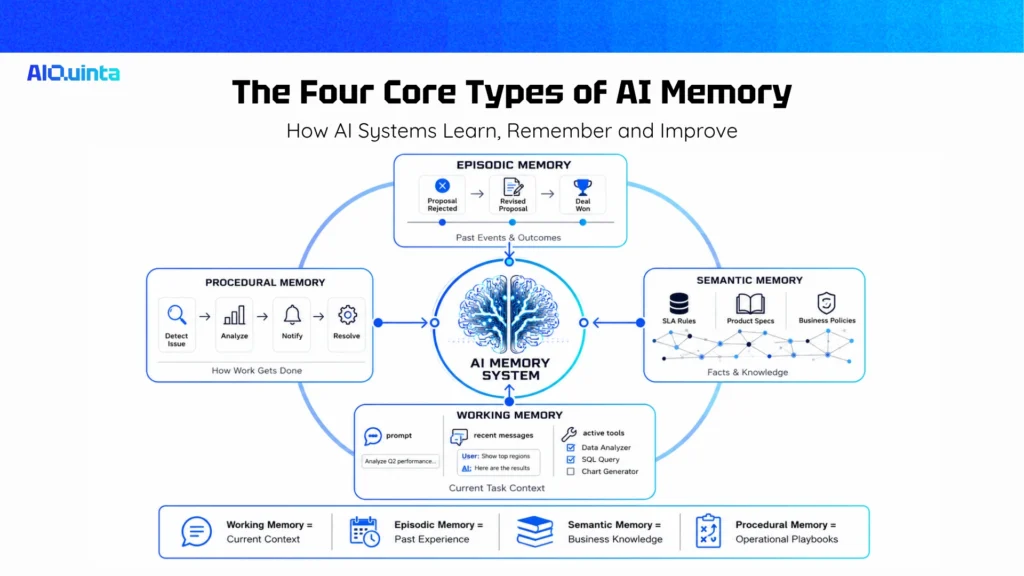
Working memory is the live context the AI uses during the current task. It includes the current prompt, recent messages, active instructions, tool results, and immediate goals.
For example, if a sales agent is drafting a proposal, working memory may include the customer’s latest request, the current pricing table, and the proposal format.
Working memory is fast and temporary. It helps the agent complete the current task, but it does not create long-term learning by itself.
Episodic memory stores specific events. It remembers what happened, when it happened, who was involved, what action was taken, and what result followed.
For example: “The customer rejected the first proposal because implementation time was too long. The revised proposal with phased deployment was accepted.”
This type of memory is valuable because enterprises run on exceptions, history, and context. In sales, customer service, manufacturing, and compliance, the reason behind a past decision can be as important as the decision itself.
Semantic memory stores facts and structured knowledge. It includes business rules, definitions, product details, process logic, policy terms, customer attributes, and domain knowledge.
For example: “Premium support customers receive a four-hour response SLA.” Or: “Machine A requires preventive maintenance every 500 operating hours.”
Semantic memory gives AI systems a stable knowledge base. But it must be governed. Facts change. Policies expire. Product details get updated. A memory system that cannot handle updates will create trust problems.
Procedural memory stores how to do things. It captures workflows, task sequences, preferred methods, tool use patterns, and proven playbooks.
For example: “When a supplier delay is detected, check inventory coverage, recalculate the production plan, notify procurement, then update the delivery commitment.”
This is where AI Memory connects to real productivity. Procedural memory allows agents to repeat successful processes, reduce manual instruction, and support complex work with less friction.
AI Memory becomes a competitive advantage because it compounds. Each useful interaction can improve the next one. Each correction can reduce future errors. Each workflow can become more efficient.
The advantage does not come from memory alone. It comes from memory plus governance, workflow integration, and business-specific data.
It Reduces Repeated Context Work
Employees spend time explaining the same background to tools, teams, and systems. AI Memory reduces this drag. A memory-enabled agent can remember user preferences, active projects, prior constraints, and known issues.
This creates a better user experience and lowers the effort needed to get useful output.
It Preserves Institutional Knowledge
Many enterprises lose knowledge when employees change roles, vendors rotate, or projects end. AI Memory can help preserve operational know-how that often lives in email threads, meeting notes, support tickets, spreadsheets, and individual experience.
This is critical for complex industries such as manufacturing, logistics, banking, insurance, healthcare, and enterprise software.
It Improves Decision Consistency
Stateless AI may give different answers when the same issue appears in a new form. Memory can help agents apply past decisions, policy interpretations, and approved workflows with more consistency.
This does not remove the need for human review. It improves the quality of the first draft, first recommendation, or first escalation.
It Enables Better Personalization
In consumer AI, personalization often means preferences. In enterprise AI, personalization means role-based context.
A plant manager, CFO, sales director, and compliance officer may ask about the same issue but need different levels of detail. AI Memory can adapt output to the user’s role, goals, and past behavior.
It Turns AI From Reactive to Proactive
Without memory, AI waits for instruction. With memory, an agent can detect patterns, anticipate needs, and suggest next steps.
For example, a customer success agent could identify that a client has raised the same issue three times in 60 days and suggest a retention action. A maintenance agent could notice repeated equipment faults and recommend a preventive inspection.
This is where AI shifts from response generation to operating leverage.
AI Memory can fail in several ways.
For this reason, AI Memory should not be treated as a hidden feature. It should be treated as enterprise infrastructure.
A production-grade AI Memory system needs more than a vector database.
It should include five layers.
1. Memory Capture
The system needs clear rules for what can be stored. Not every message, file, or tool result should become memory. Enterprises should define memory-worthy events, such as confirmed user preferences, approved decisions, validated facts, recurring issues, or successful workflow patterns.
2. Memory Classification
Each memory should have a type. Is it a fact, an event, a user preference, a workflow rule, or an audit record? Classification helps the system retrieve and govern memory correctly.
3. Memory Retrieval
The agent should retrieve only the most relevant memory for the task. Retrieval should use a mix of semantic search, metadata filters, entity matching, time filters, and business rules.
4. Memory Governance
Governance defines who can access memory, how long memory is kept, how it is updated, and when it must be deleted. This layer also covers privacy, consent, audit logs, and compliance controls.
5. Memory Evaluation
Memory systems need continuous testing. Enterprises should measure recall accuracy, relevance, freshness, latency, token cost, contradiction handling, and user satisfaction.
Without evaluation, memory quality will decay.
The best path is not to add memory everywhere. Start with a narrow workflow where continuity matters.
A practical rollout can follow this sequence:
This phased approach is important. AI Memory should start as a controlled business capability, not an open-ended data capture layer.
AI Memory is becoming one of the most important layers in enterprise AI. It gives agents continuity, context, and the ability to improve across time. But it also creates new risks around privacy, stale data, auditability, and governance.
The enterprises that win will not be the ones that store the most memory. They will be the ones that store the right memory, govern it well, and connect it to high-value workflows.
The next competitive advantage in AI will not come only from model access. It will come from the ability to transform organizational knowledge into a governed, reusable, and compounding memory layer.
For enterprise leaders, the question is no longer whether AI can answer. The question is whether AI can remember enough, forget correctly, and act with the right business context.
What is AI Memory?
AI Memory is the ability of an AI system to store, retrieve, and use past context across sessions, users, workflows, and decisions. It helps AI agents move beyond one-off responses and support continuous work.
Why is AI Memory important for enterprises?
AI Memory helps enterprises reduce repeated context work, preserve institutional knowledge, improve decision consistency, personalize workflows, and make AI agents more useful over time.
What are the main types of AI Memory?
The main types are working memory, episodic memory, semantic memory, and procedural memory. Working memory handles the current task. Episodic memory stores events. Semantic memory stores facts. Procedural memory stores workflows and methods.