

















 Duc Nguyen (Dwight)
BLEU vs ROUGE vs BERTScore compared for enterprise AI: learn what each metric detects and how to build a reliable evaluation stack.
Table of Contents
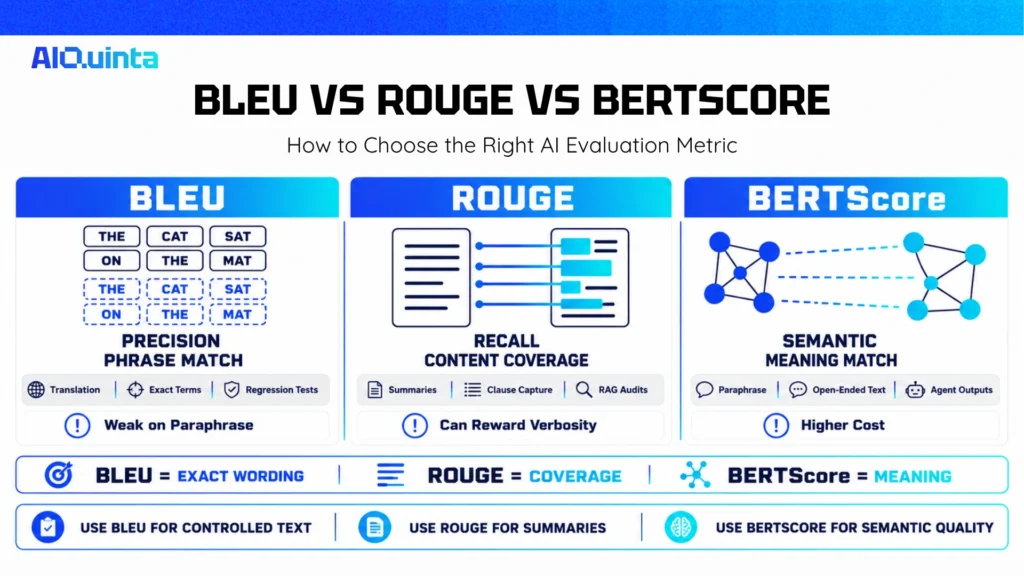
Toggle BLEU (Bilingual Evaluation Understudy) measures n-gram precision. It asks: How many words or phrases in the generated text appear in the reference text?
BLEU is highly brittle. Its most significant limitation is its inability to recognize paraphrasing. If the reference is “The experiment succeeded” and the model outputs “The test was successful,” BLEU returns a near-zero score despite identical semantic meaning.
Furthermore, BLEU breaks down on short texts. Because it relies on n-gram matching (often up to 4-grams), missing a single word in a short response can collapse the score to zero. It also forces models to become rigid; if you optimize an enterprise AI model strictly for BLEU, the resulting outputs will feel terse, robotic, and unnatural to human users.
Despite its flaws, BLEU is not entirely useless. It remains a standard for specific, narrow tasks:
Machine Translation Benchmarking: According to the WMT 2025 Shared Task, BLEU still achieves system-level correlations of 0.78 to 0.91 in translation, making it highly competitive with modern semantic metrics in this specific domain.
Exact-Match Retrieval: For highly regulated industries (e.g., legal or medical compliance) where exact terminology matters more than fluency, BLEU serves as a fast, deterministic check for factual correctness.
CI/CD Speed: BLEU computes in milliseconds, making it ideal for rapid regression testing where catching catastrophic degradation is more important than measuring nuance.
ROUGE (Recall-Oriented Understudy for Gisting Evaluation) flips the BLEU equation. Instead of measuring precision, it measures recall. It asks: How much of the human reference text is captured in the generated output?
The strongest argument against ROUGE is that it actively rewards verbosity and keyword stuffing. If a model generates a massive, rambling paragraph that happens to contain the key terms from the reference text, ROUGE-1 (unigram recall) will score it exceptionally high. The model gets credit for coverage while the user suffers through unreadable garbage.
Additionally, like BLEU, ROUGE is entirely blind to syntax and semantic logic. A model that simply regurgitates a bag of high-frequency words without forming a coherent sentence will trick the metric. If you are comparing BLEU vs ROUGE, realize that ROUGE’s failure mode is “long and wrong,” whereas BLEU’s failure mode is “short and robotic.”
To use ROUGE effectively, you must restrict its variants. Never report raw recall; always use ROUGE-F1 (which balances precision and recall).
Document Summarization: ROUGE-L (which measures the Longest Common Subsequence) is highly effective for evaluating whether an AI agent successfully extracted key clauses from a 50-page legal contract without losing the core narrative structure.
RAG System Auditing: ROUGE helps determine if the retrieved context from your enterprise AI memory actually made it into the final generated answer.
BERTScore bypasses exact word matching entirely. It leverages pre-trained Transformer models (like BERT or RoBERTa) to generate contextual embeddings, measuring the cosine similarity between the generated text and the reference text in a high-dimensional vector space.
The primary counterargument to BERTScore is operational overhead. Running inference through a Transformer model to evaluate another Transformer model is computationally expensive, adding significant latency and cost to the evaluation pipeline.
More critically, BERTScore is not an objective source of truth—it inherits the biases of its underlying encoder. If the base model (e.g., RoBERTa-large) struggles with specific domain terminology (like proprietary financial acronyms), the BERTScore will be inaccurate. Furthermore, research indicates that BERTScore’s correlation with human judgment is highly domain-dependent. While it excels in open-ended generation, it frequently hallucinates high scores in medical NLP contexts where exact phrasing is actually required.
When exact wording doesn’t matter, BERTScore dominates. It typically achieves a 59% alignment with human judgments in open-ended generation, compared to just 47% for BLEU.
Robustness to Paraphrasing: BERTScore survives synonyms. “Hound” and “dog” are mathematically identical in embedding space, preventing models from being penalized for vocabulary diversity.
Evaluating Agent Autonomy: When deploying advanced agent capabilities, outputs are highly variable. BERTScore allows engineers to verify that the agent solved the problem conceptually, even if the text differs wildly from the reference.
Do not rely on a single metric. Disagreement between these scores provides the most valuable diagnostic signal for enterprise AI adoption.
| Metric | Primary Focus | Best Used For | The Fatal Flaw |
|---|---|---|---|
|
BLEU |
Precision (n-gram) |
Machine translation, exact terminology. |
Penalizes valid paraphrasing; negation-blind. |
|
ROUGE |
Recall (coverage) |
Summarization, checking RAG context extraction. |
Rewards verbosity and keyword stuffing. |
|
BERTScore |
Semantic Meaning |
Open-ended generation, chat, creative tasks. |
Computationally expensive; inherits encoder bias. |
A production evaluation system should contain at least five layers.
1. Lexical control
Use BLEU, ROUGE, exact match, keyword checks, or terminology rules to detect wording changes and missing required language.
2. Semantic control
Use BERTScore or another embedding-based metric to detect meaning preservation across paraphrases.
3. Factual control
Break outputs into claims and verify each claim against approved sources, retrieved evidence, structured records, or deterministic business systems.
4. Structural and policy control
Validate output format, required fields, prohibited statements, citations, tone, privacy rules, and escalation conditions.
5. Business outcome control
Measure whether the output supports the intended result:
This evaluation logic should connect to the organization’s knowledge management capability. References, test cases, terminology, policies, and expert corrections must remain governed and current.
The difference between BLEU, METEOR, and chrF is not limited to their formulas. Each metric defines acceptable variation in a different way.
Use BLEU for strict phrase-level consistency and controlled corpus comparisons. Use METEOR when limited lexical variation and sentence-level recall matter. Use chrF when morphology, spelling, or tokenization make word-level matching unreliable.
The larger enterprise capability is not metric calculation. It is evaluation governance: defining acceptable outcomes, detecting costly errors, controlling references, tracing configurations, and connecting scores to business decisions.
Strategic takeaway: select the metric according to the failure mode, then build the release decision around multiple independent forms of evidence.
What is the main difference between ROUGE, BLEU, and BERTScore for AI text evaluation?
BLEU measures n-gram precision (did the generated words match the reference exactly?). ROUGE measures recall (did the generated text cover all the key points in the reference?). BERTScore measures semantic similarity using neural network embeddings, allowing it to recognize paraphrasing and synonyms.
When should I choose BERTScore over BLEU and ROUGE?
Use BERTScore for open-ended generation, conversational AI, and instruction-following tasks where meaning is more important than exact phrasing. If a task has multiple valid ways to answer (e.g., customer support), BERTScore will accurately evaluate the response without penalizing vocabulary choices.
Should enterprises combine ROUGE, BLEU, and BERTScore?
They should combine them only when each metric supports a defined evaluation objective. Adding more metrics without linking them to business risks creates dashboard complexity rather than stronger governance.