

















 Duc Nguyen (Dwight)
Compare BLEU vs METEOR vs chrF by language, task, risk, and reference design. Learn which lexical metric to use and when to combine them.
Table of Contents
Toggle BLEU, METEOR, and chrF are all reference-based metrics. Each compares generated text with one or more approved reference outputs.
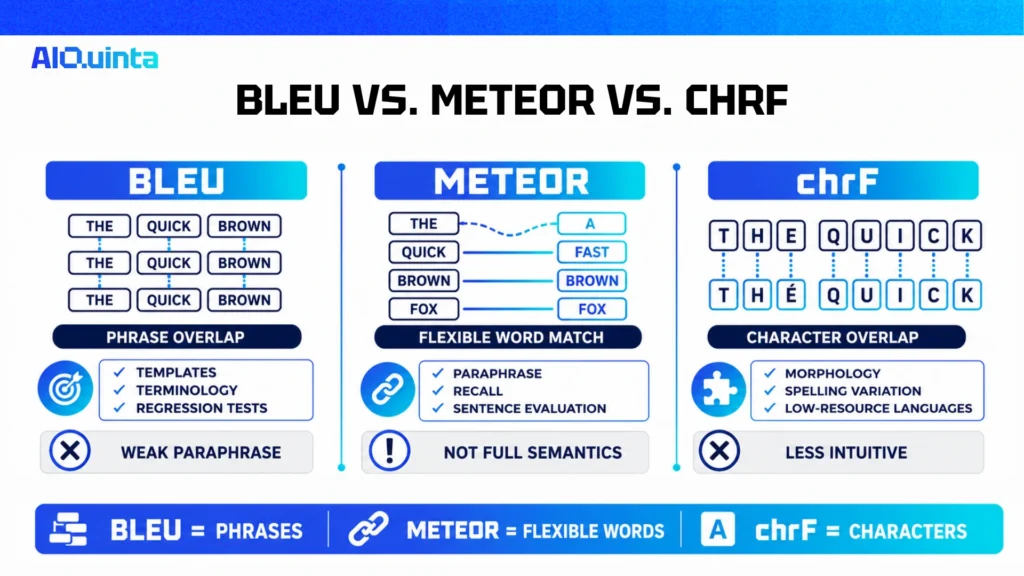
BLEU (Bilingual Evaluation Understudy) measures modified word n-gram precision, often up to four-word sequences, and applies a brevity penalty when the output is shorter than the reference.
This design rewards candidates that reproduce approved wording and phrase structure.
That makes BLEU useful when an enterprise expects controlled output, such as:
BLEU also remains useful as a benchmark because it has a long reporting history. Teams can compare a model with earlier versions when they retain the same dataset, references, preprocessing, tokenization, casing, and implementation.
The problem is that teams often change those controls without documenting them. Different BLEU configurations can produce materially different scores. SacreBLEU was created to improve reporting consistency by standardizing test sets, processing, and metric signatures.
METEOR (Metric for Evaluation of Translation with Explicit ORdering) aligns candidate and reference words before calculating a score based on precision and recall. It also applies a fragmentation penalty when matched words appear in a different sequence.
Common implementations can match words in stages:
This lets METEOR recognize some relationships that BLEU misses. NLTK’s implementation, for example, applies exact, stemmed, and WordNet-based synonym matching.
METEOR is useful for:
However, METEOR is not a full semantic metric.
Its flexibility comes from linguistic rules and lexical databases, not contextual understanding. The metric may know that two isolated words are synonyms without knowing whether they are interchangeable in a legal, medical, technical, or operational context.
chrF (CHaRacter-level F-score) compares character n-grams rather than full words.
For example, words such as “connect,” “connected,” and “connection” share several character sequences. A character-based metric can recognize this overlap even when a word-based metric treats them as separate tokens.
This makes the chrF score useful for:
Word-based metrics are more vulnerable when prefixes, suffixes, compounds, or inflections create many valid word forms. chrF reduces that dependence on token boundaries. The chrF++ extension also adds word n-grams to preserve more word-level information.
Recent research on extremely low-resource languages found that BLEU and chrF++ offer complementary signals rather than supporting a simple replacement of one with the other.
| Metric | Primary Mechanism | Best Used For | Major Weakness |
|---|---|---|---|
|
BLEU |
Word $n$-gram precision |
Legacy corpus benchmarking |
Fails on single sentences; highly rigid |
|
METEOR |
Word unigrams + stemming/synonyms |
English-heavy semantic evaluation |
High computational overhead; language-dependent |
|
chrF |
Character $n$-gram F-score |
Multilingual testing, CI/CD pipelines |
Difficult for humans to debug manually |
1. Measure output entropy
Output entropy refers to the number of valid ways a system can express the correct result.
For high-entropy outputs such as reports, recommendations, or agent-generated explanations, no lexical metric should serve as the primary quality score.
2. Assess the language profile
Ask:
chrF is often the safer lexical baseline when word formation is complex or language resources are limited.
METEOR becomes more useful when the required linguistic tools exist and have been validated.
3. Identify the costliest error
A metric should support the error analysis, not replace it.
If terminology drift is costly, add terminology checks.
If numbers matter, compare normalized numeric fields.
If entities matter, run entity-level precision and recall.
If source faithfulness matters, evaluate each claim against source evidence.
For summarization agents, see the broader framework for evaluating faithfulness, coverage, and source integrity.
4. Select the evaluation level
BLEU was designed for reliable aggregation across a corpus, not isolated sentence judgments.
Sentence-level scores often become unstable when sentences are short or contain few matching n-grams. Smoothing can reduce zero-score behavior, but it also introduces another configuration variable.
METEOR and chrF tend to provide more informative segment-level signals, but enterprises should still validate their correlation with human judgments on the target dataset.
5. Lock the configuration
Every reported result should include:
Without this information, a score is a number without an audit trail.
Neural and model-based evaluators will continue to improve, but lexical metrics will retain value as transparent diagnostic instruments.
Their strategic role will shift from “quality judges” to “controlled sensors.”
None should own the final decision.
The strongest evaluation systems will combine lexical, semantic, deterministic, operational, and human signals. They will also segment performance by language, domain, document type, risk class, and workflow instead of publishing one global average.
The difference between BLEU, METEOR, and chrF is not limited to their formulas. Each metric defines acceptable variation in a different way.
Use BLEU for strict phrase-level consistency and controlled corpus comparisons. Use METEOR when limited lexical variation and sentence-level recall matter. Use chrF when morphology, spelling, or tokenization make word-level matching unreliable.
The larger enterprise capability is not metric calculation. It is evaluation governance: defining acceptable outcomes, detecting costly errors, controlling references, tracing configurations, and connecting scores to business decisions.
Strategic takeaway: select the metric according to the failure mode, then build the release decision around multiple independent forms of evidence.
What is the main difference between BLEU and METEOR and chrF for text evaluation?
BLEU relies on exact word-level matching (n-grams) and penalizes variations in phrasing. METEOR addresses this by using external dictionaries to allow for synonym and stem matching. chrF ignores words entirely and matches character sequences, making it highly effective at catching partial word matches without needing external language databases.
Is chrF better than BLEU for morphologically rich languages?
chrF often provides a stronger signal because related word forms share character n-grams. BLEU may treat each inflected form as a different token. However, chrF does not understand meaning and should still be combined with source-aware and human evaluation.
Can METEOR evaluate LLM-generated text?
METEOR can provide a lexical alignment signal for generated text when reliable references exist. It works best for constrained tasks with moderate wording variation. It should not serve as the primary metric for open-ended reasoning, factual answers, or agent task execution.