

Standardize BMS Data Across a Multi-Building Portfolio
- Publised September, 2026
-
Duc Nguyen (Dwight)
Build a Building Data Foundation for a Multi-Building Portfolio that makes fragmented BMS data reusable for analytics, automation, and AI.
Table of Contents
Toggle Key Takeaways
- Portfolio standardization should create a common semantic contract, not force every building into an identical BMS structure.
- Connecting BACnet, Modbus, APIs, and other protocols solves data access. It does not solve inconsistent equipment meaning, units, relationships, or operating context.
- The scalable model is a canonical portfolio schema with controlled local extensions, source-data provenance, mapping validation, and ongoing drift management.
- Measure success through onboarding effort, mapping quality, relationship completeness, template reuse, and downstream application performance, not the number of points collected.
Standardization should not make every building identical
The strongest argument against portfolio BMS standardization is valid: buildings are not identical.
A hospital, office tower, retail site, and data center should not be forced into the same operating assumptions. Even two office buildings may contain different HVAC topologies, control sequences, sensor coverage, equipment generations, and local requirements.
A rigid global naming template can hide those differences.
The objective should instead be to define the information that downstream applications can rely on while allowing each site to retain valid local characteristics.
Both Brick and Project Haystack follow this semantic principle. They describe building entities such as sites, spaces, equipment, points, and the relationships between them rather than relying on raw labels alone. Brick explicitly aims to provide a consistent cross-vendor representation of building systems.
That is the design principle multi-building portfolios should adopt.
What should be common and what should remain local?
| Data element | Portfolio standard | Site-level flexibility |
|---|---|---|
|
Equipment classes |
Canonical AHU, chiller, VAV, meter and other classes |
Local equipment subtype and configuration |
|
Point meaning |
Common sensor, command, status and setpoint classes |
Original vendor point ID and label |
|
Units |
Canonical engineering units |
Raw source unit retained for traceability |
|
Relationships |
Common site, space, system and equipment relationships |
Unique local topology |
|
Operating states |
Standard representation where equivalent |
Vendor-specific states when no safe equivalent exists |
|
Data quality |
Shared validation and confidence rules |
Site-specific exceptions |
|
Control permissions |
Portfolio governance model |
Equipment-specific safe limits |
The principle is simple: standardize what applications need to compare, query, and reason over. Preserve what engineers need to understand the source system.
A portfolio data foundation needs more than a common point list
Many standardization projects begin with a master naming spreadsheet.
That is useful, but insufficient.
A point called Supply_Air_Temp is only meaningful when the system also knows which AHU owns it, which building contains that AHU, what unit the value uses, whether it represents a sensor or setpoint, where the original value came from, and whether the mapping has been validated.
A scalable portfolio model should therefore contain several layers.
Preserve the raw source layer
Do not overwrite vendor identifiers during normalization.
Keep:
- original point name
- device and object identifier
- source BMS
- protocol
- raw unit
- original state enumeration
- gateway or connector identity
- mapping version
This makes mappings reversible and auditable.
When a facility engineer disputes a standardized value, the team can trace it back to the actual controller rather than reverse-engineering a transformed database.
Build a canonical semantic model
The next layer describes the physical building consistently.
A practical hierarchy may include:
portfolio → site → space → system → equipment → point
Relationships matter as much as classifications.
Knowing that SAT_01 is a temperature sensor is less valuable than knowing that it measures the supply air temperature of AHU-3, which serves Zones 2A to 2F in Building B.
Brick describes buildings using entities and graph relationships for this reason. Project Haystack similarly models sites, spaces, equipment, points, devices, and references between them.
AIQuinta’s guide to BMS data normalization and point mapping discusses this semantic layer in more detail.
Normalize telemetry without destroying context
Values also need normalization.
Common transformations include unit conversion, timestamps, time zones, state enumeration, missing-value handling, and consistent data types.
But normalization should not create false precision.
If one building samples temperature every minute and another trends it every 15 minutes, resampling both into identical five-minute records does not make the underlying telemetry equivalent.
The data model should expose resolution, freshness, and quality so applications know what evidence they are using.
How to standardize BMS data across buildings
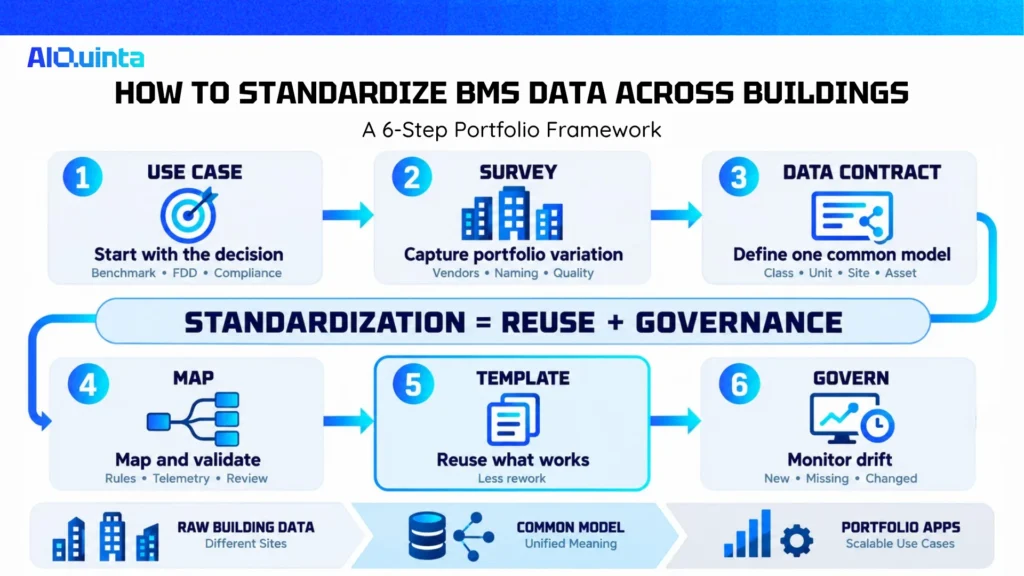
The implementation sequence should begin with operational decisions, not with an attempt to map every available point.
Define the portfolio use case first
Start with a decision such as:
- compare AHU performance across sites
- identify equipment running outside schedules
- centralize environmental compliance data
- deploy FDD across several buildings
- support portfolio energy benchmarking
Then identify the minimum equipment, points, relationships, and telemetry needed.
This prevents teams from spending months standardizing thousands of points that no application uses.
Survey representative buildings
Select sites that expose the real portfolio variation.
A useful sample might include a modern site, an average building, an older integration, and a site from a different BMS vendor.
Inventory protocols, controllers, available histories, naming conventions, network access, point counts, trend intervals, sensor quality, and documentation.
The existing installation often differs from design records. That gap needs to be treated as an engineering discovery problem rather than a data-cleaning problem.
Define the minimum portfolio data contract
Specify what every mapped object must contain.
For a point, this could include:
- canonical point class
- equipment relationship
- engineering unit
- source identifier
- site identifier
- read or write role
- mapping confidence
- provenance
- data-quality status
This contract becomes the interface between each building and portfolio applications.
Map and validate the first sites
Automated classification can accelerate repeated patterns, but point names alone should not determine high-impact mappings.
Use equipment templates, naming rules, metadata, telemetry behavior, drawings, sequences of operation, and engineering review together.
Ambiguous and safety-related points should be routed for human validation.
This hybrid model is more scalable than either manual mapping of every point or unrestricted automated classification.
Convert successful mappings into reusable templates
When several AHUs from the same vendor and integration pattern map reliably, convert that work into a reusable template.
The important portfolio metric is then no longer “How many points have we mapped?”
It becomes:
How much engineering work must be repeated when the next building is onboarded?
Establish change and drift governance
Standardization is not a one-time migration.
Controllers get replaced. Equipment is renamed. Sensors disappear. Retrofit projects alter system topology. Integrators add new points.
The foundation therefore needs monitoring for:
- newly discovered points
- missing points
- changed units
- renamed objects
- broken relationships
- stale telemetry
- schema changes
- mapping overrides
Without drift management, a standardized portfolio gradually becomes fragmented again.
How to manage different BMS vendors across a portfolio
Different vendors create two separate problems that should not be confused.
The first is connectivity.
Systems may expose BACnet, Modbus, OPC UA, MQTT, proprietary APIs, or gateway interfaces. A vendor-neutral ingestion layer isolates these differences at the edge.
The second problem is semantics.
Two systems can both support BACnet while describing similar equipment differently. Protocol compatibility therefore does not create portfolio interoperability.
For an enterprise architecture, this implies a clear boundary:
Vendor-specific integration belongs below the canonical data layer. Portfolio applications belong above it.
An analytics application should request “all AHU supply-air-temperature sensors in Region A.” It should not need separate logic for Siemens, Schneider, Honeywell, or another source system.
This also reduces lock-in. Replacing a BMS connector should not require rewriting every application that consumes building data.
For organizations assessing the broader software layer, the multi-site AI building management software buyer guide provides complementary selection criteria.
What should be automated and what requires engineering review?
Automation is useful when repetition is high and ambiguity is low.
| Suitable for automation | Route for review |
|---|---|
|
Known point-name patterns |
Ambiguous abbreviations |
|
Unit conversion |
Conflicting unit metadata |
|
Repeated equipment templates |
Custom mechanical systems |
|
Standard state mappings |
Vendor-specific operating modes |
|
Duplicate detection |
Conflicting asset identities |
|
Data freshness checks |
Unexpected telemetry behavior |
|
High-confidence classification |
Safety-related or writable points |
This is especially important if the standardized data will later support AI or automated control.
A wrong dashboard label is inconvenient. A wrong writable-point mapping can affect physical equipment.
Organizations considering supervisory AI should keep this risk separation explicit. AIQuinta’s implementation guide on adding AI to an existing BMS recommends maintaining deterministic local controls and expanding AI permissions in stages.
Where portfolio BMS standardization fails
- The first failure mode is centralization without semantics. A data lake containing millions of raw BACnet objects is centralized, but applications still require custom translation for every building.
- The second is over-standardization. If local equipment differences are forced into inaccurate global classes, the model becomes easier to query but less truthful.
- The third is point-only modeling. Equipment and spatial relationships are omitted, so analytics cannot reliably understand how systems interact.
- The fourth is uncontrolled automated mapping. High coverage rates look impressive until incorrect classifications enter reports, diagnostics, or control workflows.
- The fifth is missing lifecycle ownership. Nobody is accountable for updating mappings after retrofits or BMS changes.
- Finally, teams often standardize data before deciding what business decision the data should support. This creates a technically large project with weak operational value.
Standardized BMS data is the first layer of operational AI context
Once multi-site BMS data is semantically consistent, the portfolio can support more than centralized reporting.
FDD can apply reusable logic to equivalent equipment. Energy teams can compare similar systems across buildings. AI applications can retrieve equipment context without learning each vendor’s naming conventions.
But BMS telemetry alone still does not provide enough context for advanced operational decisions.
An agent investigating an AHU fault may also need the sequence of operation, equipment manual, maintenance history, technician notes, site operating policy, and current work orders.
The semantic building model becomes one part of a wider enterprise knowledge system.
That distinction is important for AI in building management systems. The BMS remains the operational source and deterministic control layer, while structured building data allows analytics and AI systems to reason about those signals consistently.
An enterprise ontology can extend this model further by defining relationships between operational assets, business processes, policies, people, and decisions. Enterprise ontology and agentic AI
For multi-building portfolios, that is the real strategic value of data standardization: each new application can start from a shared interpretation of the estate instead of reconstructing building context from raw BMS data.
Conclusion
The hardest part of building data standardization is not moving data from several BMS platforms into one database. It is creating a common model that remains accurate when buildings, vendors, equipment, and operating conditions differ.
A scalable Building Data Foundation therefore needs a canonical semantic model, preserved source identity, controlled local extensions, validation, reusable mappings, and lifecycle governance.
Structured extraction also extends beyond document automation. In building operations, enterprises must extract and structure meaning from BMS point lists, alarms, trend logs, equipment hierarchies, control sequences, manuals, and maintenance records. Together, those sources create the operational context that analytics and AI agents require.
The practical takeaway is to start narrow. Pick one portfolio-level decision, define the minimum semantic contract needed to support it, validate the model across several different buildings, and measure how much of that work can be reused at the next site.
A portfolio data standard has succeeded when adding building 21 is materially easier than adding building 2.
FAQs
How do you standardize BMS data across multiple buildings?
Create a canonical portfolio model for sites, spaces, systems, equipment, points, units, states, and relationships. Map each site’s source data into that model while preserving original identifiers and metadata. Validate uncertain mappings and maintain governance for later BMS changes.
Do all buildings need the same BMS vendor to standardize their data?
No. A portfolio can use different BMS vendors if a vendor-neutral integration and semantic layer converts source-specific representations into a common model. Protocol access and data ownership still need to be confirmed for each system.
Should enterprises use Brick Schema or Project Haystack?
Both provide established approaches to building semantics. Project Haystack uses a controlled vocabulary, tags, taxonomy, and ontology, while Brick provides an ontology and graph-based representation of building entities and relationships. The right choice depends on the existing technology stack, required applications, partner ecosystem, modeling depth, and governance model.
Turn Enterprise Knowledge Into Autonomous AI Agents
Your Knowledge, Your Agents, Your Control
Your Knowledge, Your Agents, Your Control
Related Articles







Latest Articles