

BMS Predictive Maintenance: From Early Fault to Service
- Publised October, 2026
-
Duc Nguyen (Dwight)
See how BMS predictive maintenance connects fault, alarm and maintenance data to predict HVAC failures and turn early signals into planned service.
Table of Contents
Toggle
Key Takeaways
Static threshold alarms in standard building management systems produce alarm fatigue rather than early intervention; true predictive maintenance demands continuous cross-variable anomaly detection.
High-frequency telemetry alone is insufficient; without standardized semantic tagging (Project Haystack or Brick Schema) and automated work-order integration, early telemetry flags fail to become maintenance actions.
Machine learning algorithms fail in facilities operations when deployed over uncalibrated sensors, drifting baselines, or unverified work order records.
Sustainable ROI comes from converting multivariate operational drift into structured, prioritized maintenance tasks before physical degradation triggers emergency repairs.
The Structural Failure of Threshold Alarms in Building Automation
Standard building management systems (BMS) are designed to keep indoor parameters within narrow setpoints and protect mechanical equipment from catastrophic destruction. They do this through static threshold alarms. When a supply fan static pressure falls below 0.5 inches of water gauge, or a chilled water supply temperature rises above 48°F (8.9°C), the system flags an alarm.
By the time a static threshold alarm triggers, physical degradation has already advanced to the point of operational compromise or outright breakdown.
Static thresholds create two operational traps:
Rampant False Negatives (Silent Wear): A centrifugal chiller operating with fouled condenser tubes can consume 15% more power while meeting its chilled water setpoint of 44°F (6.7°C). Because setpoints are satisfied, the BMS generates zero alarms while the compressor experiences elevated head pressures, accelerated thermal stress, and excessive utility draw.
Alarm Floods (Action Paralysis): A single mechanical fault—such as a tripped primary chilled water pump—cascades into dozens of downstream alerts across secondary loops, differential pressure switches, and air handling units (AHUs). Technicians silence alarms instead of diagnosing root causes.
Predictive maintenance using BMS data redefines this workflow. Rather than evaluating isolated variables against static limits, predictive architectures monitor the mathematical relationship between interrelated operational variables over time.
The Counterargument: Why BMS-Driven Predictive Maintenance Often Stalls
Before committing capital to software platforms promising zero-downtime operations, engineering leaders must confront why most predictive maintenance deployments stall after the pilot phase.
Predictive maintenance is not a plug-and-play capability. In commercial portfolios and industrial facilities, several failure modes routinely derail implementations:
Garbage Telemetry from Miscalibrated Sensors: Machine learning algorithms assume data fidelity. In practice, building sensors suffer from calibration drift, incorrect wiring, or poor spatial placement. A supply air temperature sensor mounted directly downstream of an unmixed stratified coil provides erroneous readings that corrupt predictive models. Deploying predictive models over unvalidated data structures magnifies errors. This is why establishing an accurate building data foundation is mandatory before deploying analytical tooling.
The “Unlabeled History” Bottleneck: Supervised failure prediction models require historical examples of past mechanical breakdowns paired with granular timeseries telemetry. Most facilities log work orders in computerized maintenance management systems (CMMS) as unstructured, ambiguous text (e.g., “fixed leak” or “reset chiller”) without linking to specific asset IDs, failure modes, or time-synchronized sensor logs. Without clean historical event labeling, training precise supervised algorithms is nearly impossible.
Disconnection from Field Execution: Detecting an anomaly provides zero economic value if the insight stays trapped inside an engineering dashboard. When predictive alerts do not automatically generate prioritized, actionable work orders within the existing technician workflow, facility teams dismiss the software as another monitoring silo.
Predictive maintenance fails when treated as a pure algorithm challenge rather than a socio-technical data integration challenge.
Deconstructing the Fault Signature: How Early Failures Manifest in BMS Telemetry
Equipment failure is rarely an instantaneous event; it is a progression along a degradation curve. Mechanical, electrical, and thermal subcomponents display measurable deviations long before an operational parameter trips a conventional limit.
AHU Simultaneous Heating and Cooling
A common HVAC fault is leaking or sticking hydronic control valves. In an air handling unit, if a heating coil valve fails to close completely during summer cooling mode, the cooling coil valve must open further to counteract the unintended heat gain and satisfy the supply air setpoint.
The BMS Blind Spot: Supply air temperature remains stable at 55°F (12.8°C). No alarm trips.
The Predictive Indicator: The model tracks chilled water valve command relative to outdoor air temperature, mixed air temperature, and fan speed. By correlating the thermal energy balance equation across the coil, the system flags that cooling valve position is 35% higher than modeled baseline for current ambient load, identifying hydronic leakage weeks before actuator failure.
Chiller Condenser Tube Fouling and Refrigerant Leaks
Water-cooled chillers accumulate mineral scale and biofilm inside condenser tubes, degrading heat transfer efficiency.
The BMS Blind Spot: The chiller runs continuously, meeting load demands until entering high-pressure head cutoff under peak summer heat.
The Predictive Indicator: The predictive engine tracks condenser approach temperature (the difference between the refrigerant condensing temperature and the entering/leaving condenser water temperature) alongside lift and compressor power draw. An increasing approach temperature at steady-state condenser flow signals tube fouling, allowing maintenance managers to schedule mechanical brushing or chemical descaling during planned off-peak windows.
Variable Air Volume (VAV) Hunting and Actuator Fatigue
VAV terminal boxes maintain zone comfort via motorized damper actuators. Poor tuning, oversized ductwork, or sticking mechanical linkages cause damper actuators to “hunt”—modulating continuously from 10% to 90% open.
The BMS Blind Spot: Zone temperature remains within acceptable deadbands.
The Predictive Indicator: Cumulative travel distance and cycle counts per hour. Actuators rated for 100,000 lifetime cycles can consume that endurance within 18 months under severe hunting. Early detection prompts PID re-tuning, preserving actuator hardware.
Rule-Based FDD vs. Machine Learning vs. Agentic Intelligence
Enterprise buyers must select the correct analytical approach for condition-based maintenance in buildings. The industry has evolved across three distinct methodologies:
| Capability Dimension | Rule-Based FDD (APAR / Static Logic) | Machine Learning & Statistical Anomaly Models | Agentic Enterprise Intelligence |
|---|---|---|---|
|
Detection Mechanism |
Hardcoded if-then statements (e.g., AHU cooling valve open > 90% for 30 min while zone cold) |
Unsupervised clustering, autoencoders, regression models on multivariate timeseries |
Multi-agent reasoning combining timeseries telemetry, maintenance manuals, and asset logs |
|
Setup & Engineering Effort |
High manual configuration; requires custom rule writing per asset type |
Moderate configuration; requires extensive data cleaning and feature engineering |
Fast deployment over standardized knowledge structures and API integrations |
|
Adaptability to Dynamic Loads |
Brittle; generates false positives during seasonal transitions or variable occupancy |
Strong; learns baseline operating profiles across seasonal and operational shifts |
Context-aware; cross-references occupancy schedules, weather forecasts, and historical logs |
|
Root Cause Attribution |
Identifies symptoms, rarely pinpoints deeper mechanical root causes |
Flags statistical deviation; requires human analysis to interpret cause |
Diagnoses mechanical root cause, verifies spare part availability, and drafts work orders |
|
False Positive Rate |
High during non-standard operating states |
Low-to-moderate; sensitive to sensor drift and network packet loss |
Low; agent validates sensor health before surfacing operational findings |
The Data Pipeline: From Sensor Drift to Normalized Action
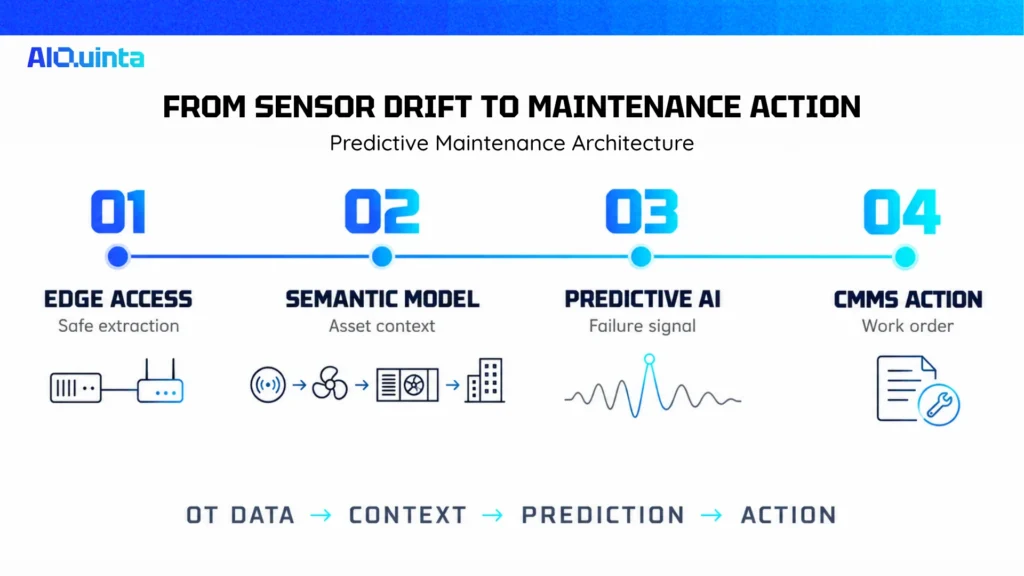
Executing predictive maintenance using BMS data requires a strict data pipeline that bridges physical building automation protocols with enterprise decision intelligence.
Step 1: Protocol Extraction Without Disrupting Field Controllers
BMS field networks operate on operational technology (OT) protocols: BACnet MS/TP, BACnet/IP, Modbus RTU, and LonWorks. Polling legacy field controllers too aggressively over RS-485 serial buses can overwhelm controller CPU bandwidth, leading to dropped communication and compromised real-time environmental control. High-performance predictive architectures implement edge gateways that read secondary trend logs or ingest change-of-value (COV) broadcasts without interrupting native control sequences.
Step 2: Semantic Tagging and Metadata Normalization
Raw BMS point names are notoriously cryptic (e.g., B02_FL04_AHU01_SF_VFD_SPD). An analytics model cannot infer physical relationships from arbitrary strings. Enterprises must standardize data structures using open semantic standards like Project Haystack or the Brick Schema.
This semantic layer explicitly links the static pressure sensor to its parent fan, that fan to its air handling unit, and that AHU to the specific thermal zones it serves. Without semantic consistency, machine learning models cannot scale across heterogeneous building portfolios.
Step 3: Predictive ML and Cross-Variable Correlation
Once data is normalized, models analyze multivariate relationships:
Supervised learning models assess asset degradation curves based on historical run-hours, start-stop cycles, and mechanical strain metrics.
Unsupervised learning models (such as isolation forests and deep autoencoders) identify anomalies in multidimensional operational envelopes. When a pump exhibits elevated electrical current draw without a corresponding increase in head pressure or fluid flow, the system isolates an internal impeller blockage or mechanical bearing resistance.
Step 4: Closed-Loop Dispatch to CMMS
Early fault detection is worthless if it ends at an analytics dashboard. The inference layer must interface directly with enterprise asset management platforms (such as IBM Maximo, SAP PM, or ServiceNow) via REST APIs. When a fault signature is verified, the system automatically creates a work order containing the target asset ID, identified failure mode, recommended tools and replacement parts, and prioritized dispatch timeline.
Enterprise Implementation Roadmap
Transitioning an enterprise real estate portfolio or manufacturing campus from reactive alarms to condition-based predictive maintenance requires disciplined staging:
Audit and Triage the Physical Plant: Identify Tier-1 critical assets that lack internal operational redundancy. Verify sensor placement and calibrate temperature, pressure, and electrical transducers across these target systems.
Establish the Semantic Data Layer: Implement standardized naming conventions and open metadata tagging protocols (Brick/Haystack) across all BMS point databases to ensure analytical portability.
Deploy Passive Baselining: Ingest continuous telemetry for 30 to 60 days across operational transitions (including occupancy peaks and weather shifts) without generating automated alerts. Use this period to map normal operational boundaries and establish true baselines.
Integrate Closed-Loop Work Order Workflows: Connect predictive inference outputs directly to the enterprise CMMS. Mandate that technicians validate every automated alert upon physical inspection, feeding field ground truth back into the model to refine diagnostic accuracy.
Scale to Agentic Maintenance Execution: Layer specialized AI agents capable of synthesizing live BMS signals, historical work orders, equipment manuals, and inventory data into end-to-end diagnostic and dispatch actions.
Conclusion
Predictive maintenance using BMS data is not an off-the-shelf software plugin or a dashboard cosmetic upgrade. It represents a fundamental operational shift away from static, reactive alarm thresholds toward continuous, multidimensional degradation modeling.
Deploying predictive maintenance successfully requires engineering rigor: establishing clean semantic structures, validating sensor accuracy, and bridging the gap between digital analytical anomalies and physical field operations. When facilities teams bridge BMS telemetry with structured institutional knowledge and automated maintenance workflows, building operations shift from reactive emergency firefighting to controlled, planned service execution.
FAQs
How does predictive maintenance differ from automated fault detection and diagnostics (FDD)?
Traditional FDD relies on predefined, deterministic rule sets (e.g., if damper position is 0% but airflow is detected, trigger an alert). While useful for finding obvious control errors, rule-based FDD cannot assess progressive wear, estimate remaining useful life (RUL), or capture complex, non-linear multi-sensor anomalies. Predictive maintenance applies statistical baselines and machine learning to forecast impending failures weeks before static FDD rules trigger.
Can predictive maintenance be deployed on legacy building management systems?
Yes. Legacy BMS platforms do not require complete replacement. By installing non-intrusive edge IoT gateways that communicate via standard open protocols (such as BACnet/IP, Modbus, or OPC-UA), facilities teams extract real-time point telemetry into an external cloud or on-premise analytical layer without placing computational load on older field controllers.
What specific data points are most critical for HVAC predictive maintenance?
Essential predictive points include variable frequency drive (VFD) output frequency, motor current draw, entering and leaving fluid temperatures, refrigerant suction/discharge pressures, differential pressure across coils and filters, and control valve/damper modulation commands. Analyzing changes in the physical relationship between control output and sensor feedback reveals mechanical degradation.
Turn Enterprise Knowledge Into Autonomous AI Agents
Your Knowledge, Your Agents, Your Control
Your Knowledge, Your Agents, Your Control
Related Articles




Latest Articles