















 Duc Nguyen (Dwight)
BLEU Score, short for Bilingual Evaluation Understudy, compares an agent output with one or more human reference outputs.
Table of Contents
Toggle Having established its operational limitations, it is still necessary to understand how the Bilingual Evaluation Understudy (BLEU) functions mathematically. Originally introduced by IBM for machine translation, the BLEU score NLP community standard evaluates the quality of AI-generated text by comparing it to one or more human-generated reference texts.
The metric outputs a score between 0.0 and 1.0 (often scaled to 0 to 100 for readability). A score of 0.0 indicates no overlap with the reference, while 1.0 indicates a perfect mathematical match. In practice, even two expert human translators translating the exact same document will rarely score above 0.6 or 0.7 due to natural vocabulary divergence.
The BLEU algorithm relies on two primary mathematical pillars: n-gram precision and the brevity penalty.
An n-gram is a sequence of adjacent tokens:
BLEU usually combines precision from unigrams through 4-grams. Unigram matches reflect word choice. Longer n-grams add evidence about local order and phrase structure.
The metric uses modified precision, which clips repeated n-gram counts to the maximum count found in a reference. This prevents outputs such as “the the the the” from earning full credit simply because “the” appears in the reference.
Precision alone rewards short outputs. A candidate such as “approved policy” might match every word in a reference while omitting the conditions, exceptions, and actions that make the statement useful.
BLEU addresses this with a brevity penalty:
BP = 1 when candidate length is greater than the effective reference length.BP = exp(1 - r/c) when the candidate is shorter.Here, c is total candidate length and r is the effective reference length.
The penalty reduces the score when a system produces output that is too short. It does not prove that the omitted information was important.
The final BLEU score formula combines the brevity penalty with the geometric mean of the n-gram precisions:
BLEU = BP × exp(Σ wn log pn)In this formula:
pn is modified n-gram precision.wn is the weight assigned to each n-gram order.BP is the brevity penalty.Because BLEU uses a geometric mean, one weak n-gram level can pull down the total score. This is deliberate. A translation should not score well only because it contains the right individual words while placing them in implausible sequences.
A BLEU score has no universal passing threshold.
A score of 35 may be strong for one language pair and domain, weak for another, and incomparable with a score produced under different tokenization, casing, reference sets, or smoothing rules.
SacreBLEU was created to standardize these choices and produce a signature that makes results more reproducible.
| BLEU can indicate | BLEU cannot prove |
|---|---|
|
Lexical overlap with references |
Semantic equivalence |
|
Local phrase similarity |
Factual accuracy |
|
Regression against a fixed benchmark |
Source faithfulness |
|
Whether output became too short |
Whether all critical facts are present |
|
Consistency under one test setup |
General performance in another domain |
|
Relative change between comparable systems |
Business value or task success |
This distinction matters in enterprise procurement. A vendor can present a higher BLEU score without proving that its system handles your terminology, document types, users, or risk profile.
BLEU should support a decision. It should not substitute for one.
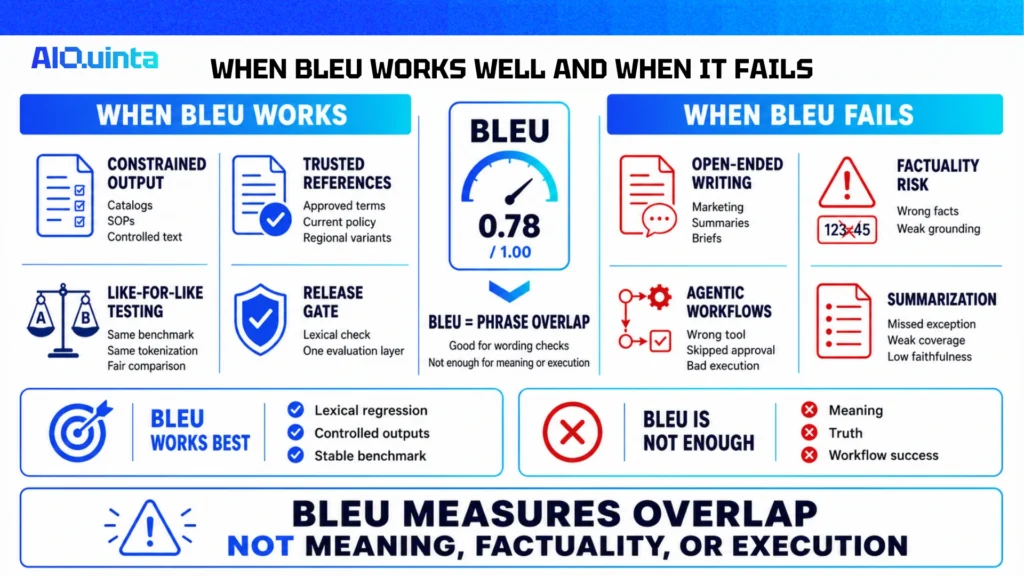
BLEU creates value when four conditions hold.
The output space is constrained
Machine translation for product catalogs, controlled technical documentation, standard operating procedures, and repetitive service messages often has a limited set of acceptable phrasings.
Exact phrase overlap carries more signal in these cases.
References are trusted and representative
Reference quality sets the ceiling for metric quality.
Enterprises need references that reflect:
This is where human expertise and AI memory become part of evaluation design, not just content inputs.
Teams compare like with like
BLEU is most useful for A/B comparison when the language pair, test set, references, preprocessing, tokenization, and implementation remain fixed.
A model upgrade that drops BLEU on the same benchmark deserves investigation, even if the score alone cannot explain the failure.
BLEU is one layer in a release gate
Use BLEU to detect lexical regression. Then apply semantic metrics, terminology checks, factuality tests, task-level validation, and human review based on risk.
This layered design aligns evaluation with enterprise AI adoption. Leaders need evidence across accuracy, control, workflow fit, and ROI rather than one technical score. AIQuinta’s analysis of the enterprise AI adoption gap explores the wider leadership and governance problem.
Open-ended generation
Marketing copy, executive briefs, meeting summaries, explanations, and conversational responses can have many valid forms.
BLEU penalizes useful paraphrases and may reward dull copying. Research has shown that lexical overlap metrics can penalize semantically correct outputs that differ from the reference.
Factuality and groundedness
A generated answer can repeat reference phrases while adding a false number, wrong entity, or unsupported claim.
BLEU may not isolate the critical error. This is a major issue in RAG, compliance, finance, healthcare, and policy workflows.
Agentic workflows
An AI agent may produce fluent text and still:
BLEU evaluates the wording of the output, not the quality of the plan or execution.
For knowledge-base-first AI agents, release criteria should include retrieval quality, tool-call success, policy compliance, traceability, and outcome accuracy.
Summarization
Summaries require coverage, compression, faithfulness, and audience fit.
BLEU overweights surface similarity and cannot determine whether the summary preserved a critical exception. A production content summarization agent skill should test omission risk, factual grounding, citations, format compliance, and downstream usability.
The most common mistakes are operational, not mathematical:
The corrective action is to preserve segment-level diagnostics, define risk-weighted test slices, and connect automated metrics to human error analysis.
To mitigate the risks of legacy lexical metrics, enterprises must migrate toward a multi-tiered, composite evaluation stack. A modern QA framework for enterprise AI does not discard BLEU entirely; rather, it demotes BLEU to a basic sanity check within a broader matrix of semantic and agentic measurements.
1. Semantic and Neural Metrics (BERTScore and COMET)
Instead of matching distinct tokens, modern frameworks utilize models to evaluate models. Metrics like BERTScore, BLEURT, and COMET use contextual embeddings to measure semantic similarity. These metrics understand that “automobile” and “car” share the same conceptual space in a high-dimensional vector environment. By evaluating meaning rather than syntax, semantic metrics align far closer to human judgments of text quality, effectively solving BLEU’s paraphrasing penalty.
2. Task-Specific Instruction Adherence
For enterprise workflows, text quality must be defined by utility. Did the model correctly structure a JSON payload? Did it follow the formatting constraint? Was personally identifiable information (PII) successfully redacted? These require deterministic rule-based checks and LLM-as-a-judge methodologies, looking specifically for correctness, safety, and action completion.
3. Integration with Enterprise AI Memory
Static text evaluations fail to account for how a model performs longitudinally. Modern systems utilize enterprise AI memory to recall past interactions, user preferences, and organizational context. Evaluating these systems requires tracking how effectively the AI retrieves and synthesizes historical context, not just how well it translates a single string in a vacuum. The benchmark must transition from “Did it match the reference sentence?” to “Did it accurately resolve the complex knowledge management query?”
The BLEU score remains a fundamental piece of NLP history and a useful mathematical baseline for tracking raw token convergence during model training. However, as the primary metric for enterprise evaluation, it is inherently flawed. It prioritizes structural mimicry over semantic accuracy, penalizes valid paraphrasing, and fundamentally fails to guarantee that AI-generated text is factually correct or operationally safe.
For technical leaders, this means looking beyond legacy string-matching. Structured extraction is not only a document automation task—it is a critical requirement for scalable knowledge management where context and factual fidelity must be preserved. Position your AI evaluation stack to reflect real-world utility by augmenting lexical baselines with neural metrics, strict semantic checks, and workflow integration standards. Stop optimizing for the metric, and start optimizing for the enterprise workflow.
What is a good BLEU score for enterprise applications?
There is no universally “good” BLEU score because the metric depends heavily on the specific domain, test set, and number of human references. Generally, scores above 0.40 (or 40) are considered strong translations, and scores above 0.60 indicate near-human lexical matching. However, high scores in highly regulated industries (like legal or medical) do not guarantee factual safety.
Why does my AI model get a low BLEU score even when the text is accurate?
Because BLEU relies on exact n-gram matching, it severely penalizes synonyms, paraphrasing, and different word orders. If your AI generates perfectly understandable text that uses different vocabulary than the human reference, its precision drops, resulting in a low BLEU score.
Should BLEU be used for evaluating LLMs and generative AI?
No. BLEU was designed for machine translation and fails to evaluate open-ended text generation. Generative AI tasks (like RAG or summarization) produce highly variable, creative outputs that cannot be effectively judged against a single static human reference using pure string overlap.