

How to build an Enterprise AI Summarization Evaluation Framework?
- Publised September, 2026
-
Duc Nguyen (Dwight)
Learn to build an Enterprise AI Summarization Evaluation Framework. Compare NLI, QA, and LLM-as-a-judge pipelines at scale.
Table of Contents
Toggle
Key Takeaways
- An enterprise AI summarization evaluation framework should start with failure modes and business risk, not with a preferred metric.
-
Evaluation must be decoupled into distinct operational dimensions: Factuality, salient information coverage, conciseness, and structural schema validity require independent evaluation layers rather than a single composite score.
-
Hybrid evaluation pipelines balance cost and rigor: Combining deterministic rules, natural language inference (NLI), and calibrated LLM-as-a-judge scoring reduces evaluation compute overhead while preventing catastrophic hallucination leaks.
-
Pre-deployment benchmarks do not guarantee production reliability: Static golden datasets must be paired with shadow deployment testing, input drift monitoring, and runtime fallback routing to maintain summary quality over time.
Why Legacy Summary Quality Metrics Fail in Production
Before engineering an LLM evaluation pipeline, AI architects must understand the mechanical failure points of traditional summarization benchmarks. The industry relied heavily on n-gram matching algorithms for years, calculating the direct overlap of words between a generated summary and a human-written reference text.
ROUGE and BLEU calculate lexical similarity. If the source text reads “Revenue did not meet expectations” and the generated summary reads “Revenue met expectations,” the ROUGE score remains artificially high due to the heavy overlap of identical words. The algorithm registers a high similarity score while missing a catastrophic failure in factual accuracy.
The transition to semantic metrics attempted to solve this by mapping words to vector embeddings. Metrics like BERTScore evaluate whether the generated text shares a similar position in vector space to the reference text. While BERTScore: Measuring Meaning in AI-Generated Content is highly effective for detecting general semantic similarity, it still operates as a regression tool. It cannot confirm if the specific facts in the summary are logically entailed by the source document.
Factual consistency requires a completely different computational approach. Faithfulness evaluation specifically measures whether the information presented in an AI-generated summary can be explicitly proven true using solely the provided source text.
Core Dimensions of an Enterprise Summarization Evaluation Matrix
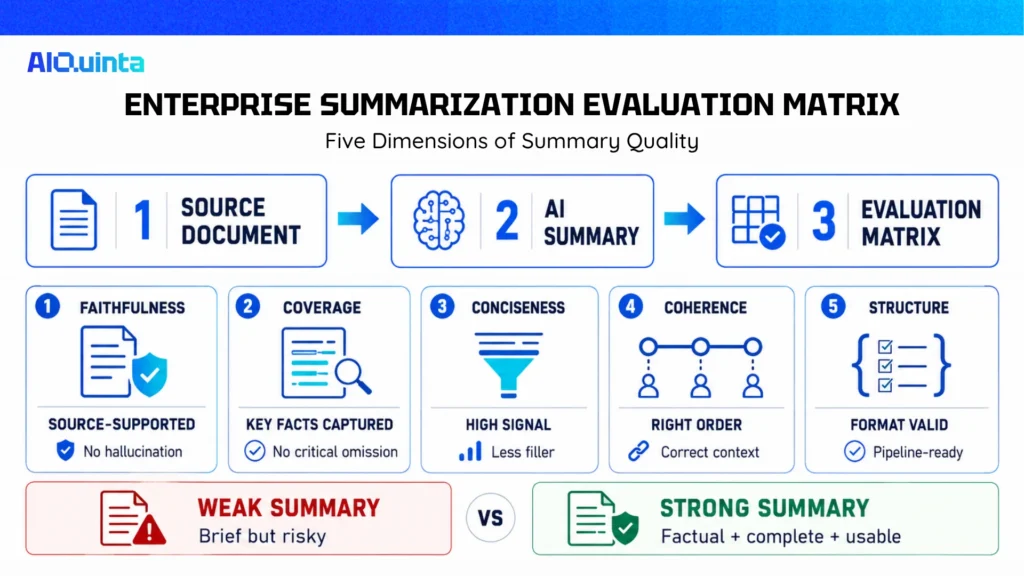
A comprehensive enterprise AI evaluation framework cannot rely on a single consolidated score. It must evaluate candidate summaries across five orthogonal dimensions, each targeted at a distinct failure mode.
Factual Consistency and Entailment (Faithfulness)
Faithfulness measures whether every assertion in the generated summary is logically entailed by the source text. In enterprise workflows, ungrounded extrapolations represent legal and operational liabilities. Evaluation systems must flag both intrinsic hallucinations (contradicting source facts) and extrinsic hallucinations (introducing unverified external claims). Utilizing specialized factual consistency metrics is mandatory to prevent models from generating plausible but fabricated statements.
Salience and Key Fact Coverage
A summary can be perfectly factual while omitting the most critical takeaway. Salience measures whether the generated text captures key business parameters: financial terms, liability caps, operational blockers, and action items. This is evaluated by extracting named entities and causal clauses from the source text and calculating entity-level recall against the summary.
Conciseness and Information Density
Verbosity is a common failure mode where models pad summaries with filler transitions to simulate completeness. Enterprise frameworks calculate the compression ratio alongside information density, measured by dividing the count of unique atomic facts by the total token count.
A high score reflects tight synthesis without unnecessary preamble or redundant restatements.
Temporal and Contextual Coherence
Long enterprise records—such as multi-month incident tickets or multi-party email chains—contain shifting context. If a summary attributes an action to the wrong stakeholder or presents an early incident hypothesis as the final post-mortem root cause, it fails temporal coherence. Evaluators must verify co-reference resolution and chronological fidelity across document sections.
Structural and Schema Integrity
When summaries feed downstream automated pipelines or agentic execution workflows, formatting errors break downstream ingestion. Summaries must conform to defined structural contracts (e.g., Markdown headers, strict JSON schemas, bulleted extraction constraints) verified via deterministic schema validation.
Architectural Comparison: Deterministic, NLI/QA, and LLM-as-a-Judge
Selecting the right evaluation mechanism requires balancing compute latency, execution cost, explainability, and multi-hop reasoning capabilities.
| Evaluation Approach | Primary Metrics / Tools | Median Latency | Cost per 1k Evals | Multi-Hop Reasoning | Explainability | Production Deployment Fit |
|---|---|---|---|---|---|---|
|
Deterministic & Lexical |
ROUGE, BLEU, Length/Compression Ratio |
< 2 ms |
$0.00 |
None |
High (Exact string matching) |
CI/CD build gates; fast sanity checks |
|
Embedding Similarity |
BERTScore and learned semantic metrics |
15–40 ms |
~$0.01 (Local GPU) |
Poor |
Low (Vector distance) |
Offline model comparison; regression drift |
|
Natural Language Inference (NLI) |
SummaC, DAE, TrueTeacher |
50–150 ms |
~$0.05 (Local GPU) |
Moderate |
High (Sentence-level entailment matrix) |
Real-time guardrail; production safety filtering |
|
Question Generation & Answering (QG/QA) |
QAFactEval, QuestEval |
200–600 ms |
~$0.20 |
Strong |
High (Pinpoints failed question-answer pairs) |
High-value batch processing; audit pipelines |
|
Unified Alignment Models |
AlignScore |
80–200 ms |
~$0.10 |
Strong |
High (Chunk-to-sentence alignment scores) |
Production gating; high-accuracy batch evaluation |
|
LLM-as-a-Judge (Rubric-Guided) |
G-Eval, Prometheus |
1,000–3,500 ms |
$2.00–$15.00 |
Excellent |
High (Chain-of-Thought reasoning traces) |
Offline golden set validation; sampled audit checks |
Deep-Dive: NLI vs. LLM-as-a-Judge Trade-Offs
NLI models treat the source document as a premise and summary sentences as hypotheses, classifying each relationship as entailment, neutral, or contradiction. For deep comparisons of specialized architectures, review the AlignScore vs SummaC vs QAFactEval breakdown. While NLI models are fast and resistant to prompt injection, they often struggle when a summary synthesizes facts scattered across disparate paragraphs.
Conversely, LLM-as-a-Judge architectures leverage advanced reasoning models guided by explicit evaluation rubrics. These judges handle nuanced enterprise criteria such as tone, ambiguity, and multi-step inference. However, uncalibrated LLM judges introduce structural biases:
-
Position Bias: Evaluating candidate summaries higher simply because they appear first in comparative prompts.
-
Verbosity Bias: Favoring longer, more elaborate summaries over concise summaries that capture identical information.
-
Self-Preference Bias: LLMs systematically award higher scores to summaries generated by their own model family.
To mitigate these biases, enterprise LLM judges must employ structured Chain-of-Thought (CoT) prompting, score decomposition across explicit sub-criteria, and swap-order scoring passes.
Step-by-Step Architecture: How to Build an Enterprise Evaluation Framework for AI Summarization
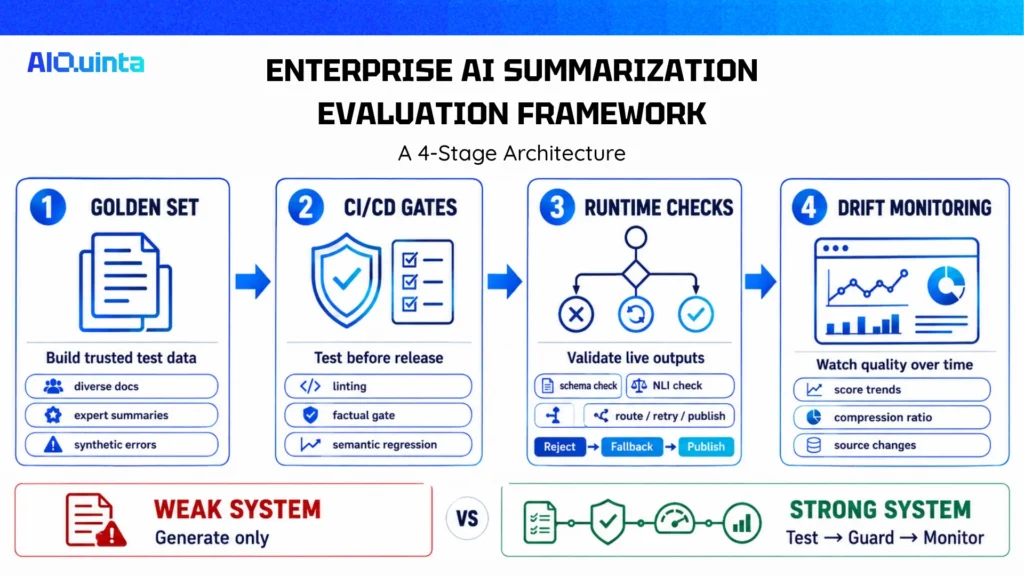
Building an enterprise LLM evaluation pipeline requires a four-stage architecture that transitions from offline staging to continuous runtime governance.
Stage 1: Curate Domain-Specific Golden Evaluation Sets
Academic benchmarks cannot validate internal workflows. Teams must construct an internal golden dataset composed of 150 to 300 representative business documents.
-
Extract diverse document types covering varied lengths, formats, and noisy source inputs (e.g., OCR scans, call transcripts).
-
Generate expert human reference summaries with labeled critical entities and key takeaways.
-
Inject synthetic perturbations—such as swapped numbers, inverted sentiment, and fabricated claims—to test whether evaluation metrics successfully detect corrupted outputs.
Stage 2: Implement Tiered Pre-Deployment Testing (CI/CD Gates)
Integrate evaluation into continuous deployment pipelines. Any prompt change, chunking strategy adjustment, or base model upgrade must clear automated gating thresholds before reaching staging:
-
Deterministic Linting: Verify character lengths, markdown syntax, and mandatory section headers.
-
Factual Consistency Gate: Run an NLI suite across the golden dataset. Require an entailment pass rate >= 98% on critical facts.
-
Semantic Regression Check: Calculate BERTScore against baseline outputs to detect unexpected shifts in terminology or structure.
Stage 3: Deploy Runtime Guardrails and Dynamic Routing
Production traffic requires inline validation without adding unacceptable user latency. Implement a tiered verification routing system:
🐍
filename.py
# Conceptual Runtime Evaluation Gatekeeper
def evaluate_summary_runtime(source_text: str, summary_text: str) -> dict:
    # Tier 1: Fast deterministic checks (<5ms)
    if not validate_schema_and_length(summary_text, min_ratio=0.1, max_ratio=0.35):
        return {"action": "REJECT", "reason": "Length constraint violation"}

    # Tier 2: Lightweight NLI entailment check (~80ms)
    entailment_score = calculate_nli_entailment(premise=source_text, hypothesis=summary_text)
    if entailment_score < 0.85:
        return {
            "action": "ROUTE_FALLBACK",
            "reason": f"Low factual consistency score: {entailment_score:.2f}",
            "fallback": "RETRY_WITH_STRICT_PROMPT"
        }

    # Tier 3: Async LLM-as-a-judge sampling (5% of traffic for governance)
    schedule_async_audit_eval(source_text, summary_text)

    return {"action": "PUBLISH", "score": entailment_score}
Stage 4: Continuous Drift Detection and Observability
Summary quality degrades when source document distributions change. Monitor token distributions, average compression ratios, and NLI entailment score trends weekly. A downward shift in median entailment scores indicates vocabulary drift, unannounced upstream template modifications, or newly introduced source formatting anomalies.
Enterprise Failure Modes and Anti-Patterns
Organizations often encounter preventable bottlenecks when deploying evaluation frameworks at scale.
| Anti-Pattern | Root Failure Mechanism | Operational Consequence |
|---|---|---|
|
The “Vibe Check” Trap |
Informal, ad-hoc qualitative review during prompt design |
Silent hallucination leaks in production |
|
The 100% LLM-Judge Monolith |
Running frontier models as judges on every transaction |
Unsustainable API costs and SLA timeouts |
|
Unanchored Reference Free Auditing |
Evaluating summaries against each other without source data |
Blindness to missed critical context |
|
Static Benchmark Stagnation |
Failing to update test suites as source documents evolve |
Evaluation passes while production accuracy drops |
Operationalizing the Framework: Governance, Cost, and SLA Alignment
An evaluation framework must align with corporate risk profiles and operational budgets. High-risk use cases justify computationally intensive validation pipelines, whereas internal drafting tools require lightweight checks.
Establishing Risk-Tiered Gating Thresholds
-
Tier 1: High-Risk Compliance & Legal (e.g., Contract Summaries, Incident Reports): Enforce strict deterministic linting and a mandatory NLI entailment threshold ($\ge 0.92$). Any unverified entity or factual contradiction triggers an automated rewrite or human escalation.
-
Tier 2: Internal Operations (e.g., Knowledge Base Digest, Meeting Transcripts): Run deterministic checks alongside sampled NLI validation (10% of traffic). Track quality through weekly aggregate drift reports.
Budgeting Evaluation Compute
As a rule of thumb, evaluation overhead should not exceed 15% to 20% of the total inference budget. Organizations running enterprise AI deployments, such as those leveraging enterprise agent governance and orchestration, can control compute costs by deploying dedicated 3B-parameter NLI models on local infrastructure for real-time filtering, reserving expensive LLM judges for weekly benchmark validation.
Conclusion
Evaluating AI-generated summaries is fundamentally a risk governance and data integrity function. Relying on legacy n-gram overlap metrics or unstructured manual reviews exposes enterprises to hallucinations, omitted operational constraints, and systemic decision errors.
Building an enterprise AI summarization evaluation framework requires decoupling evaluation into factual entailment, information coverage, conciseness, and structural validity. By implementing a tiered pipeline—combining deterministic filters, dedicated NLI entailment models, and calibrated LLM-as-a-judge audits—enterprises establish verifiable quality gates. This enables technical leaders to deploy autonomous summarization agents with measurable accuracy, predictable costs, and defensible governance.
FAQs
What is the main difference between a summarization benchmark and an evaluation framework?
A summarization benchmark is a static dataset paired with scoring metrics used to measure model performance at a fixed point in time. An enterprise evaluation framework is an end-to-end operational system that connects benchmarks, continuous CI/CD deployment gates, runtime verification filters, anomaly alerting, and governance policies to manage production AI systems.
Is ROUGE still useful for LLM summarization evaluation?
Yes, but its role is limited. ROUGE is fast, repeatable, and useful for comparing outputs against stable reference summaries. It does not measure factual support, logical correctness, or semantic quality well enough to act as the sole production metric.
How does summarization evaluation affect enterprise AI memory?
AI memory layers store past interactions, summarized documents, and workflow decisions to provide context for future tasks. If a summarization evaluation framework fails to block a hallucination, that corrupted fact enters the memory layer and is subsequently retrieved by agents as truth, causing errors to scale across the organization.
Turn Enterprise Knowledge Into Autonomous AI Agents
Your Knowledge, Your Agents, Your Control
Your Knowledge, Your Agents, Your Control
Related Articles

Latest Articles