

















 Duc Nguyen (Dwight)
BERTScore measures semantic similarity, but not factual truth. Learn how to use it in enterprise AI evaluation, set thresholds, and avoid false confidence.
Table of Contents
Toggle In short: BERTScore checks meaning similarity, not factual accuracy.
BERTScore is a metric that measures how similar AI-generated text is to a reference based on meaning, not exact wording.
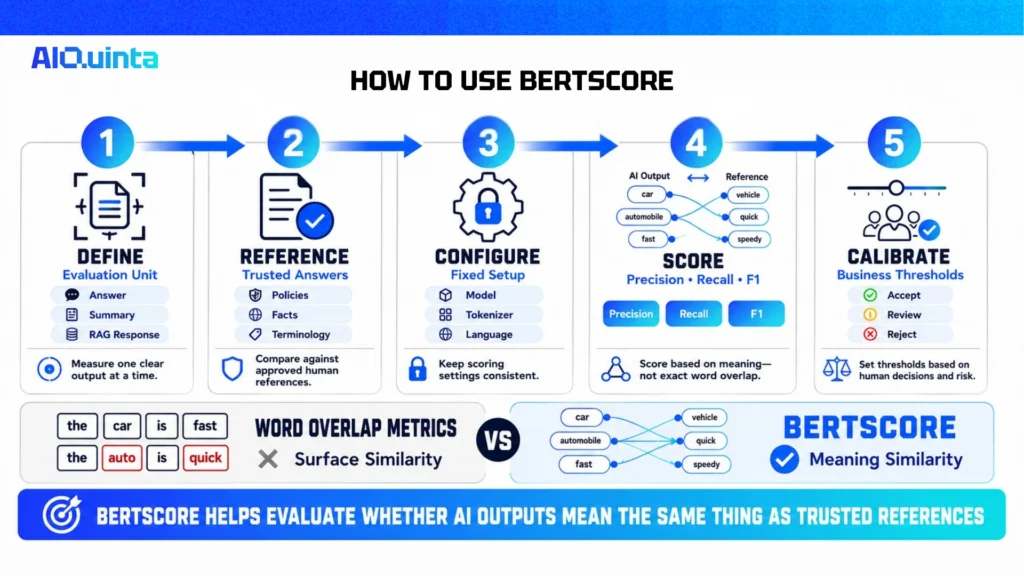
It compares tokens between texts and produces three scores:
BERTScore is useful for tasks like summarization, translation, and paraphrasing where wording can vary.
However, it measures semantic similarity, not correctness. It cannot verify facts, sources, or compliance.
For years, enterprises relied on metrics like BLEU (used for translation) and ROUGE (used for summarization). These are lexical metrics—they count the exact n-gram overlap between a human-written reference and the AI-generated output.
This creates a massive blind spot for generative AI. Consider two sentences:
Reference: “The organization rapidly successfully deployed the software.”
Generated: “The company quickly released the application.”
To a human, these sentences mean exactly the same thing. To an n-gram metric like ROUGE, the overlap is zero. The AI is unfairly penalized for using synonyms, restructuring grammar, or demonstrating linguistic fluidity.
BERTScore solves this by translating words into high-dimensional vectors (much like how a vector database operates) and measuring the distance between them. It does not check if the exact word is present; it checks if the meaning is present.
BERTScore precision starts from the generated output.
For every token in the generated text, it finds the most similar reference token and averages those maximum similarity values.
In operational terms, precision asks:
How much of the generated content is semantically supported by the reference?
Low precision may indicate irrelevant detail, repetition, unsupported expansion, or content that does not belong in the answer.
This is not factual precision in the traditional true-positive sense. It is directional semantic alignment from generated output to reference.
BERTScore recall starts from the reference text.
For every reference token, it finds the closest token in the generated output and averages the resulting similarities.
Operationally, recall asks:
How much of the reference meaning did the generated text preserve?
Low recall may indicate missing requirements, omitted facts, incomplete summaries, or lost policy conditions.
BERTScore F1 is the harmonic mean of semantic precision and semantic recall.
It provides a balanced headline score, but that balance can conceal different failure patterns.
Two outputs can receive the same F1 score:
For production diagnosis, teams should retain precision and recall rather than monitoring F1 alone.
Do not start with an entire AI application. Define the output being measured:
BERTScore works best when each generated output aligns with a clear reference unit.
Long documents require segmentation. The official implementation notes that common BERT, RoBERTa, and XLM configurations truncate sequences beyond their supported token length.
For long summaries, compare aligned sections, claims, or sentences before aggregating the results.
A reference is not merely a well-written answer. It must reflect the actual evaluation target.
References should include:
Multiple references are valuable when several answers are valid. The official package can compare a generated output against multiple references and retain the closest match.
This is relevant to enterprise content summarization agent skills, where the same source may require different summaries for executives, compliance teams, or operational users.
Use the same:
The BERTScore repository recommends reporting the full configuration hash because transformer versions and tokenizer choices can change results.
This matters in enterprise regression testing. A score change is not useful when the scoring system also changed.
Calling the evaluation function in Python code with the syntax
from bert_score import BERTScorer

references = [
"Customers may return an unused product within 30 days with proof of purchase."
]

generated_outputs = [
"Unused products can be returned within 30 days when the customer provides a receipt."
]

scorer = BERTScorer(
model_type="microsoft/deberta-large-mnli",
lang="en",
rescale_with_baseline=True
)

precision, recall, f1 = scorer.score(generated_outputs, references)

print("Precision:", precision.mean().item())
print("Recall:", recall.mean().item())
print("F1:", f1.mean().item())
The official repository recommends DeBERTa-based configurations when stronger correlation with human judgments is the priority, while smaller models reduce infrastructure cost. It also provides a BERTScorer object that caches the encoder for repeated evaluations.
There is no universal BERTScore threshold for production.
Build a calibration set that contains:
Have domain experts label the examples. Then measure score distributions for each class.
Select thresholds based on the cost of errors:
The threshold is a business-control decision, not a metric default.
Teams often report one average F1 score for an entire dataset. That view is too shallow.
Track at least five perspectives:
A model that raises mean F1 from 0.84 to 0.86 may still be worse if its lowest-performing compliance cases fall from 0.78 to 0.61.
Production decisions should focus on failure distribution, not leaderboard movement.
As enterprises move from simple chatbots to autonomous systems, evaluation metrics must keep pace.
Evaluating RAG Pipelines
In Retrieval-Augmented Generation (RAG), the system first fetches context from a database, then generates an answer. You can use BERTScore to evaluate the faithfulness of the generation. By setting the retrieved context as the “Reference” and the LLM’s answer as the “Candidate,” a high precision score guarantees that the model did not hallucinate information outside of the retrieved documents.
Validating Summarization Agents
When deploying a content summarization agent skill to compress 50-page vendor agreements, recall becomes the defining metric. The summarization agent must compress the token count without losing the semantic weight of the original document. Continuous monitoring ensures that as models drift or update, the core facts are never quietly omitted.
BERTScore is a paradigm shift in how we validate machine-generated language, moving the industry away from brittle exact-match comparisons toward true semantic understanding. However, as demonstrated, it is not a silver bullet. It carries heavy computational costs, requires thoughtful model selection to avoid jargon blindness, and demands baseline rescaling to be useful to business stakeholders.
For technical decision-makers, the strategic takeaway is clear: structured text evaluation is no longer just a data science task; it is a core enterprise capability. Transitioning to semantic metrics ensures that your Agentic Enterprise Platform can scale securely, catching hallucinations and omissions before they impact downstream business logic or client trust.
What is BERTScore used for?
BERTScore is used to evaluate how closely AI-generated text matches the meaning of a reference text. It is commonly applied to summarization, translation, question answering, paraphrasing, text generation, and RAG response evaluation.
Why is BERTScore better than BLEU or ROUGE?
BLEU and ROUGE measure exact word overlaps. If the AI uses synonyms or paraphrases a concept accurately, these legacy metrics penalize it. BERTScore uses contextual embeddings to measure semantic similarity, correctly rewarding text that means the same thing even if it uses different vocabulary.
What do BERTScore precision, recall, and F1 mean?
BERTScore precision measures how much of the generated text is semantically supported by the reference. Recall measures how much of the reference meaning appears in the generated output. F1 combines precision and recall into one balanced score.