

Factual Consistency Metrics: Evaluating AI Faithfulness
- Publised August, 2026
-
Duc Nguyen (Dwight)
Discover top metrics for evaluating factual consistency in AI summaries and why QA/NLI outperform ROUGE in enterprise pipelines.
Table of Contents
Toggle
Key Takeaways
-
No factual consistency metric is reliable enough to approve high-risk summaries on its own.
-
Faithfulness and factual accuracy are different. A summary can match a source that is stale or wrong.
-
ROUGE and BERTScore help track similarity and regression, but they do not prove source support.
-
NLI, QA, alignment, and LLM-based methods have different blind spots. Use at least two independent signals for material claims.
-
Use hard-fail rules and human review for critical contradictions, unsupported numbers, and metric disagreement.
The Illusion of Solved Hallucinations in Enterprise AI
The prevailing consensus among many enterprise IT leaders is that specialized evaluation frameworks are becoming redundant. The argument is straightforward: by utilizing state-of-the-art LLMs with massive context windows and deploying robust RAG (Retrieval-Augmented Generation) pipelines, the hallucination problem is effectively solved. If you feed the exact source document directly into the prompt and strictly instruct the model to “only use the provided text,” the resulting summary should be factually pristine. Consequently, investing engineering resources into complex, standalone factual consistency metrics is often viewed as unnecessary overhead.
This assumption is critically flawed because it conflates grounding with faithfulness.
Providing an LLM with the correct source text grounds its response, but it does not guarantee that the model will accurately preserve the relationships, constraints, and causal links during the compression process of summarization. Generative models, by design, rely on language priors—learned distributions from their training data—to ensure fluency. When compressing a dense, 50-page technical manual into a three-paragraph executive summary, the model may seamlessly attach the wrong operational metric to the right machine, or invert a negative constraint into a positive one. The resulting text reads beautifully, references real entities from the source, but is entirely factually inconsistent.
Relying on human-in-the-loop review to catch these micro-hallucinations negates the ROI and speed of automated systems. To safely deploy an Agentic Enterprise Platform, organizations must implement automated, scalable metrics capable of verifying that generated text is absolutely faithful to its source before it is served to a user or downstream API.
Defining Factual Consistency Metrics
Factual consistency—often referred to as faithfulness evaluation—specifically measures whether the information presented in an AI-generated summary is logically entailed by the source document.
A summary is factually consistent if and only if every fact, relationship, and claim within it can be explicitly proven true using solely the provided source text. If the summary introduces external facts (even if they are objectively true in the real world) or distorts the original meaning, it fails the faithfulness test.
Why Legacy Semantic Similarity Fails Factuality
For years, the industry relied on n-gram overlap metrics (like ROUGE and BLEU) and early semantic similarity metrics to evaluate text generation. This is a severe architectural mistake for enterprise AI.
As discussed in BLEU, ROUGE or BERTScore?, these legacy metrics measure surface-level text overlap. If a source text states, “The firewall configuration must not bypass the proxy server,” and the AI summary states, “The firewall configuration must bypass the proxy server,” ROUGE and BERTScore will return exceptionally high similarity scores because the vocabulary is nearly identical. Yet, the factual accuracy is completely inverted. Factual consistency metrics must evaluate meaning and logic, not just vocabulary matching.
The Core Methodologies for Factual Accuracy Metrics
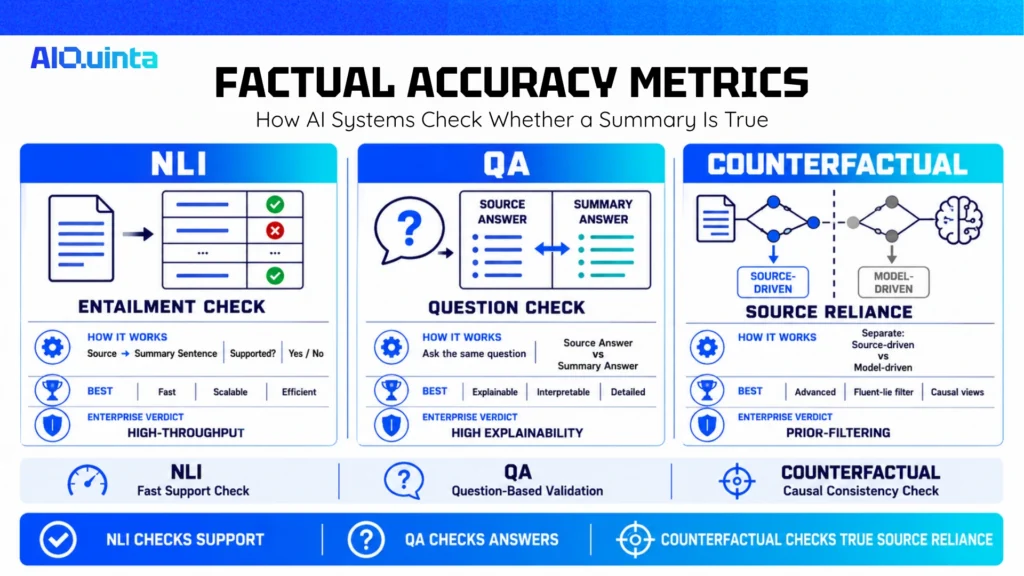
To move beyond the limitations of lexical overlap, the AI engineering community has developed discrete methodologies to accurately measure summary consistency.
NLI-Based Evaluators (Natural Language Inference)
Natural Language Inference models are trained specifically to determine if a “premise” entails a “hypothesis.” In the context of summarization factuality metrics, the source document is the premise, and each sentence of the generated summary is the hypothesis.
-
SummaC (Summary Consistency): SummaC segments the source document and the generated summary into individual sentences. It then computes an entailment matrix using a specialized NLI model (often RoBERTa-based) to score whether each summary sentence is supported by the source. It comes in zero-shot variants and convolutional variants that aggregate scores effectively.
-
DAE (Dependency Arc Entailment): DAE takes a more granular approach by extracting dependency arcs from parse trees of the text. Instead of checking full sentences, it evaluates entailment at the dependency level, identifying precise structural hallucinations.
Enterprise Verdict: NLI models are highly efficient and scale well. They are the standard for high-throughput pipelines where latency and compute costs must be kept low.
QA-Based Frameworks (Question Answering)
QA-based faithfulness evaluation operates on a highly interpretable mechanism: if a summary is factually consistent with the source, answering a question using the summary should yield the exact same answer as answering that question using the source document.
-
QuestEval & QAFactEval: These frameworks automatically generate a set of questions based on the entities and claims within the generated summary. A QA model then attempts to answer these questions using the original source text. The overlap (precision and recall) between the answers provides a highly accurate factual consistency score.
Enterprise Verdict: QA metrics provide unparalleled explainability. If a summary fails, the metric highlights exactly which question yielded conflicting answers. However, running a Question Generation (QG) model followed by a Question Answering (QA) model is computationally heavy and slower than NLI approaches.
Causal and Counterfactual Estimation
One of the most advanced methodologies addresses the root cause of hallucinations: the LLM’s learned language priors.
-
CoCo (Counterfactual Estimation): As proposed in recent research, CoCo evaluates consistency by mapping a causal graph between the source document, the generated summary, and the LLM’s language prior. It isolates and estimates the causal effect of the language prior (which causes hallucinations) and removes it from the total causal effect. The remaining effect—how much the summary actually relied on the source document—serves as the factual consistency score.
Enterprise Verdict: While highly sophisticated, counterfactual estimation provides a mathematical approach to filtering out the “fluent lies” that language models naturally want to generate, avoiding the need for heavy auxiliary tasks.
Best Metrics for Evaluating Factual Consistency in AI-Generated Summaries (Table)
When architecting an evaluation pipeline, engineering teams must weigh accuracy against computational overhead.
| Metric Category | Leading Frameworks | Core Mechanism | Best Used For |
|---|---|---|---|
|
NLI (Entailment) |
SummaC, FactCC |
Sentence-to-sentence logical entailment scoring. |
High-speed, low-latency evaluation in live agentic workflows. |
|
QA (Question Answering) |
QAFactEval, QuestEval |
Generates questions from the summary; verifies answers in the source. |
Auditing, offline evaluation, and use cases requiring high explainability. |
|
Dependency Entailment |
DAE |
Evaluates semantic relationships at the parse-tree dependency level. |
Complex technical or legal documents where syntactic relationships matter most. |
|
Advanced Embeddings |
SBERTScore |
Zero-shot comparison of sentences using off-the-shelf pretrained embeddings without references. |
Teams looking for a lightweight upgrade from BERTScore vs BLEURT |
Implementation Challenges and Trade-offs for Enterprises
Deploying factual consistency metrics in production is not as simple as importing an open-source library. Enterprise buyers must navigate significant trade-offs.
The Domain Shift Dilemma
Most NLI and QA models are trained on open-domain datasets like Wikipedia or generic news corpora. When these out-of-the-box models are deployed to evaluate dense legal contracts, clinical trial summaries, or industrial IoT diagnostic logs, they suffer severe performance degradation. The models may fail to recognize complex domain-specific entailment, flagging accurate summaries as inconsistent or missing subtle technical hallucinations.
To solve this, enterprises must fine-tune evaluation models on synthetic datasets generated from their own proprietary data.
Latency and Compute Overhead
Running a generative LLM already requires substantial compute. Adding an intensive QAFactEval pipeline immediately after generation effectively doubles or triples the computational load and latency. For real-time applications (e.g., customer support agents), this delay is unacceptable. Enterprises must strategically choose when to use heavy QA metrics (offline batch processing, nightly audits) versus lightweight NLI metrics (in-line real-time routing).
LLM-as-a-Judge: The Proprietary Trap
Currently, it is popular to simply prompt GPT-4 or Claude to act as a judge with a prompt like: “Evaluate if this summary is factually consistent with the source text.” While effective for prototyping, using proprietary LLMs for automated factuality evaluation in production creates a fragile architecture. It introduces API latency, exorbitant variable costs at scale, and non-deterministic behavior—the judge might pass a summary on Tuesday and fail the exact same summary on Wednesday following a silent API weight update. Open-source, deterministic evaluation metrics remain a safer enterprise choice.
Designing a Factual Consistency Pipeline for AI Agents
The true value of measuring summary consistency is realized when it is integrated into autonomous agentic workflows.
When an AI agent searches an enterprise knowledge base and synthesizes an answer, a factual accuracy metric must act as an automated gatekeeper.
-
Generation: The Specialized Agent generates a summary based on retrieved context.
-
Evaluation: An NLI metric (like SummaC) immediately scores the output against the retrieved context.
-
Routing: If the factual consistency score falls below a predefined confidence threshold (e.g., 0.85), the text is blocked. The agent is forced to regenerate the response, or the query is escalated to a human operator.
-
Execution: Only highly faithful summaries are allowed to trigger downstream API calls or database updates.
As organizations push toward Enterprise AI Maturity 2026: The Economic Advantage, the ability to quantitatively prove that AI systems do not hallucinate operational data is what will separate scalable deployments from stalled proof-of-concepts.
Conclusion
Measuring factual consistency is the definitive capability required to transition generative AI from a novel brainstorming tool into a reliable enterprise engine. Implementing RAG alone is insufficient; enterprises must deploy rigorous, automated faithfulness evaluation frameworks—such as NLI entailment or QA-based testing—to ensure that generated outputs strictly adhere to source truths. Structured extraction and validation are not merely document automation tasks; they are the foundational security layers of any enterprise AI capability. By embedding deterministic factual consistency metrics directly into agentic workflows, organizations can finally deploy AI that operates with undeniable accuracy, protecting both business operations and enterprise knowledge.
FAQs
What is the best metric for factual consistency in AI summaries?
There is no universal best metric. AlignScore, FENICE, MiniCheck, SummaC, and QAFactEval are useful starting points for different needs. High-risk workflows should combine claim-level entailment or fact checking with QA, deterministic checks, and human review.
Are ROUGE and BERTScore factual accuracy metrics?
No. They measure lexical or semantic similarity. They can support regression testing and content comparison, but a high score does not prove that each generated claim is supported by the source.
What is the difference between faithfulness and factual accuracy?
Faithfulness asks whether a claim is supported by the provided source. Factual accuracy asks whether it is true in the real world. A faithful summary can repeat an error from a stale source, so external claims may need corroboration.
Turn Enterprise Knowledge Into Autonomous AI Agents
Your Knowledge, Your Agents, Your Control
Your Knowledge, Your Agents, Your Control
Related Articles






Latest Articles