













 Duc Nguyen (Dwight)
Discover why the G-Eval metric outperforms static scoring. Learn how this LLM evaluation framework improves NLG assessment.
Table of Contents
Toggle G-Eval replaces static rule sets with a chain-of-thought (CoT) and probability-weighted scoring mechanism, aligning closely with human judgment.
By utilizing Large Language Models to generate evaluation steps automatically, teams reduce the manual overhead of designing task-specific rubrics.
For high-volume production, a hybrid approach – using G-Eval for sampled quality checks and lighter metrics for real-time monitoring – optimizes compute expenditure.
The transition from deterministic software to probabilistic AI systems breaks traditional testing paradigms. In natural language generation (NLG), exact string matching is obsolete. A generated summary can use entirely different vocabulary from a reference text and still be factually accurate and semantically superior.
Legacy metrics like BLEU and ROUGE measure n-gram overlap. They calculate how many words in the generated output match the reference text. These static scoring methods penalize paraphrasing, ignore factual hallucinations, and fail to assess tone or coherence. To solve this, AI engineering teams have shifted toward LLM-as-a-judge frameworks. By using an advanced language model to evaluate the output of another model, teams can automate qualitative assessment.
Before examining how G-Eval improves human alignment, we must evaluate its structural vulnerabilities. Relying on an LLM to assess text introduces distinct operational risks that can compromise an evaluation pipeline if left unmanaged.
The most severe limitation is the cost and latency overhead. Running inference through a high-parameter model like GPT-4 for every single output generated by a production system is economically unviable for high-throughput applications. An evaluation call requires processing the original prompt, the evaluation criteria, the generated steps, and the target text. This consumes significant token bandwidth. Evaluating a 1,000-word output can take several seconds and incur costs that exceed the original generation task.
Furthermore, LLM-based evaluators exhibit demonstrable self-preference bias. When tasked with scoring different texts, models like GPT-4 consistently assign higher scores to text generated by an LLM compared to text written by human experts, even when human evaluators prefer the human text. This bias skews baseline assessments and can lead engineering teams to falsely conclude their models are outperforming human baselines.
Position bias also affects scoring accuracy. When evaluating multiple outputs side-by-side or processing long contexts, LLMs tend to favor the information presented earlier in the prompt. If the evaluation criteria are complex, the model may anchor its final score heavily on the first few instructions while ignoring constraints listed at the end.
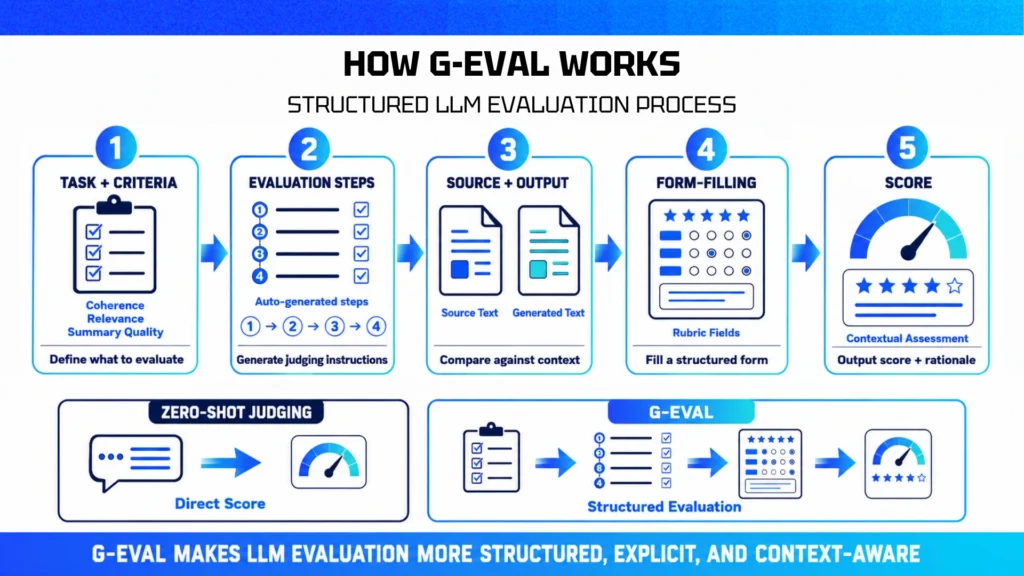
Despite these limitations, G-Eval remains one of the most effective methods for task-specific AI evaluation when properly calibrated. Introduced in the 2023 paper NLG Evaluation using GPT-4 with Better Human Alignment, G-Eval addresses the shortcomings of zero-shot prompting by introducing a structured, two-step evaluation process.
The framework utilizes an auto chain-of-thought (CoT) generation method combined with a form-filling paradigm. When an engineer inputs a task introduction and basic evaluation criteria—such as assessing the “coherence” of a text—G-Eval does not immediately output a score. First, it prompts the LLM to generate detailed evaluation steps.
For a summarization task, the model might automatically generate a CoT instructing itself to:
Identify the main topic of the source article.
Compare the summary against the source to verify all key points are present.
Check the logical order of the presented information.
Assign a score based on the specific rubric.
Once these steps are generated, the framework feeds the original prompt, the CoT, the source context, and the target text into the LLM. The model executes the evaluation task by filling out a predefined form, resulting in a highly contextualized assessment.
A major flaw in early LLM evaluation methods was their reliance on discrete, deterministic score outputs. If a model was asked to score a text from 1 to 5, it would output a single integer. This integer often failed to capture edge cases or marginal differences between two similar texts.
G-Eval solves this by shifting from discrete integer outputs to a probability-weighted scoring mechanism. Instead of taking the final token (e.g., “4”) at face value, the framework accesses the token log probabilities generated by the LLM during the scoring step.
The system extracts the probabilities of the model generating each valid score token (1, 2, 3, 4, and 5). It then applies a mathematical function—typically a softmax calculation—over these specific token probabilities. The final score is the weighted sum of these probabilities.
If the model is 70% confident the score is a 4, and 30% confident the score is a 5, the continuous output score will be 4.3. This approach provides a granular, continuous metric that correlates much closer to human judgment (achieving a Spearman correlation of 0.514 on summarization tasks) than a rigid integer.
Integrating G-Eval into an enterprise architecture requires a balanced approach to manage compute resources while maintaining high evaluation standards.
Organizations deploying autonomous systems often embed G-Eval within a broader agent harness. The harness controls the execution loop, allowing developers to define explicit failover states. If an AI agent generates a response that scores below a predetermined threshold via the G-Eval metric, the harness intercepts the output. It then feeds the evaluation feedback directly back to the agent, forcing it to self-correct and regenerate the response before surfacing it to the end user.
For applications relying on retrieval-augmented generation (RAG), G-Eval is used to test factual consistency against an AI-ready knowledge base. The evaluation criteria prompt the model to penalize any information in the generated text that cannot be explicitly verified by the retrieved knowledge base chunks.
To mitigate the high latency of LLM-based evaluation in production, engineering teams utilize asynchronous evaluation pipelines. Rather than evaluating every transaction in real-time, lightweight classification models handle immediate safety and toxicity filtering. G-Eval is then deployed asynchronously on a sampled subset of outputs. This hybrid model allows teams to monitor semantic quality trends over time without bottlenecking the user experience. By packaging these evaluation criteria as standardized agent skills, teams can deploy consistent rubrics across different departments, ensuring the sales AI agents are judged against the same factual accuracy standards as the IT support agents.
The G-Eval metric represents a necessary evolution in how we measure artificial intelligence. Moving past the limitations of exact-match algorithms, it applies semantic reasoning to qualitative assessment. While engineering teams must actively manage its latency and bias, the probability-weighted scoring mechanism provides unparalleled alignment with human judgment. Structured extraction and automated evaluation are fundamental capabilities for production AI. By integrating robust frameworks like G-Eval, enterprises can scale their autonomous systems with verifiable confidence in their outputs.
What makes G-Eval different from standard prompting for evaluation?
Standard prompting asks a model for a score directly, which often results in inconsistent outputs. G-Eval forces the model to generate a chain-of-thought rubric first, then uses token probabilities to calculate a weighted, continuous score rather than a single integer.
Why shouldn’t I use ROUGE or BLEU for my AI outputs?
ROUGE and BLEU measure n-gram overlap. They only verify if the exact words from a reference text appear in the generated text. They cannot understand paraphrasing, factual consistency, or logic, making them inadequate for evaluating modern generative models.
How does G-Eval calculate its final score?
Instead of outputting a single number, G-Eval measures the probability of the model generating each possible score token (1 through 5). It calculates a weighted average of these probabilities, resulting in a continuous decimal score (e.g., 3.8).