


The Strategic Battle: Data Ownership and Model Power
- Publised April, 2026
-
Duc Nguyen (Dwight)
Discover the economic battle between data ownership and AI model power. Learn how data governance drives enterprise success and protects intellectual property.
Table of Contents
ToggleKey Takeaways
-
Data is the New Corporate Moat: While AI models are becoming more accessible and standardized, unique, high-quality proprietary data is the ultimate competitive advantage.
-
The Rise of Licensing Models: Intellectual property laws are pushing the AI industry toward economic partnerships, where content creators are compensated through structured licensing rather than unauthorized scraping.
-
The Twin Pillars of Success: Enterprise success relies on a complementary duo: Data Governance (ensuring the quality of the input) and AI Governance (ensuring the safety and accuracy of the output).
-
Shift in Economic Value: The massive valuation of tech companies is transitioning from those who build the algorithms to those who control the exclusive rights to the data feeding them.
-
Strategic 2026 Outlook: Businesses must prioritize strict data ownership contracts when using third-party AI tools to prevent their proprietary knowledge from training competitors’ models.
Introduction to the Data-AI Economy
We are standing at the forefront of the most significant economic shift of the digital age. In the early days of artificial intelligence, the organizations that could build the most complex algorithms held all the power. Today, the landscape is dramatically changing. As AI models become more accessible and open-source, the true economic battleground has shifted. We are now witnessing the strategic battle of Data Ownership vs. Model Power.
For modern enterprises, understanding this dynamic is no longer optional – it is a critical survival skill. If AI is a highly advanced factory, the model is the machinery, and the data is the raw material. You can lease the best machinery in the world, but if your competitors control the supply of premium raw materials, they will always produce a superior product. This article explores the economic implications of data ownership, the evolving landscape of intellectual property, and how robust data and AI governance act as the ultimate strategic shields for your business.
The Core Conflict: Data Ownership vs. Model Power
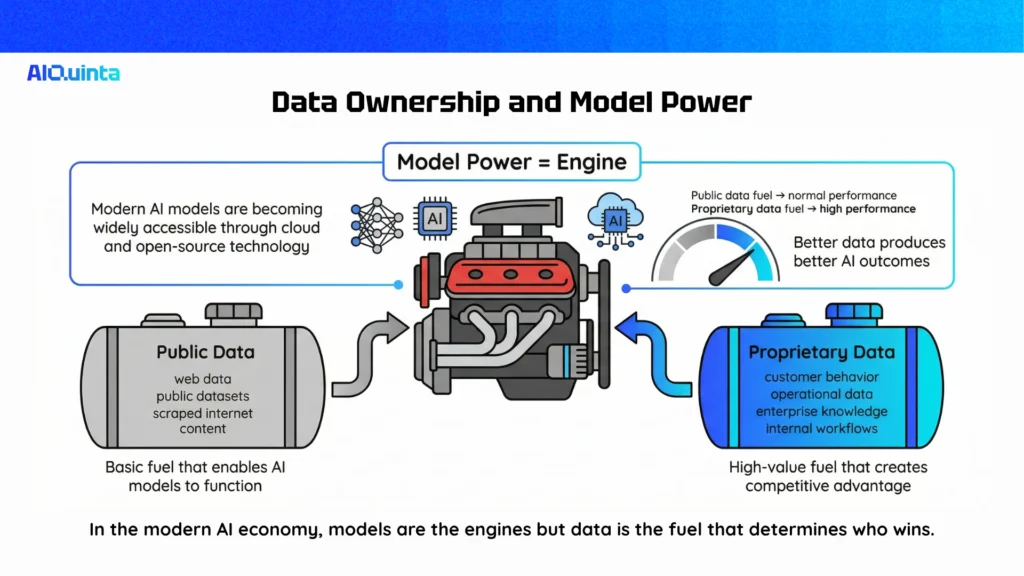
To grasp the magnitude of this shift, we must look at how value is created and captured in the modern tech economy.
Why Data is the Fuel and Models are the Engine
When tech experts talk about “large language models with billions of parameters,” it can sound incredibly intimidating. Let’s simplify it. Imagine an AI model as the engine of an ultra-high-performance race car. A few years ago, only a handful of elite engineering companies could build these engines. Today, thanks to open-source technology and cloud computing, almost any business can rent or buy a world-class engine.
However, a race car engine is entirely useless without fuel. In the AI economy, data is the high-octane fuel.
Not all fuel is created equal. Public data (information scraped freely from the internet) is like standard, unrefined gasoline. It will make the car move, but it won’t win the race. Proprietary, private data – your company’s unique financial records, customer behaviors, and internal processes – is the premium rocket fuel. The companies that own the premium fuel are the ones commanding the highest market valuations, regardless of who built the engine.
The Shift in Economic Value
Historically, tech companies fought over software patents. Today, the battle is over data access rights. According to recent technology outlooks, data ownership is becoming the primary driver of corporate mergers and acquisitions.
When a large enterprise integrates a third-party AI tool into its workflow, a silent economic transaction occurs. If the enterprise is not careful, the AI tool absorbs their proprietary data to train its own systems, effectively extracting the enterprise’s unique value for free. This is why the most forward-thinking businesses are drafting strict data ownership contracts, ensuring that their proprietary knowledge remains their exclusive economic asset.
Comparison Table: Model Power vs. Data Ownership
| Feature | Model Power (The Engine) | Data Ownership (The Fuel) |
|---|---|---|
|
Nature of Asset |
Often commoditized, open-source, or rentable. |
Unique, proprietary, and highly specific. |
|
Economic Value |
Decreasing in exclusivity; high development costs. |
Increasing in exclusivity; generates long-term ROI. |
|
Competitive Edge |
Temporary (competitors can adopt similar models). |
Permanent (competitors cannot legally copy private data). |
|
Core Risk |
Obsolescence (newer models arrive rapidly). |
Leakage (losing IP to third-party training). |
Navigating the Intellectual Property Battlefield
As AI models consume massive amounts of data, they inevitably collide with intellectual property (IP) and copyright laws. This is not just a legal issue; it is a fundamental economic dispute over who gets paid for the value generated by AI.
Copyright and AI Training: The Economic Impact
Imagine spending years writing a comprehensive encyclopedia, only for someone to memorize it in seconds and start selling answers based on your hard work, without giving you a dime. This is the exact economic tension between original content creators (publishers, artists, businesses) and AI developers.
Courts and markets are currently wrestling with how to value the data used in AI training. If AI companies are forced to delete models trained on copyrighted materials – a scenario some legal experts foresee – it could result in billions of dollars in lost investments. Therefore, the economic viability of future AI depends entirely on resolving these ownership disputes clearly and profitably for both sides.
Emerging Licensing Frameworks
The market is adapting by creating new economic structures. Rather than scraping data without permission, leading AI companies are moving toward licensing models.
In this new economy, data is treated like real estate. AI companies pay a “rent” (licensing fee) to data owners for the right to train their models on that data. This creates a mutually beneficial ecosystem:
-
Data Owners unlock a massive new revenue stream simply by holding high-quality information.
-
AI Companies gain legally safe, high-quality training material that improves their product without the risk of devastating lawsuits.
For your enterprise, this means your internal data archives could soon become a monetizable asset, provided you have the legal ownership clearly defined.
The Crucial Role of Data and AI Governance
Having data is one thing; controlling and trusting it is another. To safely navigate the battle for data ownership and maximize model power, businesses must implement rigorous governance. Think of governance as the rulebook and quality control systems that protect your business.
Data Governance: Ensuring Quality and Security
Data governance is the framework that manages the availability, usability, integrity, and security of the data in enterprise systems.
To use our earlier analogy, if data is the fuel for the AI race car, data governance is the refinery and quality control lab. If you feed an AI model corrupted, biased, or messy data, it will produce corrupted, biased, and messy results – a phenomenon often referred to as “garbage in, garbage out.”
Good data governance ensures:
Economic Efficiency: Employees spend less time searching for or cleaning data and more time generating insights.
Risk Mitigation: Sensitive customer data is shielded from public-facing AI tools, preventing costly data breaches or compliance fines.
Asset Valuation: Clean, organized data is worth significantly more on the corporate balance sheet than disorganized, siloed data.
AI Governance: Guiding the Output
While data governance focuses on the input, AI governance focuses on the model itself and its outputs. It is the set of policies that ensures the AI operates ethically, transparently, and accurately.
AI governance asks critical economic questions:
-
Can we explain why the AI made a specific decision (e.g., denying a customer a loan)?
-
Is the AI hallucinating (making up false facts) that could lead to corporate liability?
-
Are we auditing the AI’s performance regularly to ensure it is actually saving the company money?
The Complementary Duo for Enterprise Success
Industry leaders emphasize that data governance and AI governance are not standalone initiatives; they are a complementary duo. You cannot have effective AI governance without first having rock-solid data governance.
When working together smoothly, this duo builds absolute trust. And in the modern economy, trust accelerates adoption. When executives trust the data going in and the AI answers coming out, they can make multi-million dollar decisions faster than their competitors.
Strategies for Future-Proofing Your Business
Building a Proprietary Data Moat
In business strategy, a “moat” is a competitive advantage that protects your company’s long-term profits from competitors. Your proprietary data is your strongest moat.
-
Audit Your Assets: Identify exactly what data your company generates that no one else has.
-
Silo Third-Party AI: When purchasing AI vendor tools, strictly negotiate terms that prevent the vendor from using your data to train their universal models. Your data should only train your instance of the AI.
Strategic Checklist for Data & AI Domination:
-
Establish a Data Council: Appoint cross-functional leaders (IT, Legal, Operations) to define who owns which data sets internally.
-
Classify Data Tiers: Label data as Public, Internal, or Highly Confidential, and restrict AI access accordingly.
-
Implement Licensing Protocols: If your data is valuable to the broader market, explore secure licensing agreements to generate passive revenue.
-
Continuous Auditing: Treat AI models like employees; give them quarterly performance reviews to ensure they are generating positive economic value without compromising IP.
Conclusion
The strategic battle between data ownership and model power is reshaping the global economy. The era of the “algorithm monopoly” is fading, replaced by the era of the “data monopoly.” For businesses, the mandate is clear: protect your intellectual property, treat your proprietary data as your most valuable economic asset, and implement the complementary duo of data and AI governance. By mastering these elements, enterprises can safely harness the immense power of AI while ensuring their competitive advantage remains firmly in their own hands.
FAQs
Why is data governance important for AI?
Data governance acts as quality control. AI relies entirely on the data it is fed. If the data is unorganized, biased, or inaccurate, the AI’s outputs will be flawed, which can cost a business money and damage its reputation. Governance ensures only high-quality, secure data reaches the AI.
How are copyright laws affecting the AI industry?
Copyright laws are forcing AI companies to rethink how they acquire training data. Instead of freely scraping the internet, AI developers are increasingly having to pay licensing fees to original content creators and publishers. This creates a fairer economy where data creators are financially compensated for their intellectual property.
What is the relationship between Data Governance and AI Governance?
They are a complementary duo required for enterprise success. Data governance secures and organizes the “input” (the raw information). AI governance monitors and manages the “output” (how the AI makes decisions and whether those decisions are accurate and safe). Both must work together to create a reliable, profitable AI system.
Turn Enterprise Knowledge Into Autonomous AI Agents
Your Knowledge, Your Agents, Your Control
Your Knowledge, Your Agents, Your Control