











 Duc Nguyen (Dwight)
Learn when LLM-as-a-Judge works, where bias breaks it, and how to build calibrated, rubric-driven evaluation for enterprise AI.
Table of Contents
Toggle Traditional evaluation works well when success is deterministic.
If an extraction agent must return a customer ID, invoice date, and amount in JSON, software can verify the schema and values. If a classification system has known labels, accuracy or F1 can provide useful signals.
Open-ended generation is different.
Consider two responses to a customer asking how to change a contract. Both may use different wording while remaining correct. BLEU or ROUGE could penalize the variation because they emphasize lexical overlap. Semantic metrics such as BERTScore handle paraphrasing better, but similarity still does not prove that a response is useful, compliant, complete, or properly grounded.
This is why organizations increasingly combine traditional measures with model-based evaluation. AIQuinta’s comparison of BLEU, ROUGE and BERTScore reaches a similar conclusion: each metric detects a different class of failure, and no similarity score represents total output quality.
An LLM evaluator fills the semantic gap by applying natural-language criteria to generated output.
That flexibility is its main advantage and its main risk.
A weak evaluation prompt looks like this:
Rate this answer from 1 to 5 for quality.
“Quality” has no stable operational meaning. One model may interpret it as correctness. Another may reward detail. A third may reward polished writing.
A useful AI evaluation rubric converts quality into observable criteria.
For a maintenance-summary agent, the rubric could ask:
This changes the evaluation problem from vague preference scoring into bounded verification.
Research and current implementation guidance increasingly favor decomposed rubrics and lower-precision decisions over broad scalar scoring.
The enterprise lesson is straightforward: rubric engineering is policy engineering.
The rubric defines what the organization means by acceptable AI behavior.
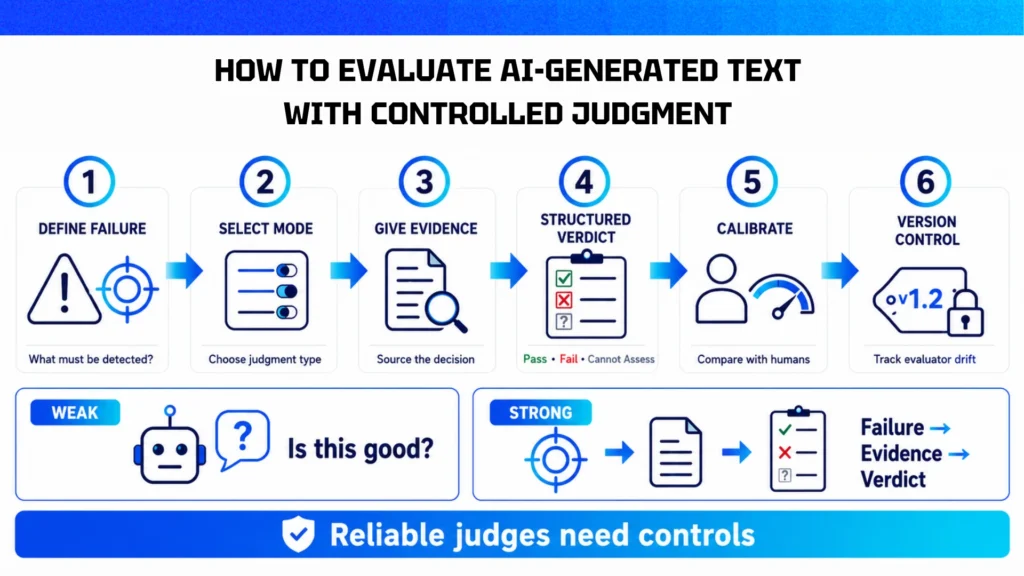
A production workflow should separate six decisions.
Start with the business failure.
If an AI-generated maintenance summary uses the wrong serial number, deterministic comparison may catch it. If it recommends an unsafe procedure despite citing the correct manual, a semantic evaluator becomes more useful.
Do not start with “We need an LLM judge.”
Start with “Which failure must we detect?”
Selecting between these three metrics requires mapping the algorithm to the specific enterprise constraint.
| Mode | Best question | Enterprise use |
|---|---|---|
|
Binary |
Did the output meet a specific requirement? |
Compliance, grounding, required action |
|
Pointwise |
How well did this response meet a rubric? |
Production quality monitoring |
|
Pairwise |
Which output is better? |
Model, prompt, or version comparison |
|
Reference-based judge |
Does the output agree with supplied evidence? |
RAG, summaries, policy answers |
|
Reference-free judge |
Does the output satisfy defined quality standards? |
Tone, usefulness, open-ended content |
judge cannot test groundedness if it never sees the source.
This mistake occurs often in RAG evaluation. Teams ask whether an answer is faithful but provide only the user question and generated response.
The evaluator then relies on its own pretrained knowledge.
For source-dependent tasks, supply the retrieved evidence, approved reference, policy, tool output, structured record, or relevant enterprise knowledge.
For factuality-sensitive outputs, separate semantic quality from factual support. AIQuinta’s guide to factual consistency metrics explains why lexical and semantic similarity cannot establish that a claim is supported by a source.
Return machine-readable results rather than a paragraph of commentary.
For example:
criterion: source_faithfulness
verdict: pass | fail | cannot_assess
evidence: [source spans]
reason: short explanation
cannot_assess deserves particular attention.
Forcing a judge to choose pass or fail when evidence is missing converts uncertainty into false certainty. Enterprises should route abstentions differently from failures.
Recent work on agreement reporting also argues that abstentions, ties, coverage, and judgment scale should be reported explicitly because they change the meaning of evaluation statistics.
A judge prompt is a hypothesis.
Before using its score as a release signal, create an expert-reviewed evaluation set containing normal cases, known failures, edge cases, ambiguous examples, and cases where humans disagree.
Measure where the judge agrees and where it systematically fails.
The original MT-Bench findings are often cited to support LLM-as-a-Judge, but their reported agreement does not mean every judge achieves 80% agreement on every enterprise domain. Performance depends on task, model, rubric, evidence, language, and evaluation protocol.
Human calibration therefore belongs in the operating loop, not only at initial setup.
Changing any of these can change the score:
An organization that changes its judge and compares the new score directly with last quarter’s score may be measuring evaluator drift instead of application improvement.
Store evaluator configuration with every result.
LLM judges offer the most value where success has semantic flexibility but can still be described clearly.
Customer support is a good example. A response can be phrased many ways, yet an evaluator can check whether it resolves the request, follows policy, provides the required next step, and avoids unsupported claims.
Summarization is another strong use case, provided the judge receives the source. Instead of asking whether the summary “looks good,” enterprises can evaluate faithfulness, coverage, source quality, and critical omissions separately. AIQuinta’s framework for evaluating agent summaries uses this failure-oriented decomposition.
Model and prompt selection also suit pairwise judgment. The business only needs to know which candidate performs better under a fixed rubric.
Do not pay a probabilistic model to decide something deterministic software can prove.
Use code or direct validation for:
An LLM judge can supplement these checks, but replacing them adds cost and uncertainty.
High-risk factual decisions also require stronger evidence than a judge score. If an AI system produces a regulatory conclusion, financial instruction, safety procedure, or operational command, semantic approval alone is weak control.
Use source verification, deterministic constraints, specialist models, and human escalation according to failure cost.
Before approving an LLM evaluator for production:
A judge that passes this process becomes useful infrastructure.
A judge that has not passed it remains an experiment.
LLM-as-a-Judge solves a real problem: enterprises need scalable ways to assess open-ended AI outputs that traditional metrics cannot evaluate well.
The practical strategy is simple: do not ask whether your LLM judge is intelligent enough to evaluate AI. Ask whether your evaluation system is engineered well enough to know when the judge should be trusted.
What is LLM-as-a-Judge?
LLM-as-a-Judge is a model-based evaluation method where a language model assesses another AI system’s output using defined criteria. The judge may return a binary verdict, score, ranking, preference, or structured assessment.
Can an LLM judge evaluate its own hallucinations reliably?
A model cannot reliably detect its own hallucinations in a zero-shot setting without external context. However, reference-guided evaluators can identify factual inconsistencies with high accuracy when provided with ground-truth reference texts and instructed to perform claim-by-claim verification.
What is the difference between single-answer scoring and pairwise comparison?
Single-answer scoring evaluates an isolated response against an absolute rubric, making it fast and scalable for production monitoring. Pairwise comparison presents two responses simultaneously to determine which is superior, offering higher discriminative precision for model benchmarking at the cost of higher token consumption and positional sensitivity.