


















 Duc Nguyen (Dwight)
Learn how BLEURT evaluates AI-generated text, where the metric adds value, where it fails, and how enterprises should calibrate it for production QA.
Table of Contents
Toggle BLEURT, or Bilingual Evaluation Understudy with Representations from Transformers, is a learned evaluation metric introduced by Google Research designed to model human judgment. Instead of counting overlapping words, it leverages a pre-trained language model (typically BERT or RoBERTa) to analyze the semantic similarity between a candidate text and a reference text.
The architectural brilliance of BLEURT does not lie merely in using BERT. If one were to simply fine-tune standard BERT on the limited datasets of human ratings available (such as the WMT Metrics Shared Task), the model would severely overfit. The human-rated datasets are simply too small to teach a model the vast permutations of how text can be subtly wrong or correct.
To solve this, BLEURT employs a two-step training pipeline:
Before looking at a single human rating, the BERT model undergoes pre-training on millions of synthetic sentence pairs. Researchers take a massive corpus of Wikipedia sentences and apply automated perturbations to them. These perturbations include:
Masking words
Back-translation (translating to another language and back to force paraphrasing)
Dropping words randomly
Swapping sentence structures
The model is trained to predict the specific perturbations applied and to calculate baseline metrics (like BLEU and ROUGE) on these synthetic pairs. This forces the neural network to develop a deep internal representation of lexical variations, omissions, and semantic shifts.
Once the model is highly sensitive to textual differences via synthetic data, it is fine-tuned on actual human judgment data. Because the model already understands the mechanics of paraphrase and degradation, it can map these understandings to human quality scores (usually on a scale of 1 to 5) without overfitting to the small dataset.
Enterprise AI rarely fails because every response is poor. It fails because a small number of high-impact responses are wrong, incomplete, misleading, or inconsistent.
BLEURT helps teams detect semantic regressions at scale. Potential applications include:
This is relevant to a governed content summarization agent skill, where quality depends on defined inputs, output contracts, and QA rules rather than one generic prompt.
The business value is not the score itself. The value is faster model selection, earlier regression detection, lower manual review volume, and clearer evidence for release decisions.
When a candidate sentence and a reference sentence are fed into BLEURT, they are concatenated with a special [SEP] (separator) token and processed through the Transformer layers.
The model utilizes contextualized embeddings. This means the evaluation is aware of the surrounding words. If the word “bank” appears, the BERT-based evaluation understands whether it refers to a financial institution or the side of a river based on context. It then projects these deep semantic embeddings into a single continuous quality score.
Independent verifications of BLEURT’s performance show a Pearson correlation with human judgment of approximately 0.65 to 0.75 across various NLG tasks. By contrast, traditional BLEU scores rarely exceed a 0.3 to 0.4 correlation on the same modern, highly fluent generative text.
Because BLEURT relies on this high-dimensional vector space rather than discrete character matching, it explicitly rewards valid lexical variance. A generated summary that condenses a paragraph into a completely novel, concise sentence will receive a high BLEURT score if the core assertions match the reference, solving the exact problem that crippled legacy metrics.
The official repository recommends BLEURT-20 for results reporting. Its scores are roughly distributed between zero and one, but values below zero or above one can occur. Different checkpoints can produce different score distributions.
This creates an important enterprise rule:
Do not define a universal “good BLEURT score.”
A score of 0.70 may indicate strong performance in one dataset and poor performance in another. The result depends on:
BLEURT scores are more useful for controlled comparisons than isolated judgments. Teams can compare:
Corpus-level averages are useful, but they should be accompanied by percentiles, failure categories, and sample outputs. A mean score can hide a small group of severe failures.
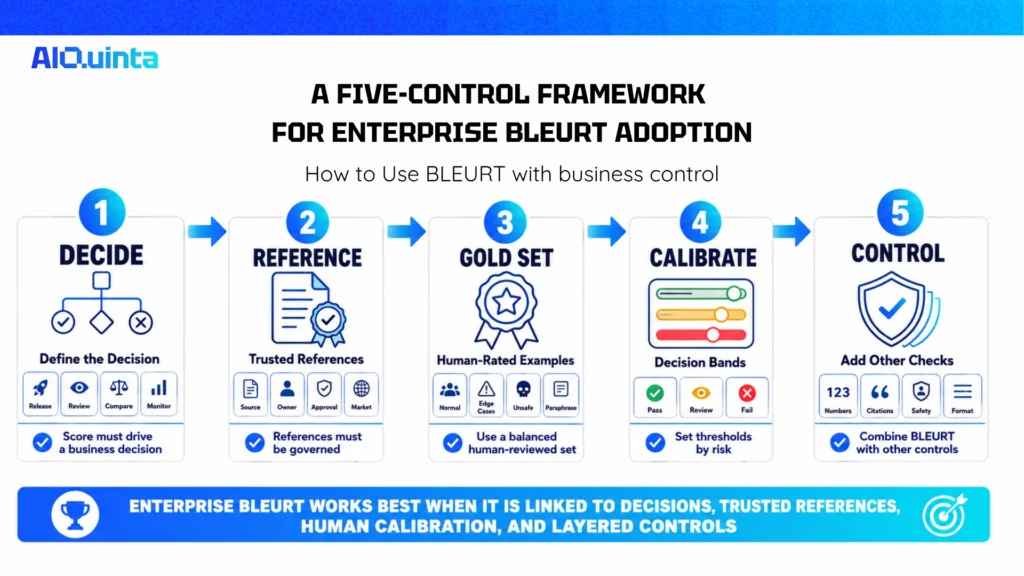
State what the score will influence.
Examples:
Do not collect BLEURT scores without a defined decision.
Each reference should have:
Where several answers are valid, use multiple references or create reference variants. A single reference can impose arbitrary wording preferences.
Build a balanced set of examples covering:
Ask reviewers to score separate dimensions such as accuracy, completeness, relevance, fluency, and compliance. Then test how BLEURT correlates with the dimension it is expected to represent.
Instead of a universal threshold, define local bands:
Select thresholds from observed false-positive and false-negative rates. High-risk workflows should tolerate fewer false passes, even if that increases manual review.
Combine BLEURT with checks that test different risks:
Evaluation logic can be packaged as reusable AI agent skills so that scoring rules, test sets, scripts, thresholds, and escalation steps remain versioned and governed.
A modern counter-trend to BLEURT is the “LLM-as-a-judge” paradigm, where a massive foundational model is prompted to score generated text and explain its reasoning.
When establishing an agentic enterprise platform, technical leaders must choose between these paradigms.
| Feature | BLEURT | LLM-as-a-Judge |
|---|---|---|
|
Speed / Latency |
Milliseconds per evaluation |
Seconds per evaluation |
|
Compute Cost |
Moderate (Local BERT/RoBERTa) |
Extremely High (API calls / massive LLMs) |
|
Transparency |
Black-box |
Explains reasoning via text generation |
|
Data Privacy |
Runs entirely local |
Often requires cloud API transmission |
|
Best Use Case |
Automated CI/CD pipelines, hyperparameter tuning |
Final stage QA, complex policy adherence |
BLEURT excels in the inner loop of model development. When engineers are fine-tuning a model and need to evaluate 10,000 generated responses per epoch, API costs and latency make LLM-as-a-judge impossible. BLEURT provides the immediate, high-quality, automated signal required for rapid iteration.
However, BLEURT is opaque. If it gives a response a score of -0.85, it cannot output a sentence explaining why it penalized the text. For auditing final agent behavior in compliance-heavy industries, LLM-as-a-judge provides necessary explainability.
Implementing a learned evaluation metric is a strategic architectural decision. It requires integrating evaluation directly into your data pipelines.
For enterprises utilizing a private knowledge base to drive Retrieval-Augmented Generation (RAG) systems, BLEURT serves as a highly effective filter. In a multi-agent system, a dedicated “Evaluation Agent” can use BLEURT to continuously measure the semantic drift of answers against a static set of ground-truth reference Q&As.
If the BLEURT score drops below an established threshold after a new batch of documents is ingested into the knowledge base, the system can automatically flag the regression for human review before the updated agent is deployed to end-users.
To mitigate BLEURT’s domain drift vulnerability, organizations must:
Establish a Domain Baseline: Run BLEURT against a carefully curated, human-annotated dataset specific to your industry (e.g., proprietary financial summaries) to verify its correlation with your SMEs’ judgments.
Use Ensemble Metrics: Never rely on BLEURT alone. Pair it with deterministic metrics (like ROUGE for strict entity recall) and hallucination-detection classifiers to ensure factual grounding is not lost in the pursuit of semantic fluency.
Monitor Distribution Shifts: Continuously track the input text distribution. If user queries dramatically shift in topic, the metric’s reliability will degrade.
BLEURT evaluates text by learning patterns aligned with human judgment, making it useful for tasks like translation and summarization.
However, it cannot ensure factual accuracy or compliance on its own. Enterprises should use it alongside trusted references and additional controls. Structured extraction enhances its value by creating data for evaluation and feedback.
Overall, BLEURT should support quality decisions, not replace comprehensive validation.
What is the BLEURT metric?
BLEURT is a learned, reference-based metric for evaluating generated text. It uses transformer representations and training data derived from synthetic examples and human ratings to predict how closely a candidate output matches the meaning and quality of a reference.
How does BLEURT evaluate the quality of generated text?
BLEURT processes a candidate and reference together, creates contextual representations of both texts, and uses a trained regression model to generate a quality score. The metric can recognize semantic similarity even when the two texts use different wording.
Is BLEURT better than BERTScore?
Neither metric is universally better. BERTScore measures contextual token similarity. BLEURT is trained to predict human quality judgments from complete candidate-reference pairs. BLEURT can provide a stronger learned quality signal, while BERTScore offers clearer precision, recall, and F1-style semantic matching.