
LightRAG Explained: Fast, Cost-Effective AI Retrieval
- Publised April, 2026
-
Duc Nguyen (Dwight)
Discover LightRAG, an innovative Retrieval-Augmented Generation framework blending graph-based indexing and dual-level retrieval for faster, context-rich AI answers.
Table of Contents
Toggle
Key Takeaways
Hybrid Innovation: LightRAG merges traditional vector search with graph-based indexing, allowing Large Language Models (LLMs) to understand both isolated facts and complex data relationships.
Dual-Level Retrieval Paradigm: The system uses a two-tiered approach to answer both hyper-specific queries (low-level facts) and broad, conceptual questions (high-level themes).
Unmatched Efficiency: LightRAG consumes significantly fewer tokens (under 100 per retrieval) and requires fewer API calls compared to traditional Graph RAG frameworks, drastically reducing computational overhead.
Incremental Updates: You can seamlessly add new documents to the knowledge graph without the need to rebuild the entire index, ensuring zero downtime for dynamic databases.
Open-Source & Accessible: Developed by researchers at HKUDS, the framework is open-source, highly modular, and deployable across various platforms including Docker and Railway
The Evolution of LLMs: Why Traditional RAG is No Longer Enough
Retrieval-Augmented Generation (RAG) fundamentally changed how enterprise AI operates by grounding Large Language Models (LLMs) in external, proprietary data. Instead of relying solely on the data a model was trained on, RAG acts as a dynamic search engine, fetching relevant documents to provide accurate, hallucination-free answers.
However, as businesses scale their AI applications, traditional RAG systems are hitting a wall. Standard vector databases retrieve text chunks based purely on semantic similarity. While great for simple, direct questions (e.g., “What is the company’s return policy?”), this “flat” retrieval mechanism struggles with complex, multi-hop queries that require connecting the dots between different concepts across multiple documents.
Enter LightRAG – a lightweight, lightning-fast framework that addresses these critical bottlenecks by introducing graph structures into the indexing and retrieval process.
What is LightRAG?
LightRAG (Lightweight Retrieval-Augmented Generation) is an advanced open-source AI framework designed to overcome the limitations of standard RAG and earlier Graph RAG models. It acts as a bridge between your data and your LLM, providing a sophisticated knowledge map rather than a simple list of related text snippets.
By combining the structural understanding of Knowledge Graphs with the semantic matching of Vector Search, LightRAG gives AI agents the ability to synthesize global themes, understand deep entity relationships, and deliver highly comprehensive answers – all while using a fraction of the computational power.
How LightRAG Works: The Core Architecture
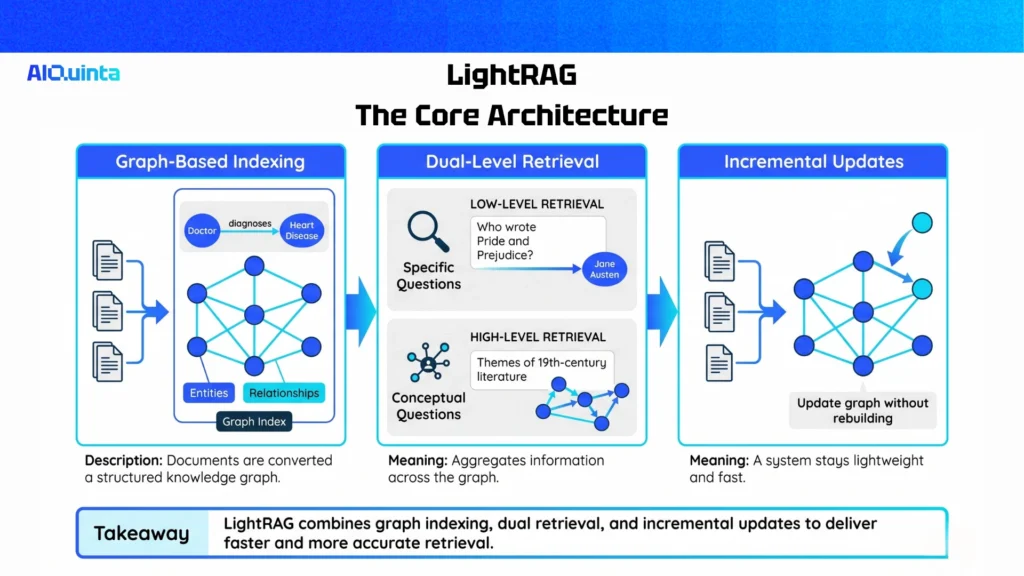
To understand why LightRAG is outperforming legacy systems, we need to look under the hood. The framework relies on three revolutionary pillars: Graph-Based Text Indexing, a Dual-Level Retrieval Paradigm, and an Incremental Update Algorithm.
Graph-Based Text Indexing
Instead of simply cutting documents into isolated chunks, LightRAG actively reads the text to extract specific entities (names, places, concepts) and the relationships between them.
Entity and Relationship Extraction: When you upload a document, an LLM processes the text chunks to identify nodes (entities like “Cardiologist” and “Heart Disease”) and edges (relationships like “diagnoses”).
Key-Value Generation: The system assigns a descriptive text key-value pair to each entity and relationship. This creates an optimized index where information can be rapidly retrieved via keywords rather than computationally heavy vector matching alone.
Deduplication: To keep the system lightweight, LightRAG deduplicates the graph. It merges identical entities found across different documents, shrinking the graph’s size, improving contextual continuity, and speeding up processing times.
Dual-Level Retrieval Paradigm
Traditional RAG often fails when users ask abstract questions because the answer is scattered across dozens of documents. LightRAG solves this using a two-tiered retrieval approach:
Low-Level Retrieval (Specific Queries): This tier focuses on exact details and precise facts. If you ask, “Who wrote Pride and Prejudice?”, LightRAG dives into the specific nodes of the knowledge graph to fetch the exact entity (Jane Austen) and its direct relationships.
High-Level Retrieval (Abstract Queries): This tier handles conceptual, broad-scope questions. If you ask, “What are the main themes of 19th-century literature?”, the system traverses multi-hop subgraphs to aggregate global information, identifying broader themes and interconnected concepts that span the entire document collection.
Fast Adaptation to Incremental Knowledge
One of the most frustrating aspects of traditional Graph RAG is updating the database. Often, adding a single new document requires reprocessing the entire knowledge graph, costing time and API credits.
LightRAG features a seamless Incremental Update Algorithm. When new data is ingested, the system processes it using the same graph indexing steps and simply merges the new nodes and edges into the existing graph. This preserves historical data connections and ensures the system remains instantly up-to-date with minimal computational overhead.
LightRAG vs. Traditional RAG vs. GraphRAG
| Feature | Traditional RAG | Standard GraphRAG | LightRAG |
|---|---|---|---|
|
Retrieval Method |
Vector semantic similarity |
Graph traversal |
Dual-Level (Graph + Vector) |
|
Handling Complex Queries |
Poor (Struggles to connect dots) |
Excellent |
Excellent (Uses less resources) |
|
Token Usage |
Low |
High (600 – 10,000+ tokens) |
Very Low (< 100 tokens) |
|
Token Cost |
Low (Single LLM call) |
Medium |
High (Multiple LLM calls and tool usage) |
|
API Calls per Retrieval |
1 |
Multiple |
1 |
|
Database Updates |
Fast (Add to vector DB) |
Slow (Rebuild entire graph) |
Instant (Incremental updates) |
|
Data Synchronization |
Fragmented |
Strong but rigid |
Highly cohesive and deduplicated |
The Enterprise Benefits of Implementing LightRAG
Integrating LightRAG into your AI ecosystem provides several distinct advantages that align perfectly with Google’s E-E-A-T (Experience, Expertise, Authoritativeness, Trustworthiness) principles, ensuring high-quality, reliable outputs.
Unmatched Cost and Computational Efficiency
By utilizing an optimized key-value data structure derived from the graph, LightRAG drastically reduces the tokens consumed during retrieval. Relying on a single API call and fewer than 100 tokens per query, organizations can scale their AI applications without facing exponentially growing API costs from providers like OpenAI or Anthropic.
Deeper Contextual Understanding
The combination of vector search and knowledge graphs means your AI agents are no longer providing fragmented answers. They can now “understand” the overarching narrative of your proprietary data. This makes LightRAG indispensable for complex fields such as legal tech, medical research, and financial analysis, where missing a connection between two documents can lead to critical errors.
Multimodal Capabilities
Recent updates to the LightRAG open-source repository have introduced comprehensive multimodal data handling. Through “RAG-Anything” integration, the system can seamlessly parse and index diverse formats, including PDFs, images, Office documents, tables, and complex mathematical formulas, making it a universal tool for enterprise data.
Read more: LightRAG Framework on Github
Conclusion
As AI transitions from experimental chatbots to mission-critical enterprise agents, the underlying retrieval architecture must evolve. Traditional RAG, while foundational, simply lacks the structural awareness to handle complex, interrelated data.
LightRAG represents a massive leap forward. By seamlessly integrating graph-based text indexing with a dual-level retrieval paradigm, it delivers the deep contextual understanding of Graph RAG with the blazing speed and low cost of standard vector search. Whether you are building an intelligent research assistant, a legal document analyzer, or a customer service bot, LightRAG provides the reliability, efficiency, and intelligence required to make your AI truly powerful.
FAQs
What does “Lightweight” mean in LightRAG?
“Lightweight” refers to the system’s computational efficiency. Unlike standard Graph RAG systems that require heavy processing, high token usage, and multiple API calls, LightRAG uses optimized key-value indexing. This allows it to retrieve data using fewer than 100 tokens and just one API call, drastically reducing operating costs.
Can LightRAG handle non-text files like images and PDFs?
Yes. With its latest updates integrating “RAG-Anything,” LightRAG supports comprehensive multimodal data processing. It can parse, index, and extract relationships from PDFs, images, Microsoft Office documents, data tables, and even complex formulas.
How does LightRAG’s Dual-Level Retrieval actually work?
It answers questions using two distinct methods depending on user intent. If you ask a specific, fact-based question (Low-Level), it jumps directly to the relevant nodes in the graph to find the exact answer. If you ask a broad, conceptual question (High-Level), it scans across multiple interconnected relationships to synthesize a comprehensive, thematic summary.
Turn Enterprise Knowledge Into Autonomous AI Agents
Your Knowledge, Your Agents, Your Control
Your Knowledge, Your Agents, Your Control