

















 Duc Nguyen (Dwight)
BERTScore vs BLEURT for enterprise AI: compare semantic coverage, human-judgment alignment, risks, costs, and practical deployment criteria.
Table of Contents
Toggle For two decades, the standard for evaluating Natural Language Generation (NLG) was lexical overlap. Metrics like BLEU penalized generated text if it did not share exact n-gram sequences with a human-written reference. ROUGE measured recall based on similarly rigid criteria.
Modern Large Language Models (LLMs) naturally excel at paraphrasing, restructuring syntax, and utilizing synonyms. A lexical metric actively penalizes an LLM for producing natural, articulate variations of a reference. Semantic evaluation metrics solve this by evaluating text via contextual embeddings. If the candidate sentence and the reference sentence map to similar coordinates, the models recognize semantic equivalence, regardless of the surface-level vocabulary used.
In the enterprise context, selecting between BERTScore and BLEURT dictates the operational cost, speed, and accuracy of offline evaluation pipelines.
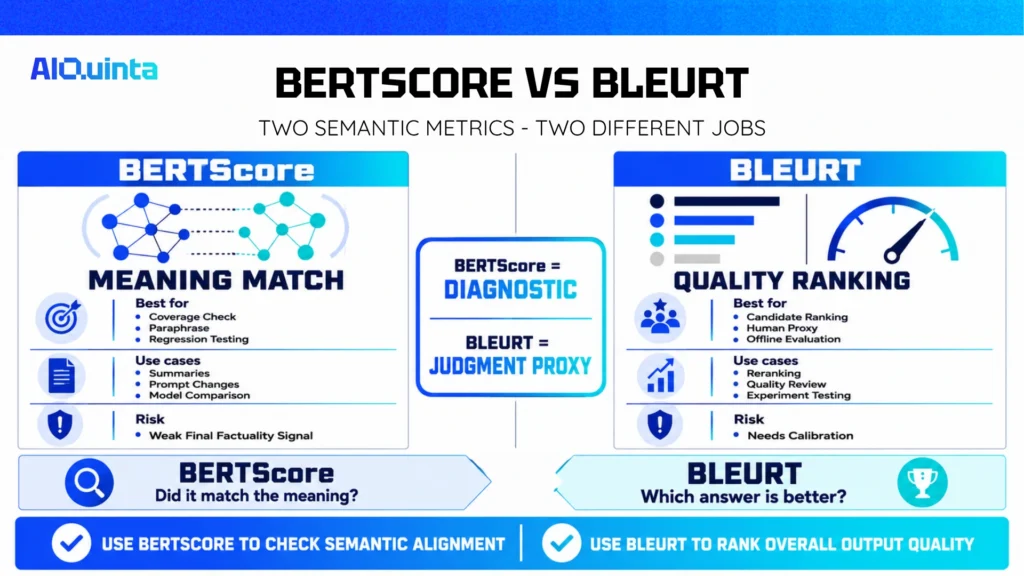
BERTScore is stronger when teams need to understand how a generated output differs from a reference.
BERTScore recall can indicate whether the generated text covers the semantic content of the reference. Precision can indicate whether much of the generated text has weak alignment with the reference.
For example, consider an AI agent that summarizes a maintenance incident.
Reference
Pump P-104 stopped because the inlet pressure fell below the safety threshold. Production resumed after the blocked filter was replaced.
Candidate
Pump P-104 stopped because of low inlet pressure. The maintenance team replaced the filter and restarted production. The failure was caused by operator error.
Most of the candidate matches the reference. The final claim does not.
A combined F1 score may still appear acceptable, but the precision component gives teams a better signal that the candidate added material beyond the reference. This makes BERTScore useful as part of a diagnostic pipeline, not as a final factuality decision.
BERTScore works well for regression testing when an enterprise changes:
Teams can compare score distributions before and after the change, then investigate examples where precision or recall shifts.
BERTScore is useful for summarization, paraphrasing, translation, and response generation when many wordings can express the same meaning.
It is less useful when exact values, exact clauses, fixed terminology, or required fields matter more than semantic equivalence.
BLEURT is stronger when the objective is to rank outputs according to a broader learned notion of quality.
Suppose an enterprise generates five versions of a customer response. All five cover similar facts, but some are awkward, incomplete, or poorly expressed.
BERTScore may place them close together because their semantic content is similar. BLEURT may provide a stronger ranking signal because its training includes human quality judgments and synthetic text degradations.
This makes BLEURT useful for:
Human evaluation is costly and slow. BLEURT can act as a proxy after the organization has confirmed that its scores correlate with the company’s own review rubric.
This condition matters. The official BLEURT documentation notes that scores vary across checkpoints, remain noisy, and should be aggregated across a corpus for robust system evaluation. It also states that adequacy and fluency can become difficult to separate in practice.
BLEURT checkpoints can be fine-tuned with custom rating data. This creates an opportunity for enterprises with mature annotation programs.
A company could collect expert ratings for:
Fine-tuning can improve task alignment, but it also creates model-governance obligations. Teams must version the ratings, annotation rubric, checkpoint, and validation dataset.
| Feature | BERTScore | BLEURT |
|---|---|---|
|
Core Mechanism |
Cosine similarity via greedy matching |
Regression model predicting human scores |
|
Training Needs |
None (Unsupervised similarity) |
Requires fine-tuning on human rating data |
|
Output Metric |
Precision, Recall, and F1 |
Single scalar regression score |
|
Domain Adaptation |
Strong out-of-the-box zero-shot capability |
May require custom fine-tuning for niche domains |
|
Primary Strength |
Computational efficiency and robustness |
High correlation with human fluency judgments |
|
Vulnerability |
Susceptible to antonym/negation blindness |
Checkpoint drift and domain mismatch |
Deploying BERTScore alternatives and semantic metrics is not just an offline testing task; it is a foundational pillar of enterprise knowledge management. If your evaluation metrics are misaligned with business objectives, the automated feedback loops designed to improve your AI models will optimize for the wrong outcomes.
Balancing Cost, Speed, and Accuracy
The most accurate way to evaluate deep nuance and factuality is through an LLM-as-a-judge framework. However, utilizing a frontier model to judge every single generated output across thousands of daily enterprise interactions is computationally prohibitive and prone to latency.
Semantic metrics serve as the crucial intermediate layer. They are significantly less expensive than an LLM-as-a-judge, yet far more capable of handling natural language variance than traditional heuristic metrics.
Integration into Agentic Workflows
In modern AI architectures, evaluation is no longer a static script run by data scientists; it is an automated capability. Organizations package these metrics directly into AI agent skills. A dedicated “Evaluator Agent” can execute BERTScore to monitor baseline semantic drift across production logs.
If an agent detects that the BERTF1 score between a generated summary and a ground-truth reference has dropped below a defined threshold (e.g., $0.85$), the system automatically routes that specific output to a more rigorous, LLM-as-a-judge pipeline to investigate for factual drift.
Protecting the Memory Layer
Evaluation metrics also dictate the quality of data ingested into the system over time. Only high-quality, semantically accurate outputs should be indexed back into the system. Implementing a strict semantic evaluation gate ensures that noisy, low-adequacy responses are filtered out before they can pollute the memory layer in enterprise AI, thereby preserving the integrity of future retrieval tasks.
The difference between BERTScore and BLEURT is a difference in evaluation philosophy.
BERTScore asks whether the candidate covers similar meaning at the token level. BLEURT asks how a learned evaluator may rate the candidate-reference pair as a whole.
BERTScore offers more transparency. BLEURT can offer a stronger learned quality signal. Neither establishes factual truth, compliance, or operational safety.
The practical takeaway is clear: select metrics based on the errors the business cannot afford, calibrate them on internal data, and place them inside a layered evaluation system rather than treating one semantic score as proof of quality.
What is the main difference between BERTScore and BLEURT?
BERTScore directly matches contextual token embeddings between a candidate and reference. BLEURT uses a trained regression model to predict an overall quality score based partly on human rating data and synthetic examples.
Can BERTScore or BLEURT detect AI hallucinations?
No. Both metrics measure semantic similarity or predict human judgment regarding meaning and fluency. They are highly susceptible to lexical overlap and can easily score a factually incorrect statement (such as a negated sentence) highly if it shares the same semantic neighborhood as the reference.
Should enterprises use BERTScore and BLEURT together?
They can be complementary. BERTScore can support semantic diagnostics, while BLEURT can support candidate ranking. Using both is justified only when validation shows that each metric detects useful differences that the other misses.