
Multi-Echelon Inventory Optimization (MEIO): 2 Core Mechanics
- Publised April, 2026
-
Duc Nguyen (Dwight)
Master Multi-Echelon Inventory Optimization (MEIO) to reduce supply chain costs and boost service levels with AI-driven strategies.
Table of Contents
Toggle
Key Takeaways
Holistic Optimization: Unlike traditional methods, MEIO calculates optimal inventory levels across the entire supply chain network simultaneously, rather than in isolated silos.
Cost Reduction: By understanding the interdependencies between nodes, MEIO drastically reduces redundant safety stock, freeing up significant working capital.
Mitigating the Bullwhip Effect: MEIO prevents demand signal distortion as it moves upstream, ensuring smoother production and procurement cycles.
AI Integration: Modern MEIO relies heavily on enterprise AI and machine learning to process massive datasets, handle stochastic demand, and dynamically adjust inventory policies in real time.
Service Level Enhancement: MEIO ensures that the right stock is in the right place at the right time, allowing businesses to meet strict customer Service Level Agreements (SLAs) without overstocking.
Introduction: The Modern Supply Chain Imperative
In today’s hyper-connected, volatile global market, traditional supply chain management techniques are no longer sufficient. Disruptions, fluctuating consumer demand, and complex distribution networks have made inventory management a critical battleground for enterprise profitability. Supply chain leaders are under immense pressure to reduce working capital tied up in inventory while simultaneously improving customer service levels.
This is where Multi-Echelon Inventory Optimization (MEIO) becomes indispensable. By shifting the paradigm from localized, node-by-node guesswork to a holistic, mathematically rigorous network view, MEIO empowers enterprises to strike the perfect balance between cost and availability. In this comprehensive guide, we will explore the mechanics, benefits, AI-driven advancements, and implementation strategies of MEIO to help you transform your supply chain operations.
What is Multi-Echelon Inventory Optimization (MEIO)?
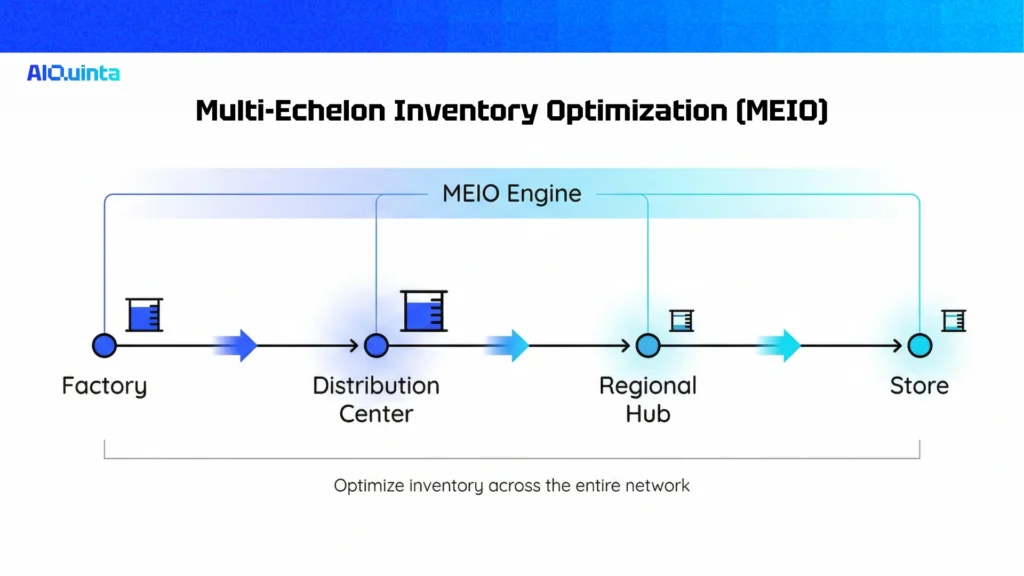
Multi-Echelon Inventory Optimization (MEIO) is an advanced supply chain strategy that determines the optimal inventory levels across every tier (or “echelon”) of a supply chain network simultaneously. An echelon can be a manufacturing plant, a central distribution center (CDC), a regional distribution center (RDC), a retail store, or even an e-commerce fulfillment hub.
Traditional inventory management focuses on optimizing each location independently. In contrast, MEIO recognizes that inventory at one tier acts as a buffer for the tiers upstream and downstream. By applying advanced algorithms to model the entire network’s lead times, demand variability, and cost structures, MEIO identifies exactly where safety stock should be positioned to minimize overall network costs while meeting target service levels.
MEIO vs. Single-Echelon Inventory Optimization
To truly understand the value of MEIO, it is crucial to compare it with the traditional Single-Echelon approach.
| Feature | Single-Echelon Optimization | Multi-Echelon Optimization (MEIO) |
|---|---|---|
|
Scope of View |
Localized (Node-by-Node). |
Holistic (Entire Network). |
|
Safety Stock |
High. Buffers are duplicated at every node to protect against local variability. |
Minimized. Safety stock is strategically placed to protect the entire network. |
|
The Bullwhip Effect |
Highly susceptible. Small demand changes cause massive upstream disruptions. |
Highly resilient. Network-wide visibility absorbs demand shocks effectively. |
|
Cost Efficiency |
Sub-optimal. Capital is trapped in redundant inventory. |
Highly efficient. Frees up working capital by reducing system-wide inventory. |
|
Computational Method |
Simple heuristics, basic statistical models, often managed in spreadsheets. |
Advanced algorithms, AI/Machine Learning, stochastic modeling. |
The Core Mechanics of MEIO in Modern Supply Chains
To leverage MEIO effectively, enterprise leaders must understand the underlying mechanics that make it superior to legacy inventory management solutions.
Overcoming the Bullwhip Effect
The bullwhip effect occurs when small fluctuations in consumer demand at the retail level cause progressively larger fluctuations in demand at the wholesale, distributor, and manufacturer levels. Single-echelon systems exacerbate this because each node forecasts independently and adds its own “just-in-case” safety buffer.
MEIO acts as a shock absorber. Because the optimization engine understands the lead times and inventory states of the entire network, it prevents downstream noise from triggering panic-driven over-ordering upstream. It synchronizes replenishment policies, ensuring that a demand spike at retail is met by a calculated, proportionate response from the CDC.
Demand Variability and Lead Time Buffering
Supply chains deal with two primary types of uncertainty: demand variability (how much will customers buy?) and supply variability (how long will it take suppliers to deliver?). MEIO uses stochastic modeling (probability-based models) to account for these uncertainties simultaneously. Instead of calculating a static reorder point, MEIO dynamically evaluates the cost of holding inventory versus the cost of a stockout at every specific node, factoring in the cascading lead times of the entire network.
Key Benefits of Implementing MEIO
Enterprises that successfully transition to a Multi-Echelon Inventory Optimization strategy typically experience transformative results across both operational and financial metrics.
Significant Working Capital Reduction
By eliminating redundant safety stock across various echelons, companies can reduce their total network inventory by 10% to 30%. This massive reduction directly translates into freed-up working capital, which can be reinvested into R&D, marketing, or other growth initiatives. Furthermore, less inventory means reduced carrying costs, less warehousing space required, and lower risks of obsolescence and spoilage.
Enhanced Customer Service Levels
Paradoxically, reducing inventory through MEIO often increases customer service levels. This is because inventory is no longer stranded at the wrong echelons. MEIO ensures that fast-moving goods are positioned closer to the end consumer, while slower-moving or high-value components are pooled centrally to aggregate demand variability. This strategic positioning maximizes the probability of order fulfillment.
Supply Chain Resilience
In an era of supply chain shocks—from geopolitical tensions to global pandemics—resilience is paramount. MEIO models provide a “digital twin” of your inventory flow, allowing supply chain planners to run “what-if” scenarios. If a key supplier faces a two-week delay, an AI-powered MEIO system can instantly recalculate how to redistribute existing network inventory to mitigate the impact on the end customer.
How AI and Machine Learning Supercharge MEIO
As an enterprise AI solution provider, we recognize that the true potential of MEIO cannot be unlocked with legacy software. The sheer volume of variables in a global supply chain – millions of SKUs, thousands of locations, daily demand shifts – exceeds human cognitive capacity and traditional rule-based computing.
Predictive Analytics for Demand Forecasting
Traditional MEIO relies on historical sales data to predict future demand. AI-driven MEIO incorporates predictive analytics, consuming vast amounts of external data—such as macroeconomic indicators, weather patterns, social media trends, and point-of-sale (POS) data. Machine learning algorithms identify hidden correlations, generating highly accurate, granular demand forecasts that feed directly into the multi-echelon optimization engine.
Dynamic Optimization Algorithms
Supply chains are not static; therefore, inventory policies shouldn’t be either. AI enables dynamic MEIO. Reinforcement learning algorithms continuously monitor the actual performance of the supply chain against the MEIO model’s predictions. When deviations occur (e.g., a port strike extends lead times), the AI autonomously recalibrates safety stock targets, reorder points, and replenishment quantities across all echelons in real-time.
Read more: AI for Sustainable Supply Chain Management
Step-by-Step Guide to Implementing MEIO
Deploying MEIO is a strategic initiative that requires alignment across people, processes, and technology. Here is an enterprise checklist for a successful MEIO rollout:
Step 1: Data Integration and Cleansing
The foundation of any AI-driven optimization is data. You must integrate data from your ERP, WMS (Warehouse Management System), and CRM.
Actionable step: Establish a single source of truth for item master data, historical demand, lead times, bill of materials (BOM), and holding costs. Cleanse data to remove anomalies and fill gaps.
Digitize all data from the production layer to the highest management layer
Embed Agentic AI to Analyze and Optimize Production with AIQuinta.
Embed Agentic AI to Analyze and Optimize Production with AIQuinta.
Step 2: Network Mapping
Before you can optimize the network, you must accurately model it.
Actionable step: Map the physical flow of goods from raw material suppliers to the end customer. Define every echelon, the transportation lanes between them, and the transit times. Create a digital twin of your supply chain architecture.
Step 3: Setting Service Level Targets
Not all SKUs are created equal. You cannot afford to maintain a 99% service level for every item.
Actionable step: Segment your inventory based on profitability, demand velocity, and strategic importance (e.g., ABC-XYZ analysis). Assign specific, realistic service level targets to each segment. The MEIO engine will use these targets to calculate the minimum inventory required to achieve them.
Step 4: Pilot and Phased Rollout
Do not attempt a “big bang” implementation.
Actionable step: Select a specific product line, business unit, or geographic region for a pilot. Run the MEIO model in parallel with your existing system to compare results. Validate the recommendations, build trust with your planning team, and then scale across the enterprise.
Step 5: Continuous Monitoring and Tuning
MEIO is not a “set it and forget it” tool.
Actionable step: Establish KPIs such as inventory turnover ratio, fill rate, and forecast accuracy. Use AI-driven dashboards to monitor performance and allow the machine learning models to continuously refine their parameters based on actual outcomes.
Common Challenges and How to Overcome Them
While the ROI of MEIO is undeniable, enterprises often face hurdles during adoption.
Siloed Organizational Structures
The Challenge: In many organizations, the manufacturing division, the regional warehouses, and the retail teams operate in silos, each possessing their own KPIs and inventory buffers. MEIO requires them to trust a centralized mathematical model.
The Solution: Change management is critical. Executive leadership must align KPIs across departments, shifting the focus from local metrics (e.g., “warehouse utilization”) to global metrics (e.g., “end-to-end cost to serve”).
Legacy Technology Constraints
The Challenge: Older ERP systems lack the computational power and algorithmic sophistication to perform true multi-echelon optimization, often resorting to sequential single-echelon calculations and calling it “network planning.”
The Solution: Invest in cloud-native, AI-powered supply chain planning solutions that integrate seamlessly with your existing ERP via APIs. These modern platforms provide the necessary computing scale and advanced stochastic algorithms required for true MEIO.
Conclusion
Transitioning to Multi-Echelon Inventory Optimization (MEIO) is no longer a luxury for enterprise supply chains; it is a competitive necessity. By moving away from localized, siloed inventory decisions and embracing a holistic, network-wide strategy, businesses can unlock trapped capital, neutralize the bullwhip effect, and deliver superior customer experiences.
When powered by advanced Artificial Intelligence and Machine Learning, MEIO transforms from a static mathematical exercise into a dynamic, autonomous engine that continuously adapts to global volatility. For supply chain leaders looking to build resilience and drive profitability, AI-driven MEIO is the foundational step toward the supply chain of the future.
FAQs
What is the main difference between single-echelon and multi-echelon inventory optimization?
Single-echelon optimization calculates inventory targets for one location at a time without considering the broader network, often leading to duplicated safety stock. Multi-echelon optimization (MEIO) looks at the entire supply chain network simultaneously, placing inventory strategically to minimize overall costs and redundant buffers while meeting service goals.
Can MEIO work for omni-channel retail businesses?
Yes, absolutely. In fact, MEIO is highly beneficial for omni-channel retail. It helps determine the optimal mix of inventory across central fulfillment centers, regional hubs, and brick-and-mortar stores, ensuring that e-commerce orders and in-store demands are met efficiently without overstocking the entire network.
Does implementing MEIO require replacing our current ERP system?
No. Most advanced AI-driven MEIO solutions are designed to sit on top of your existing ERP as a specialized planning layer. They extract the necessary data, perform the complex multi-echelon calculations, and push the optimized inventory policies back into the ERP for execution.
Turn Enterprise Knowledge Into Autonomous AI Agents
Your Knowledge, Your Agents, Your Control
Your Knowledge, Your Agents, Your Control