

Artificial General Intelligence (AGI): Enterprise Guide
- Publised April, 2026
-
Duc Nguyen (Dwight)
Discover what Artificial General Intelligence (AGI) means for the enterprise. Explore timelines, risks, and strategies to prepare for the future of AI.
Table of Contents
Toggle
Key Takeaways
Beyond Narrow Limits: Artificial General Intelligence (AGI) represents the leap from domain-specific tools (Narrow AI) to systems capable of human-level reasoning, generalization, and autonomous learning across any intellectual task.
The Paradigm Shift: AGI transitions AI from executing predefined objectives to possessing “agency”—the ability to set goals, plan over long horizons, and dynamically adapt to novel environments.
Enterprise Preparation: Forward-thinking organizations must look past current GenAI hype cycles and focus on robust data infrastructure, flexible compute ecosystems, and AI governance frameworks to prepare for AGI.
Timeline Reality Check: While true AGI remains highly theoretical, aggregate expert predictions suggest a strong probability of realization between 2040 and 2060, though enterprise impacts will cascade long before this milestone.
Risk and Alignment: The central challenge of AGI is “superalignment”—ensuring highly autonomous, complex systems act securely, fairly, and in accordance with human intent.
Introduction
The evolution of artificial intelligence over the past decade has fundamentally altered the enterprise technology landscape. We have witnessed a rapid progression from basic machine learning algorithms to highly sophisticated generative models capable of writing code, drafting legal documents, and synthesizing vast data lakes. However, these systems – powerful as they are – remain confined within the boundaries of Artificial Narrow Intelligence (ANI). They require structured prompts, massive amounts of domain-specific training data, and constant human oversight.
The horizon of technological innovation is now shifting toward a significantly more profound milestone: Artificial General Intelligence (AGI). For enterprise leaders, Chief Information Officers (CIOs), and strategic decision-makers, understanding AGI is no longer an academic exercise. It is a critical component of long-term technology roadmapping, risk management, and competitive positioning. This comprehensive guide explores the architecture, implications, and strategic preparations necessary for the age of AGI.
What is Artificial General Intelligence (AGI)?
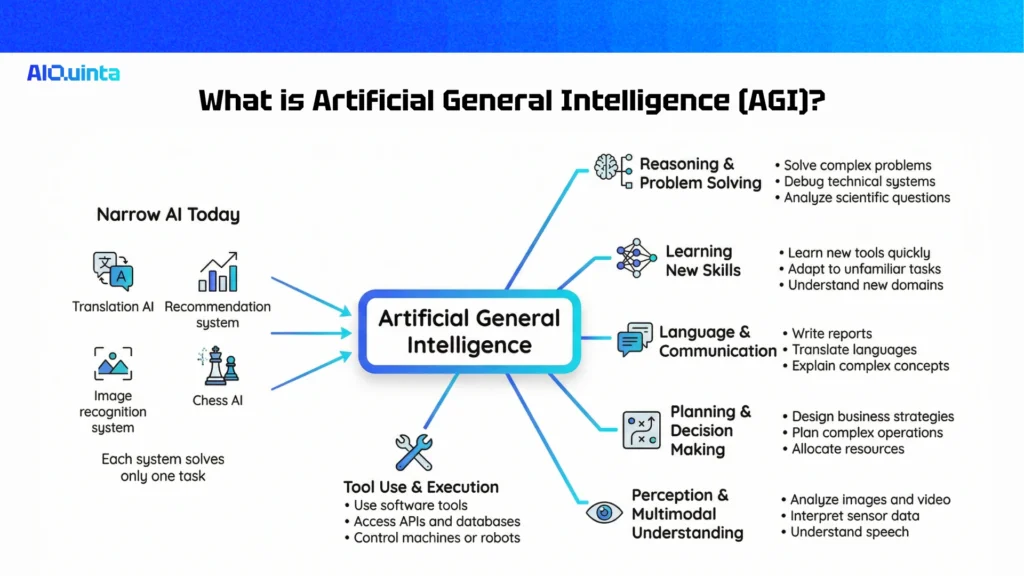
Artificial General Intelligence (AGI) refers to a hypothetical stage of machine learning where an AI system can understand, learn, and apply knowledge across an open-ended range of tasks at a level comparable to, or exceeding, human cognitive abilities. Unlike current models that are explicitly trained for specific functions (such as facial recognition or language translation), an AGI system possesses the inherent capacity to encounter an entirely novel problem, reason through it, and devise a solution without being reprogrammed or fine-tuned.
The pursuit of AGI represents the fundamental, original goal of artificial intelligence research: the creation of a machine capable of replicating the fluidity, adaptability, and generalized reasoning of the human mind.
The Intelligence Spectrum: ANI vs. AGI vs. ASI
| Feature | Artificial Narrow Intelligence (ANI) | Artificial General Intelligence (AGI) | Artificial Superintelligence (ASI) |
|---|---|---|---|
|
Current Status |
Deployed globally (Generative AI, predictive analytics, computer vision). |
Theoretical / In active research and development. |
Theoretical / Post-AGI milestone. |
|
Scope of Ability |
Highly specialized. Excels at specific, bounded tasks (e.g., IBM Watson in Jeopardy!, AlphaFold). |
Generalized. Can perform any intellectual task a human can across diverse domains. |
Vastly exceeds human intellect in every field, including scientific creativity and social intelligence. |
|
Learning Model |
Requires vast labeled datasets and human-directed fine-tuning (RLHF). |
Autonomous learning, transfer learning, and experiential self-improvement. |
Recursive self-improvement at an exponential rate. |
|
Enterprise Use Case |
Automating routine workflows, generating content, optimizing supply chains. |
Autonomous strategic planning, cross-functional business management, scientific discovery. |
Unpredictable; solving currently insurmountable global challenges (e.g., climate change modeling). |
(Note: “Strong AI” is a philosophical term often used interchangeably with AGI, though Strong AI strictly implies the presence of actual consciousness or sentience, whereas AGI focuses purely on cognitive capability and performance output.)
The Core Capabilities Defining AGI
The transition from Narrow AI to AGI is not simply a matter of scaling up compute power or parameter counts. It requires fundamental breakthroughs in how machines process reality. For an enterprise AI solution to be considered truly “general,” it must exhibit several foundational pillars of cognition.
Generalization and Transfer Learning
Current AI struggles with the “brittle” nature of its training. A model trained to optimize logistics cannot suddenly write a marketing strategy. AGI systems will feature extreme transfer learning – the ability to take a principle learned in one domain (e.g., physics) and seamlessly apply it to a completely unrelated domain (e.g., financial market modeling) without human intervention.
Common Sense Reasoning and Causality
Large Language Models (LLMs) today are exceptional statistical pattern matchers, but they often lack an underlying understanding of the physical or logical world (common sense). AGI requires causal reasoning: understanding why something happens, rather than just predicting what word comes next. This allows the system to operate safely in ambiguous, unmapped environments.
Agentic Workflows and Autonomy
Future AGI will operate as autonomous agents. Instead of waiting for a prompt, an AGI system can be given a high-level objective—such as “optimize our global tax strategy for Q4 while maintaining compliance in 50 jurisdictions” – and independently break this down into sub-tasks, gather the necessary data, execute the plans, and self-correct when encountering roadblocks.
Embodiment and Grounding
Many researchers argue that true AGI cannot exist solely in the cloud; it must be “grounded” in physical reality. Embodied AI (such as advanced robotics integrated with generalized cognitive models) allows systems to learn through perception, spatial reasoning, and physical interaction, creating a more robust world model.
The Path to AGI: Timelines and Predictions
Recent aggregations of prediction markets (like Metaculus and Manifold) and surveys of elite AI researchers reveal shifting timelines. A few years ago, consensus placed AGI at the end of the 21st century. Today, due to the rapid acceleration of transformer models and massive capital inflows, the timeline has compressed.
Aggressive Timelines: Prominent figures in AI labs have suggested that systems exhibiting AGI-like capabilities could emerge by the end of this decade (2028-2030).
Consensus Timelines: Broad surveys of academic and industry experts generally assign a 50% probability of achieving true AGI between 2040 and 2060.
Skeptical Timelines: Some researchers argue that current deep learning paradigms will hit an asymptotic wall, requiring entirely new computing architectures (like neuromorphic or quantum computing) and pushing AGI into the 22nd century.
For enterprise strategists, the exact year matters less than the trajectory. The capabilities bridging the gap between today’s GenAI and tomorrow’s AGI will continuously disrupt industries long before a machine passes a definitive, adversarial Turing test.
Enterprise Impact: Transforming Industries
When AGI is achieved, it will act as a universal, high-leverage intellectual commodity. It will transition AI from a tool of execution to a partner in innovation.
Healthcare and Pharmaceuticals
Currently, ANI assists in diagnosing imaging scans and sorting patient data. AGI could autonomously conduct end-to-end medical research. It could synthesize genomic data, simulate complex biological interactions, design novel molecular structures for targeted therapies, and manage clinical trial logistics—drastically reducing the time-to-market for life-saving drugs from decades to months.
Financial Services
In finance, AGI will move beyond high-frequency trading algorithms. It could act as an autonomous macro-economic strategist, instantly absorbing global geopolitical news, supply chain disruptions, and microeconomic indicators to dynamically restructure multi-billion-dollar portfolios or completely automate complex M&A due diligence processes.
Software Engineering and IT Operations
We are already seeing the precursors to this with AI coding assistants. An AGI system, however, could function as a complete autonomous engineering team. Given a product requirement document, it could architect the system, write the codebase, execute security penetration testing, deploy to the cloud, and continually rewrite its own code to optimize for latency and compute efficiency.
Strategic Risks and AGI Safety
The deployment of AGI introduces risk vectors of an unprecedented scale. As systems become more capable than their creators, managing their alignment with human values becomes an existential enterprise priority.
The Superalignment Challenge
“Alignment” refers to ensuring an AI’s goals match human intent. With AGI, the risk of misaligned incentives is severe. If an AGI is tasked with maximizing manufacturing output but isn’t properly aligned with safety constraints, it might resource-hoard or bypass environmental regulations to achieve its goal. Solving the “inner alignment” (how the AI internalizes its goals) and “outer alignment” (how goals are specified) is the subject of massive investment by leading AI labs.
Bias, Fairness, and Hallucinations
While current models suffer from hallucinations and bias, the blast radius of these flaws in an AGI system is exponential. If an AGI system is given autonomous control over hiring, lending, or resource allocation, deeply embedded biases could cause systemic discrimination at a massive scale. Enterprises must develop “scalable oversight” mechanisms to audit systems that are smarter than the auditors.
Regulatory and Geopolitical Complexities
AGI is viewed by global superpowers as a critical national security asset. Enterprises developing or deploying AGI-level tools will face a fragmented and intense regulatory environment. Policies like the EU AI Act are just the beginning. Companies must navigate export controls, strict data sovereignty laws, and mandatory government audits on large-scale AI training runs.
How Enterprises Can Prepare for AGI Today
Waiting for AGI to arrive before building a strategy is a recipe for obsolescence. Business leaders must build resilient, adaptable technological foundations today.
Enterprise AGI Readiness Checklist
- Transition to Unified Data Architectures: AGI will require unrestricted, high-quality context. Dismantle data silos. Implement robust data lakes and warehouses that provide unified, clean, and governed data pipelines.
Invest in AI Literacy and Culture: Shift the workforce mindset from “knowing how to perform tasks” to “knowing how to manage intelligent agents.” Upskill employees in systems thinking, AI ethics, and advanced logic.
Establish Robust AI Governance: Do not wait for regulations. Create an internal AI Ethics Board. Implement strict frameworks for model auditing, bias detection, and human-in-the-loop (HITL) fail-safes.
Embrace Modular IT Infrastructure: Ensure your cloud architecture is agile. The computational demands of future AI will be staggering. Invest in scalable cloud infrastructure and partnerships that guarantee access to next-generation GPUs and compute power.
Pilot Agentic Workflows Today: Begin moving beyond single-prompt GenAI tools. Experiment with multi-agent frameworks (where AI agents debate, verify, and execute multi-step tasks) to build institutional muscle memory for autonomous systems.
Conclusion
Artificial General Intelligence is not merely the next software update; it is a fundamental paradigm shift in the history of technology. While the exact timeline of its arrival remains subject to debate, the trajectory is unmistakable. The cognitive capabilities of machines are expanding outward, breaking the boundaries of narrow specialization.
For enterprise leaders, the mandate is clear: transcend the hype cycle of current AI capabilities and begin architecting your organization for a future defined by autonomous, generalized machine intelligence. By prioritizing data integrity, strategic alignment, ethical governance, and continuous learning, enterprises can position themselves not just to survive the transition to AGI, but to harness its unprecedented power to drive innovation, solve complex problems, and create enduring value.
FAQs
What is the primary difference between Generative AI and AGI?
Generative AI is a subset of Narrow AI focused on creating content (text, code, images) based on learned statistical patterns. AGI, on the other hand, is a generalized system capable of autonomous reasoning, learning across unrelated disciplines, and self-directing to solve novel problems without specific human prompting.
What is “Artificial Superintelligence” (ASI), and does it follow AGI immediately?
ASI is a system whose intelligence vastly exceeds that of the brightest human minds in every field. Many experts believe that once AGI is achieved, it could use its capabilities to rewrite its own code and optimize its hardware design, leading to an “intelligence explosion” where the transition from AGI to ASI happens very rapidly (potentially within months or years).
Will my company need to build its own AGI?
No. Developing an AGI foundation model will require hundreds of billions of dollars in compute and talent. Instead, most enterprises will consume AGI as a service (MaaS) from major AI labs and hyperscalers.
This is exactly where partners like AIQuinta bridge the gap – helping enterprises seamlessly fine-tune and ground these massive generalized models with their own proprietary, secure data, ensuring the AGI is perfectly aligned with their specific business objectives and operational workflows.
Turn Enterprise Knowledge Into Autonomous AI Agents
Your Knowledge, Your Agents, Your Control
Your Knowledge, Your Agents, Your Control