

Autoresearch vs Meta-Harness: The Future of Self-Optimizing AI Systems
- Publised April, 2026
-
Duc Nguyen (Dwight)
Explore the differences between Autoresearch and Meta-Harness. How these autonomous AI frameworks optimize models and research loops.
Table of Contents
Toggle
Key Takeaways
Distinct Optimization Targets: Autoresearch focuses on automating the Machine Learning training loop (e.g., tweaking PyTorch models), whereas Meta-Harness optimizes the code wrapping an LLM (prompts, retrieval algorithms, and state updates).
Architectural Approaches: Autoresearch utilizes a straightforward Git-based propose-train-evaluate cycle with fixed time budgets. Meta-Harness relies on sophisticated, filesystem-backed raw trace analysis to dynamically refine agent behavior.
Human Involvement: Both frameworks remove human engineers from the tedious “benchmaxing” loop, shifting their role from manual tweaking to setting high-level directions and objectives.
Enterprise Fit: Autoresearch is ideal for AI research labs and teams training custom foundation models. Meta-Harness is crucial for MLOps and product teams deploying complex, highly reliable agentic applications.
The Rise of Autonomous AI Optimization
In the rapidly accelerating landscape of enterprise artificial intelligence, manual optimization has become a critical bottleneck. Historically, AI engineers spent the majority of their time executing a repetitive cycle: guessing an improvement, writing the code, running the evaluation, and logging the results. Whether it was tweaking hyperparameters for a machine learning model or refining prompt templates for a coding agent, this “benchmaxing” loop was slow, expensive, and limited by human bandwidth.
Enter the era of autonomous AI optimization. Frameworks like Autoresearch and Meta-Harness represent a paradigm shift in how AI systems are built and refined. By utilizing large language models (LLMs) and agentic frameworks to act as “proposers” and “evaluators,” these tools allow AI to optimize its own architecture and wrappers. For enterprise AI solution providers, understanding when and how to deploy Autoresearch versus Meta-Harness is essential for scaling AI capabilities and driving superior performance without linearly scaling engineering headcount.
This comprehensive guide will break down the technical mechanics, use cases, and strategic value of both frameworks, ensuring your enterprise makes data-driven architectural decisions.
What is Autoresearch? Core Principles and Mechanics
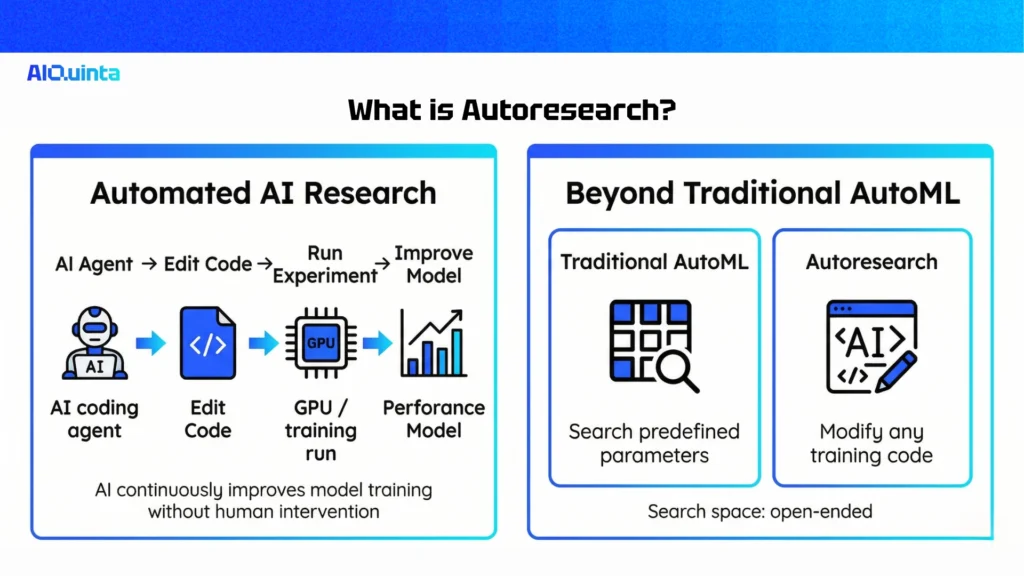
Autoresearch, pioneered by Andrej Karpathy, is an open-source framework designed to automate machine learning research. It is an agentic loop that continuously edits training code, runs short experiments, and autonomously lowers validation loss without human intervention.
Unlike traditional AutoML tools that search through a predefined grid of hyperparameters, Autoresearch provides the AI agent with the freedom to modify arbitrary code. The search space is entirely open-ended, limited only by what the coding agent can conceive.
The Three-File Contract
Autoresearch operates on a strict, highly controlled architectural pattern known as the three-file contract, which ensures the agent remains focused and evaluations remain objective:
- train.py (The Sandbox): This is the implementation file that the AI agent is allowed to modify freely. It contains the model architecture, optimizer settings, and training loop.
- prepare.py (The Immutable Evaluator): This file is locked. It evaluates the outputs of train.py and returns a definitive score (usually validation bits-per-byte, or val_bpb). The agent cannot alter the grading rubric.
- program.md (The Human Direction): Written by a human engineer, this markdown file defines the broad research direction, constraints, and priorities for the AI agent to follow.
The Git-Based Ratchet Loop
The core of Autoresearch is its elegant “ratchet” mechanism. The system executes a propose-train-evaluate cycle based on a strict time budget (e.g., exactly 5 minutes per run).
- The agent reviews past results and hypothesizes an improvement.It alters train.py and commits the change to a Git branch.
- The training script runs for the fixed budget.
- If the result improves, the commit is kept.
- If it regresses or crashes, the system automatically executes a git reset, discarding the failure and starting fresh.
Best Use Cases for Autoresearch
Autoresearch is highly effective for core model engineering. Enterprise teams building custom SLMs (Small Language Models), fine-tuning proprietary architectures, or replicating complex models can leverage this framework to run hundreds of experiments overnight. It excels in environments where the primary objective is mathematical optimization (lowering loss) and the search space requires creative, code-level architectural tweaks rather than simple parameter adjustments.
What is Meta-Harness? Revolutionizing Agent Engineering
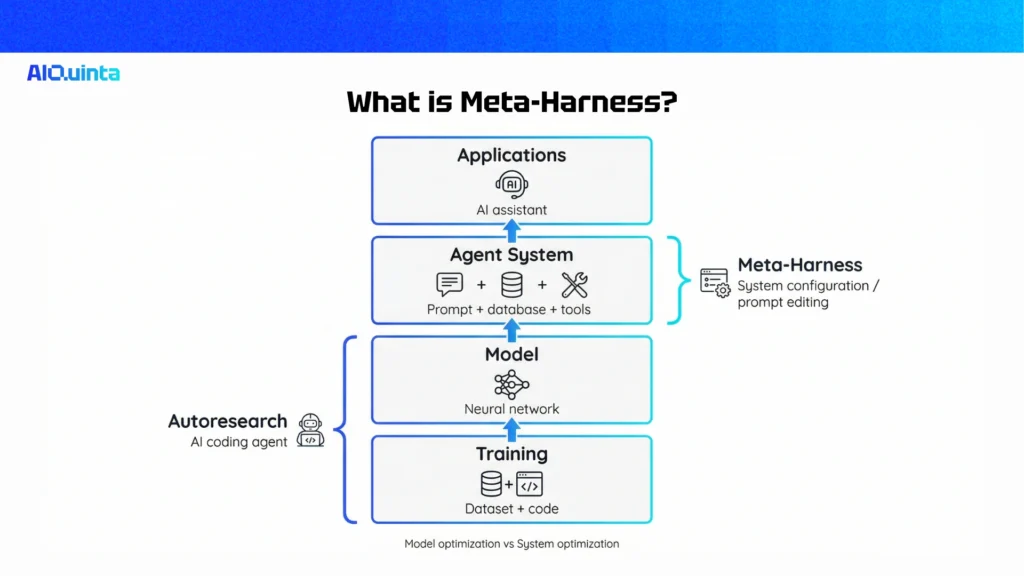
While Autoresearch optimizes the machine learning model itself, Meta-Harness optimizes the system around the model. Developed through research by Stanford, KRAFTON, and MIT in early 2026, Meta-Harness is an end-to-end framework for automating the optimization of model “harnesses.”
A harness is the executable environment wrapping an LLM. It includes prompt construction templates, Retrieval-Augmented Generation (RAG) strategies, context management rules, state updates, and tool-use logic.
The Problem with Manual Harness Design
In production, two agentic systems using the exact same underlying LLM can exhibit vastly different levels of performance. One might follow complex instructions perfectly, while the other drifts off-topic or hallucinates. This performance gap is almost always due to the harness. Yet, despite its importance, harness engineering has historically been a manual, hand-crafted process prone to human error and bias.
Meta-Harness removes the human from this loop. It treats the harness code itself as the optimization target, allowing an AI “proposer” to dynamically rewrite the wrapper to achieve better accuracy, reliability, and token efficiency.
Filesystem-First Trace Analysis
The most crucial innovation of Meta-Harness is its reliance on raw execution traces. Traditional optimization frameworks compress agent performance into lossy summaries or single-number scores. Meta-Harness, conversely, provides its proposer agent with direct filesystem or SQL access to the entire execution history.
When evaluating a regression, the proposer agent can use tools (like grep or SQL queries) to comb through millions of tokens of raw logs, agent outputs, tool calls, and error messages. By identifying the exact line of prompt code or retrieval logic that caused an error, the agent hypothesizes a targeted artifact change. This evidence-grounded approach allows Meta-Harness to outperform hand-designed state-of-the-art systems (like Agentic Context Engineering) by significant margins, often utilizing fewer context tokens.
Best Use Cases for Meta-Harness
Meta-Harness is the definitive tool for application layer optimization. Enterprise AI teams deploying autonomous coding agents, customer support bots, complex RAG pipelines, or automated CRM optimization tools should rely on Meta-Harness. It is exceptionally well-suited for improving an agent’s out-of-distribution (OOD) generalization and ensuring reliable execution in messy, real-world business scenarios.
Autoresearch vs. Meta-Harness: A Deep Dive Comparison
To better understand which framework aligns with your enterprise architecture, review the detailed comparison below.
| Feature / Aspect | Autoresearch | Meta-Harness |
|---|---|---|
|
Optimization Target |
Core ML Model architecture and training scripts. |
LLM Wrappers/Harnesses (Prompts, RAG, tool logic, context). |
|
Primary Beneficiary |
ML Researchers, Model Training Teams. |
AI App Developers, MLOps, Agent Engineers. |
|
State & Memory Management |
Lightweight Git-based (commit / reset). Essentially stateless between loops. |
Complex, filesystem or SQL-backed. Deep memory of execution traces. |
|
Evaluation Speed |
Fixed time budget (e.g., 5-minute training loops). |
Variable, task-based evaluation across diverse datasets/scenarios. |
|
Feedback Mechanism |
Binary validation loss metric. |
Multi-dimensional scoring (Accuracy, Context Cost, Token usage). |
|
Implementation Environment |
Single GPU, highly constrained local environments. |
Multi-agent setups, scalable across distinct task environments. |
Best Practices for Implementing Optimization Frameworks in the Enterprise
Deploying autonomous optimization frameworks requires strict governance to prevent runaway costs and degraded system integrity. Follow these best practices when integrating Autoresearch or Meta-Harness into your enterprise AI stack:
Establish Clear, Immutable Baselines
For both frameworks, the evaluation grading rubric must be mathematically sound and entirely isolated from the agent’s reach. In Autoresearch, this means locking down prepare.py. In Meta-Harness, this means curating a diverse, highly representative set of benchmark tasks that accurately reflect your business use cases. If the evaluation metric is flawed, the AI will autonomously optimize toward the wrong goal at lightning speed.
Implement Strict Sandboxing and Cost Control
Autonomous loops can consume massive amounts of compute if left unchecked.
For Autoresearch: Enforce strict wall-clock limits on training runs to ensure consistent cadence and prevent infinite loops.
For Meta-Harness: Utilize secure, containerized Virtual Filesystems (VFS). Ensure each candidate harness runs in an isolated environment so that a buggy proposal cannot corrupt the global trace archive. Additionally, set hard caps on API token usage to prevent the proposer agent from generating massive cloud billing spikes.
Maintain a Human-in-the-Loop Strategy for Major Merges
While the optimization loop itself should be autonomous, merging the final results into a production environment should not be. Treat the output of both Autoresearch and Meta-Harness as a highly credible “Pull Request.” A senior engineer should review the generated architecture or prompt changes to ensure they do not introduce subtle security vulnerabilities or violate enterprise compliance standards.
Conclusion
The transition from manual tuning to autonomous self-improvement is the most critical leap an enterprise AI team can make today. By leveraging Autoresearch, ML teams can rapidly discover novel model architectures and push the boundaries of validation loss while they sleep. Meanwhile, application and MLOps teams can deploy Meta-Harness to turn brittle, hand-crafted agent wrappers into robust, self-healing, and highly efficient AI applications.
Understanding the distinction between optimizing the model versus optimizing the harness is the key to building scalable, enterprise-grade AI solutions. By strategically deploying both frameworks in their respective domains, forward-thinking enterprises can achieve an unprecedented competitive advantage in the AI space.
FAQs
What is Autoresearch in AI?
Autoresearch is an automated experimentation framework where an AI agent proposes modifications to a system, runs experiments, evaluates results, and iteratively improves performance.
What is Meta-Harness?
Meta-Harness is a framework that automatically optimizes the harness architecture of AI systems, allowing agents to redesign their own execution environment.
Can Autoresearch and Meta-Harness be used together in the same pipeline?
Yes, but they operate at entirely different layers of the stack. An enterprise could theoretically use Autoresearch to fine-tune a custom base model’s weights, and then deploy Meta-Harness to optimize the prompt wrappers and tool-calling logic that interacts with that newly trained model in a production application.
Turn Enterprise Knowledge Into Autonomous AI Agents
Your Knowledge, Your Agents, Your Control
Your Knowledge, Your Agents, Your Control