

 Duc Nguyen (Dwight)
Discover the core differences between AI agent skills and capabilities. Learn how enterprise teams scale agentic AI workflows in practice.
Table of Contents
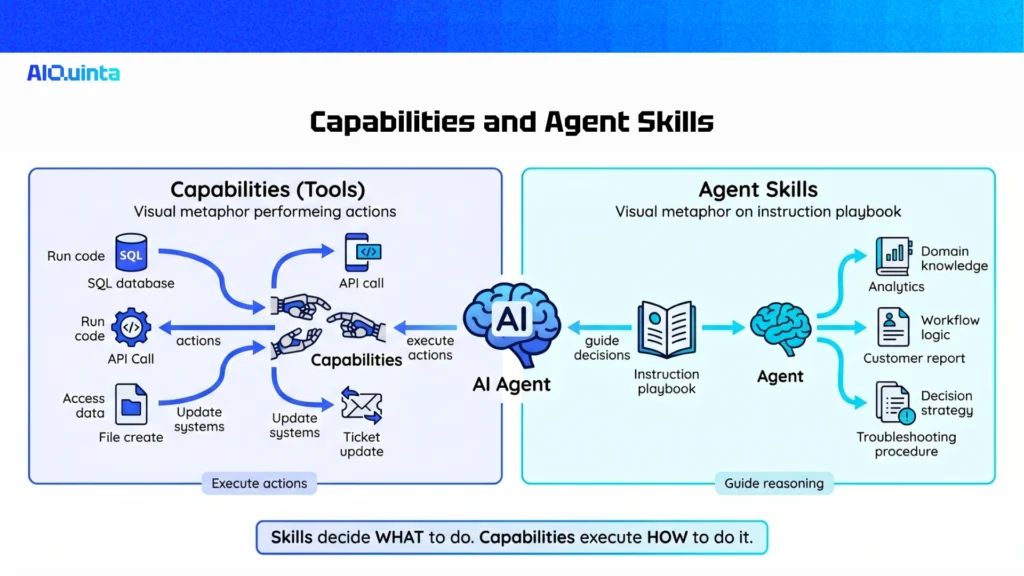
Toggle Capabilities (Tools) are for execution: They are the “hands” of the AI agent, providing deterministic, executable functions like querying a database or calling an API.
Skills are for expertise: They are the “training” of the agent, acting as modular, portable packages of procedural knowledge and domain expertise that shape how an agent reasons.
Progressive disclosure is essential: Instead of bloating system prompts, modern agentic architectures dynamically load skills only when necessary to preserve token economics and model focus.
Standardization is the future: Frameworks like the Model Context Protocol (MCP) and open skill formats are bridging the gap between reasoning models and enterprise systems.
In the rapidly evolving world of AI agents, terminology matters. “Agent skills” and “agent capabilities” are often used interchangeably in casual discussions, yet they address fundamentally different layers of agent architecture. Clarifying this distinction is the first step toward building production-grade enterprise AI that is reliable, scalable, and maintainable.
Capabilities – widely known as “tools” in frameworks – are the operational layer of your AI architecture. If the agent is the brain, capabilities are the hands.
A capability is a well-defined, executable function with strict inputs, predictable outputs, and tangible side effects. When an agent invokes a capability, something happens in the real world: a file is written, a Jira ticket is updated, or an SQL database is queried.
Key characteristics of capabilities:
Deterministic: They execute specific code (e.g., Python scripts, REST API calls).
System-agnostic: They do not think or reason; they simply perform the action requested by the agent.
Governed by integration protocols: Capabilities are increasingly standardized through frameworks like the Model Context Protocol (MCP), acting as secure routers between the agent and enterprise data.
If capabilities are the hands, agent skills are the agent’s professional training. A skill is a portable, self-contained unit of domain knowledge, procedural logic, and behavioral patterns.
Skills do not execute code directly. Instead, they provide the agent with the context and the strategy needed to approach a specific problem. A skill tells the agent when and how to use its available capabilities. For instance, a “Churn Analysis Skill” wouldn’t query the database itself; it would instruct the agent on the exact statistical methodology to use, the tone to adopt in the final report, and which database capabilities to invoke to gather the data.
Key characteristics of skills:
Declarative: Often written in plain text, Markdown, or YAML (e.g., SKILL.md), making them accessible to subject matter experts.
Modular: They can be version-controlled, shared across different agents, and updated centrally.
Contextual: They guide reasoning, sequencing, and judgment.
To model these concepts effectively, it helps to map them to a traditional corporate organization:
The Agent: The Director. Receives a business objective, decides on a high-level strategy, and orchestrates the workflow.
The Skill: The Subject Matter Expert. Possesses specialized, procedural knowledge on how to accomplish a specific task according to company standards.
The Capability (Tool): The Software/Machinery. The actual CRM, scanner, or database used to execute the work.
Enterprise deployments demand predictability, compliance, auditability, and cost control. Treating everything as a monolithic capability creates context pollution and vendor lock-in. Modeling skills separately delivers:
Start by mapping the smallest executable actions.
These usually correspond to:
Each skill should have clear inputs, outputs, and constraints.
Next, group related skills into meaningful competencies.
A capability represents a business outcome, not just technical functionality.
Example capability:
Customer Support Resolution
Skills involved:
This layer connects technical execution with business value.
Capabilities rarely involve a single linear process.
Instead, they often require decision logic and conditional paths.
A capability workflow may include:
Many agent platforms now represent this structure using capability graphs or agent workflow diagrams.
Enterprise deployments require strong guardrails.
Capabilities should define:
For example:
A finance capability may allow database access but prohibit external API calls.
Governance ensures agents operate safely within enterprise environments.
As agent systems mature, organizations are moving toward capability graph architectures.
Instead of isolated skills, agents operate through networks of connected competencies.
A capability graph describes:
Benefits of this architecture include:
Large AI platforms increasingly adopt this model because it aligns with enterprise software design principles.
You need the agent to interact with an external system (APIs, file systems, internal databases).
The action is highly deterministic with clear, programmatic inputs and outputs.
You need strict audit trails and IT access controls over the action.
The feature needs to be shared across multiple different LLM models or agentic frameworks.
You need to capture human domain expertise, workflows, or company-specific SOPs.
The task requires nuanced judgment, reasoning, and sequencing of multiple different tools.
You are trying to reduce token overhead caused by bloated, complex tool schemas.
The logic will frequently change and should be maintained by non-developers (SMEs).
Example 1: Financial Reporting
The Capabilities: Query_SQL_Database(), Export_to_PDF().
The Skill: “Quarterly Revenue Analysis.” This skill instructs the agent to first query the database for Q1 and Q2 revenue, calculate the quarter-over-quarter growth, format the findings using the company’s official financial terminology, and finally use the export tool to generate a report.
Example 2: Security Incident Triage
The Capabilities: Fetch_Data_Logs(), Block_IP_Address().
The Skill: “Suspicious Login Triage.” This skill teaches the agent the security team’s protocol: “If an IP is from a known VPN and fails login 5 times, it is low risk. If it succeeds after 5 failures, it is high risk. Fetch the logs, apply this logic, and alert a human before executing the block IP tool.”
The transition from simple AI assistants to autonomous agent systems requires a shift in architecture.
Skills and capabilities represent two different layers of this architecture.
Skills define how an agent performs individual actions, while capabilities define what the agent can achieve through orchestrated workflows.
Organizations that model this distinction clearly gain several advantages:
As enterprise AI adoption accelerates, capability-based agent design is becoming the foundation for building intelligent, operational AI systems.
What is the difference between agent skills and capabilities?
Agent skills are atomic actions an agent can execute, such as retrieving data or summarizing text. Capabilities are higher-level competencies that combine multiple skills to achieve a specific outcome.
Why should AI agents separate skills and capabilities?
Separating skills and capabilities improves scalability, governance, and maintainability. It allows organizations to reuse skills across multiple capabilities and manage complex workflows more effectively.
What is a capability graph in agent architecture?
A capability graph represents how different agent capabilities interact and which skills they depend on. It provides a visual and structured framework for designing agent systems.