


Web Search AI Agent Query Planning: Intent to Iteration
- Publised June, 2026
-
Duc Nguyen (Dwight)
Learn how a Web search AI agent plans search queries through intent analysis, search operators, query fan-out, iteration and source validation.
Table of Contents
Toggle Key Takeaways
- Query planning turns a broad user request into focused search actions.
- Intent classification decides whether the agent needs facts, comparisons, sources, updates, or proof.
- Operators such as exact match, site search, file type, date, and source filters improve precision.
- Iteration is useful only when each new search reduces uncertainty.
- Enterprise-grade search agents need cost limits, source rules, fallback logic, logs, and evaluation metrics.
What is AI Search Query Planning?
AI search query planning is the process an AI agent uses to decide what to search, how to search, where to search, and when to stop.
The counterargument is simple: many teams treat web search as a tool call. The user asks a question. The agent sends one query. The search API returns links. The model summarizes them.
That workflow works for simple questions. It fails for enterprise research, technical due diligence, regulatory checks, market intelligence, product comparison, vendor analysis, and any task where the answer is spread across many sources.
A Web search AI agent needs a stronger operating model. It must understand the user’s intent, break the task into sub-questions, choose query patterns, inspect results, identify gaps, and refine the next search. This is where query planning becomes a core agent capability.
In practice, the planning layer answers five questions:
- What does the user need to know?
- What evidence would prove the answer?
- Which sources are likely to contain that evidence?
- Which query structure should retrieve those sources?
- Has the agent found enough reliable information to answer?
Without this layer, web search becomes noisy retrieval. With it, search becomes controlled investigation.
Why Query Planning Matters for Web Search AI Agents
A Web search AI agent operates in a live information environment. That environment changes every day. Product pricing changes. API documentation changes. Regulations change. Competitors launch new features. News stories evolve. Search results also include spam, copied content, outdated pages, thin affiliate posts, and AI-generated summaries with weak sourcing.
This creates a business risk. If an agent retrieves low-quality sources and summarizes them with confidence, the output looks useful but can be wrong.
Query planning reduces that risk. It gives the agent a repeatable process for finding the right evidence before generating an answer.
For enterprise AI teams, this matters across several workflows:
- Competitive intelligence: compare market claims across official websites, reviews, press releases, and analyst reports.
- Technical research: find current API limits, SDK updates, bug reports, and release notes.
- Sales enablement: research accounts, industries, pain points, and recent company signals.
- Compliance monitoring: track policy changes, enforcement updates, and jurisdiction-specific rules.
- Procurement: compare vendors by pricing, implementation model, security posture, and customer proof.
The goal is not to make the agent search more. The goal is to make each search more intentional.
How Query Planning Works in a Web Search AI Agent
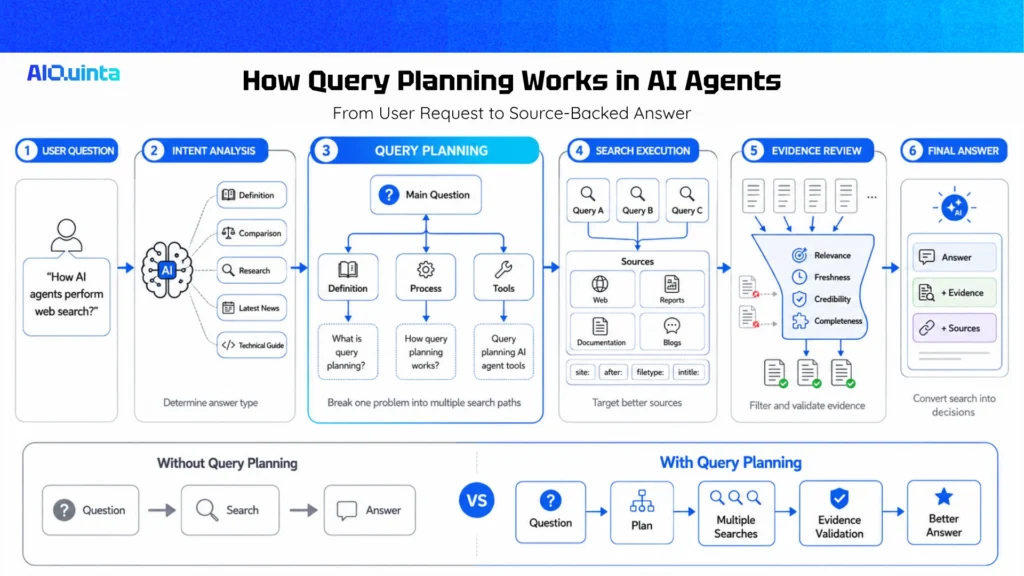
Query planning is the process an AI agent uses to turn a user request into a structured search strategy. Instead of sending one broad query to a search engine, the agent analyzes intent, breaks the topic into smaller questions, builds targeted queries, tests the results, and improves the search until it has enough reliable evidence.
The strongest counterpoint is that query planning can make the search process slower. That is true if the agent creates too many queries without clear rules. In a strong system, query planning should reduce wasted searches, improve source quality, and help the agent reach a better answer with fewer weak results.
Step 1: Understand Search Intent
The agent first identifies what the user wants to achieve. The request may need a definition, comparison, current update, technical explanation, source-backed answer, or workflow.
For example, “what is query planning?” needs a clear definition. “How an AI agent plans search queries” needs a process. “Best Web search AI agent tools” needs current product data and comparison criteria.
This step keeps the agent focused on the right answer type.
Step 2: Break the Request Into Search Paths
The agent then divides the topic into smaller questions.
For “how an AI agent plans search queries,” the search paths may include:
- What query planning means
- How intent detection works
- How queries are generated
- How search operators improve results
- How results are reviewed and refined
This gives the agent broader coverage than one broad keyword search.
Step 3: Build Targeted Queries and Use Operators
After defining the search paths, the agent creates a query set.
Examples include:
“query planning for AI agents”
“AI agent query planning web search”
“agentic search query planning”
“query fan-out AI search”
“iterative retrieval search agent”
The agent can also use operators to improve precision, such as exact match, site:, filetype:, after:, and exclusion terms.
| Operator | Purpose | Example |
|---|---|---|
|
Exact match |
Search for a fixed phrase |
“query planning” “AI agent” |
|
OR |
Include related terms |
“AI search agent” OR “agentic search” |
|
site: |
Search within a trusted domain |
site.aiquinta.ai “query planning” |
|
filetype: |
Find reports or PDFs |
filetype “AI search agent” |
|
intitle: |
Target specific page titles |
intitle:“query planning” AI |
|
after: |
Search recent pages |
after:2025 “AI search agent” |
|
– |
Exclude irrelevant results |
“web search agent” -job -course |
This helps the agent find stronger sources and avoid irrelevant results.
Step 4: Review Results and Refine the Search
The agent should not answer based on search snippets alone. It needs to inspect the sources and check whether the results answer the real question.
It should assess:
- Relevance
- Freshness
- Source credibility
- Evidence quality
- Conflicting claims
- Missing information
If the results are weak or incomplete, the agent refines the query. Each new search should close a clear gap. If it does not add useful evidence, the agent should stop iterating.
Step 5: Synthesize the Answer From Reliable Evidence
The final step is turning the search results into a useful answer.
A strong response should answer the original question, separate facts from interpretation, mention uncertainty when needed, and rely on credible sources.
This is where query planning creates business value. The agent does not just retrieve links. It converts search activity into a clear, source-backed output that supports better decisions.
Common Failure Modes in AI Search Query Planning
Even advanced search agents fail when planning is weak.
Over-Broad Queries
- A query like “AI search” returns too much noise. The agent may retrieve AI search engines, SEO articles, product pages, and unrelated news.
- Fix: add entities, intent terms, and source constraints.
Over-Narrow Queries
- A query with too many exact-match phrases may miss useful sources.
- Fix: balance precision with recall. Run one precise query and one broader semantic query.
Source Drift
- The agent starts with a technical question but ends up reading marketing pages.
- Fix: use domain priority rules and source-type filters.
Looping
- The agent keeps searching without gaining new evidence.
- Fix: add iteration budgets and novelty checks.
Shallow Snippet Dependence
- The agent summarizes search snippets instead of reading full pages.
- Fix: require source opening and claim-level extraction for important answers.
No Fallback Logic
- If the LLM creates a malformed query or a search tool fails, the workflow breaks.
- Fix: add fallback queries, default filters, and error handling.
Enterprise Guardrails for Query Planning
For production use, query planning needs governance.
A strong Web search AI agent should include:
- Source policy: which domains are trusted, allowed, blocked, or low priority.
- Freshness policy: when the agent must search recent sources.
- Cost policy: query limits, token limits, and parallel search limits.
- Security policy: prompt injection checks and unsafe content filters.
- Evidence policy: minimum number of sources by risk level.
- Logging policy: store query plan, search calls, selected sources, and reasoning summary.
- Evaluation policy: test search outcomes against known-answer datasets.
The planner should also expose its process. Enterprise users need to know why the agent searched certain sources and why it trusted specific evidence.
This is not only about transparency. It is about operational control.
Conclusion
AI search query planning is the control layer behind a reliable Web search AI agent. It turns a user request into a structured search strategy, then adapts that strategy based on evidence.
The core workflow is clear: classify intent, decompose the request, choose operators, retrieve sources, evaluate evidence, iterate with purpose, and stop when the answer is supported.
This matters because live web access alone does not make an agent trustworthy. The web contains current information, but also noise, bias, duplication, outdated pages, and unsupported claims.
For enterprise teams, query planning should be treated as a core capability inside the agent architecture. It affects accuracy, latency, cost, governance, and user trust. The strongest systems will not be the agents that search the most. They will be the agents that know exactly what to search, why to search it, and when to stop.
FAQs
What is query planning in a Web search AI agent?
Query planning is the process an AI agent uses to turn a user request into specific search queries, source targets, operators, and iteration steps. It helps the agent search with purpose instead of sending one broad query.
How does an AI agent plan search queries?
An AI agent plans search queries by identifying user intent, breaking the question into sub-questions, selecting search operators, retrieving sources, reviewing results, and refining the next query based on what it finds.
Why are search operators useful for AI agents?
Search operators help AI agents control search precision. They can limit results to specific domains, exact phrases, file types, titles, dates, or source categories. This reduces noise and improves retrieval quality.
Turn Enterprise Knowledge Into Autonomous AI Agents
Your Knowledge, Your Agents, Your Control
Your Knowledge, Your Agents, Your Control
Related Articles


Latest Articles