
Model Context Protocol (MCP)? The USB-C of Enterprise AI
- Publised April, 2026
-
Duc Nguyen (Dwight)
Discover how the Model Context Protocol (MCP) works, its core architecture, use cases and why it is the new standard for Agentic AI integrations.
Table of Contents
Toggle
Key Takeaways
- Model Context Protocol (MCP) provides a standardized interface for AI models to access external tools, APIs, and data sources.
- It reduces the complexity of custom integrations between AI agents and enterprise systems.
- MCP enables modular, interoperable AI ecosystems, where agents can dynamically connect to capabilities.
- The protocol separates model reasoning from system integration, improving reliability and scalability.
- Enterprises can use MCP to deploy secure, auditable AI agent infrastructures across internal services.
What is Model Context Protocol (MCP)?
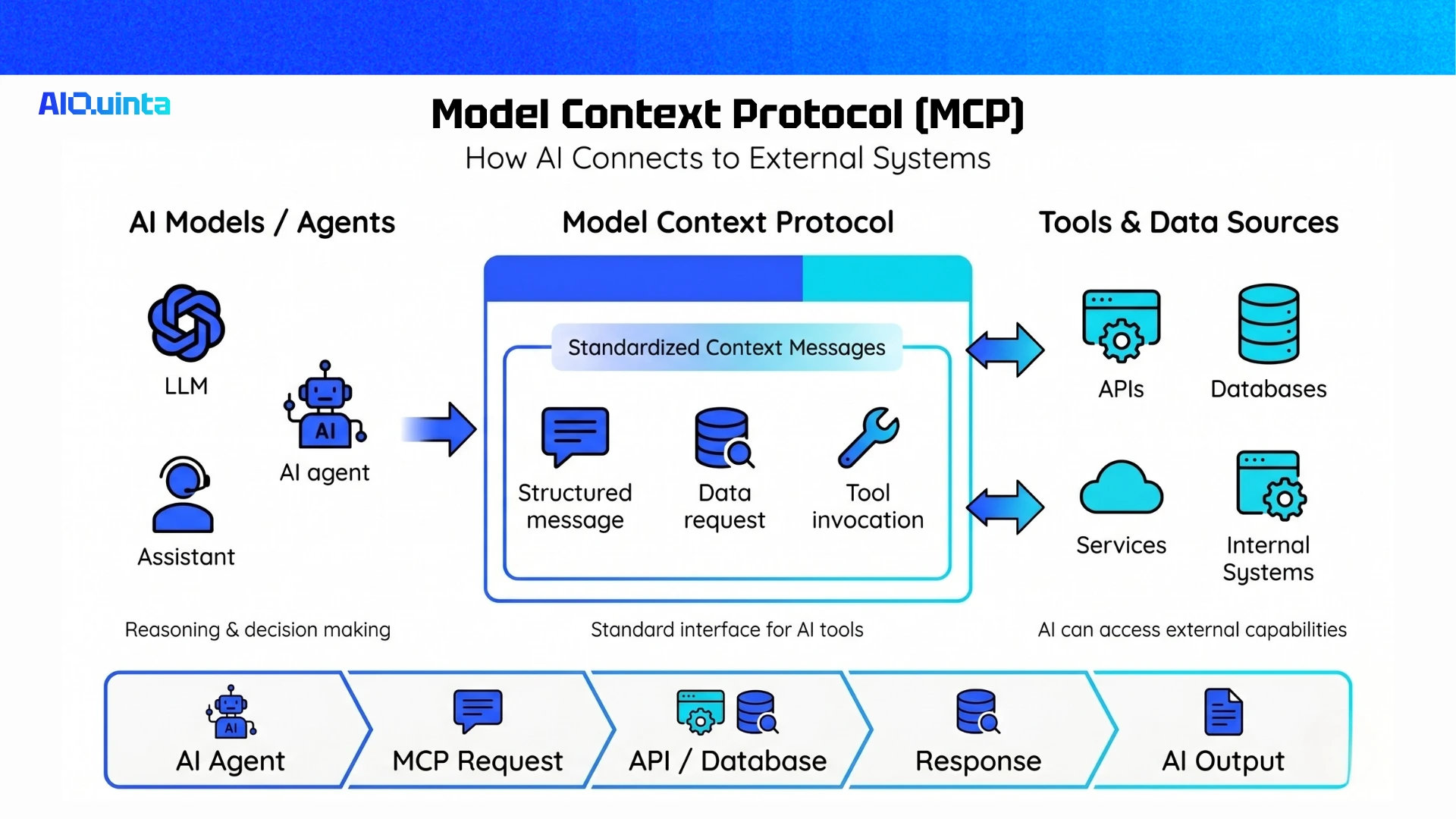
Model Context Protocol (MCP) is an open standard that defines how AI models interact with tools, data sources, and services through structured context exchange.
The protocol acts as a bridge between:
- AI models (LLMs or agent systems)
- External capabilities (APIs, databases, services)
- Execution environments
Instead of embedding integrations directly into the AI application, MCP allows systems to expose capabilities through standardized endpoints.
An AI agent can then request information or perform actions using those endpoints through structured context messages.
The History and Rapid Adoption of MCP
Anthropic announced and open-sourced MCP on November 25, 2024, as a direct response to the limitations of isolated LLMs. The protocol was quickly donated to the Agentic AI Foundation (under the Linux Foundation) in December 2025, co-founded by Anthropic, Block, and OpenAI, ensuring vendor-neutral governance.
Adoption has been explosive. Major clients include Claude Desktop, ChatGPT, VS Code, Cursor, Replit, Zed, and Sourcegraph. Pre-built MCP servers now exist for Google Drive, Slack, GitHub, Postgres, Puppeteer, and more. Enterprises like Block and Apollo were early adopters, citing dramatic reductions in integration time and improved agent reliability. By early 2026, MCP had become the de-facto standard for agentic AI, with support across Python, TypeScript, C#, Java, and cloud deployments (Cloudflare, Google Cloud Run, Kubernetes).
MCP vs. RAG, Function Calling, and Traditional APIs (Comparison Table)
| Aspect | MCP | RAG | Function Calling | Traditional APIs |
|---|---|---|---|---|
|
Primary Goal |
Standardized two-way actions & context |
Passive document retrieval |
One-off tool invocation |
Custom, hard-coded endpoints |
|
Data Access |
Real-time, dynamic, actionable |
Static knowledge base |
Pre-defined functions |
One-way, manual integration |
|
Standardization |
Universal open protocol |
Technique (not a protocol) |
Vendor-specific |
None |
|
Security Model |
User consent, least-privilege, OAuth |
Prompt injection risks |
Varies by implementation |
Credential sprawl |
|
Best For |
Agentic workflows, automation |
Factual Q&A, summarization |
Simple, single-model tasks |
Legacy integrations |
Key Benefits of MCP for Developers, Enterprises, and End Users
- Reduced Hallucinations & Higher Accuracy: LLMs pull fresh, authoritative data instead of guessing.
- True Agentic Capabilities: Multi-step automation (e.g., “Analyze Q1 sales from Postgres, update CRM, and email the team”).
- Developer Productivity: Write one MCP server → works with every compatible AI client. No more N×M boilerplate.
- Scalability & Cost Savings: Dynamic discovery eliminates custom connectors; cloud-native deployments (serverless or Kubernetes) handle enterprise scale.
- Interoperability: Model-agnostic—Claude, GPT, Gemini, open-source LLMs all benefit equally.
- Future-Proofing: Open governance under Linux Foundation prevents vendor lock-in.
How the Model Context Protocol Works: Architecture and Core Components
MCP follows a clean client-server architecture with three primary roles:
- MCP Host: The AI application or IDE (e.g., Claude Desktop, Cursor, or a custom agent) where the LLM lives and the user interacts.
- MCP Client: Embedded in the host, it discovers available servers, translates LLM intents into standardized JSON-RPC calls, and handles responses.
- MCP Server: Lightweight service exposing resources (data), tools (actions), and prompts (templates). Servers connect to real systems (databases, APIs, file systems) and return structured results.
Communication uses JSON-RPC 2.0 over two transports:
- stdio (local, fast, synchronous—ideal for desktop/IDE use).
- SSE (Server-Sent Events) (remote, real-time streaming for cloud deployments).
Key interaction flow:
- Client discovers tools/resources via tools/list.
- LLM decides which to use based on natural-language query.
- Client invokes via tools/call (with user consent prompt).
- Server executes and streams results back.
- LLM reasons over the output and continues.
This bidirectional, stateful design supports complex, multi-step agent workflows that traditional one-shot function calling cannot match.
Accelerating Agentic AI and Advanced RAG Systems
The introduction of MCP acts as a massive accelerant for two of the most critical trends in enterprise technology: Agentic AI and Retrieval-Augmented Generation (RAG).
Advancing Multi-Agent Systems
Orchestration frameworks have paved the way for autonomous agents, but they historically struggled with standardized tool execution. MCP acts as the ultimate “hands” for these multi-agent systems. Because MCP standardizes how tools are discovered and invoked, multi-agent frameworks can now dynamically assign tasks to specialized agents (e.g., a coding agent, a research agent, a QA agent), knowing that each agent can seamlessly interface with any required external software via its respective MCP server.
Upgrading RAG Architectures
Traditional RAG relies on chunking documents, embedding them into a vector database, and performing semantic search to provide context to an LLM. While effective for static document retrieval, it struggles with highly dynamic or relational data.
MCP revolutionizes this by allowing RAG architectures to connect directly to the source of truth. Instead of querying a potentially stale vector index, an AI agent can use an MCP server to execute a direct SQL query on a live database, access the most recent commit in a GitHub repository, or pull real-time sensor data. This ensures that the context provided to the LLM is perfectly accurate, contextually deep, and completely up-to-date.
How to Get Started with MCP: Step-by-Step Implementation Guide
- Choose Your Role: Build a server (expose tools) or integrate as a client/host.
- Install SDKs: Official support for Python, TypeScript, C#, Java (via modelcontextprotocol.io).
- Run Pre-Built Servers: Start with official ones for Google Drive, Slack, Postgres, etc., via Claude Desktop.
- Build Your First Server: Define resources/tools/prompts in JSON schema; implement handlers.
- Test Locally: Use stdio transport in Claude Desktop or Cursor.
- Deploy Remotely: Cloud Run, Kubernetes, or Cloudflare for production.
- Integrate OAuth (for enterprise): Use libraries like Stytch for seamless user consent.
- Monitor & Iterate: Leverage built-in error handling and observability.
Checklist for Secure MCP Deployment:
- Use only signed, trusted MCP servers.
- Implement human-in-the-loop approval for sensitive actions.
- Enable comprehensive logging and auditing.
- Apply least-privilege permissions and regular permission reviews.
- Monitor for prompt injection and supply-chain risks (verify server code signatures).
- Prefer local stdio for high-security environments; use remote SSE only with strong auth.
Conclusion
Model Context Protocol (MCP) introduces a critical infrastructure layer for modern AI systems.
By standardizing how models access tools, data, and services, MCP reduces integration complexity and enables modular AI architectures.
For enterprises building AI agents, the protocol offers a scalable foundation for connecting models with operational systems.
As AI adoption accelerates, standards like MCP will likely play a central role in shaping the next generation of enterprise AI platforms.
FAQs
What is Model Context Protocol (MCP)?
Model Context Protocol is a standard that defines how AI models connect to external tools, services, and data sources through structured context exchanges.
How does MCP differ from APIs?
APIs expose services to developers. MCP exposes capabilities to AI models, enabling them to discover and use tools dynamically.
Why is MCP important for AI agents?
AI agents require access to external capabilities to perform tasks. MCP provides a standardized and scalable way to integrate those capabilities into agent workflows.
Turn Enterprise Knowledge Into Autonomous AI Agents
Your Knowledge, Your Agents, Your Control
Your Knowledge, Your Agents, Your Control