
What is a Capability Graph in AI Agent Architecture?
- Publised April, 2026
-
Duc Nguyen (Dwight)
Discover what a capability graph is. How it optimizes routing, scales multi-agent systems and enhances enterprise AI solutions.
Table of Contents
Toggle
Key Takeaways
-
A capability graph is a structural framework used in multi-agent AI systems to map out the specific tools, skills, and sub-agents available, alongside their dependencies.
-
It solves the context bottleneck: Instead of overwhelming a single Large Language Model (LLM) with hundreds of tool descriptions, the graph allows an orchestrator to dynamically route tasks only to the relevant nodes.
-
It relies on Directed Acyclic Graphs (DAGs): Workflows are structured to ensure prerequisites are met before subsequent agents or tools are triggered.
-
Enterprise scalability: Implementing capability graphs allows organizations to build modular, secure, and highly predictable AI systems that out-perform monolithic prompt engineering.
Introduction to Agentic Architecture and Tool Routing
As enterprise AI transitions from simple chatbots to autonomous, task-executing agents, the underlying architecture has grown exponentially more complex. Early iterations of AI agents relied on monolithic structures: a single Large Language Model (LLM) was prompted with a massive list of available tools (e.g., web search, SQL querying, CRM access) and asked to reason through which tool to use.
While this works in prototyping, it fails in enterprise production. Giving an LLM access to 100+ tools degrades its reasoning ability, consumes massive amounts of the context window, increases latency, and drastically spikes token costs. Furthermore, it introduces significant security and hallucination risks.
To solve this orchestration bottleneck, AI engineers introduced multi-agent systems. But how do these systems know which agent should do what, and in what order? This is where the capability graph becomes the foundational blueprint of modern agent architecture.
Defining the Capability Graph: The Core Concept
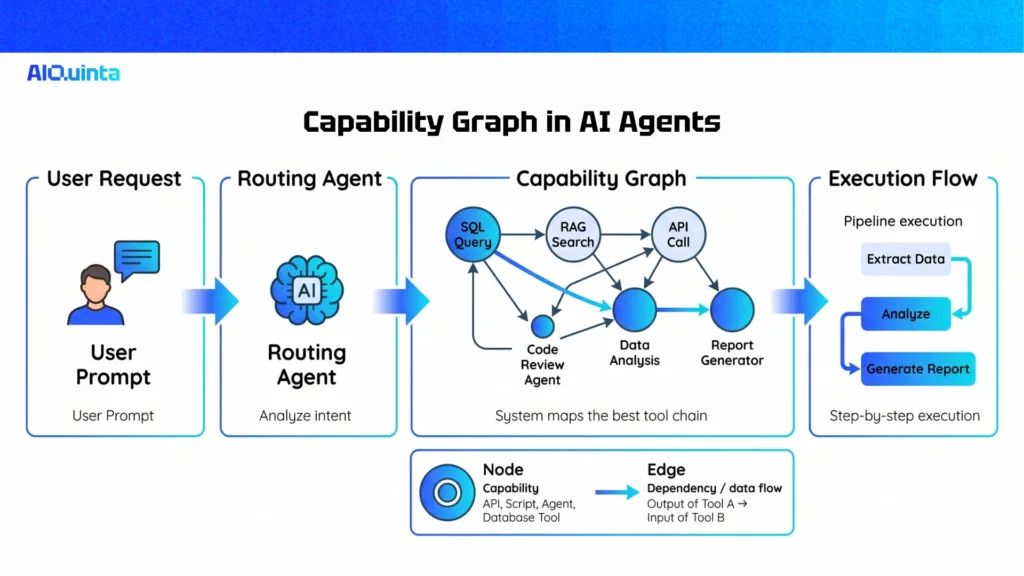
In AI agent architecture, a capability graph is a mathematical and logical representation of what a system can do and how those abilities relate to one another. It shifts the burden of tool selection from probabilistic LLM guessing to deterministic, structured routing.
At its core, a capability graph maps the entire ecosystem of tools, APIs, and specialized sub-agents available to the system. When a user submits a complex prompt, a specialized “routing agent” analyzes the intent and traverses this graph to assemble a customized, step-by-step execution plan.
Nodes vs. Edges in Capability Graphs
To understand a capability graph, you must break it down into its fundamental graph theory components:
-
Nodes (The “What”): Every node in the graph represents a distinct, atomic capability. This could be a specific Python script, an API, a RAG (Retrieval-Augmented Generation) pipeline querying internal documents, or even an entirely separate specialized LLM agent (e.g., a “Code Review Agent”).
-
Edges (The “How”): The edges (the lines connecting the nodes) represent the relationships, constraints, and dependencies between capabilities. For example, if Node B is an agent that analyzes financial data, and Node A is a tool that extracts data from a SQL database, the edge indicates that Node A must successfully execute and pass its output to Node B.
How It Differs from Traditional Decision Trees
It is easy to confuse a capability graph with a traditional software decision tree, but they are fundamentally different. A decision tree is a rigid, hard-coded sequence of “if/then” statements. If a user asks X, the system always does Y.
A capability graph, however, is dynamic. The orchestrating LLM uses the graph as a map, not a script. It can dynamically piece together a novel path through the nodes to solve a problem it has never encountered before, provided the edges (dependencies) allow for that path. This is typically structured as a Directed Acyclic Graph (DAG), ensuring that there are no infinite loops and that data flows in a logical progression toward task completion.
Why Enterprise AI Needs Capability Graphs
Modern AI agents move beyond single-turn responses to multi-step, stateful workflows. A capability graph provides the missing structural layer:
- Explicit Dependency Modeling: Agents no longer guess tool sequences; the graph encodes them.
- Emergent Capability Discovery: New abilities arise automatically via closure computation—no manual reprogramming required.
- Safety and Governance: You can audit whether a goal is reachable without violating constraints (e.g., data-privacy rules).
- Orchestration Foundation: Frameworks like LangGraph, CrewAI extensions, and Salesforce Agentforce build directly on graph topologies where nodes are specialized agents or decision points.
How a Capability Graph Works in Practice
Step 1: Intent Parsing and Node Matching (Semantic Routing)
A user inputs a prompt: “Generate a Q3 revenue report for our European division, translate the summary into German, and email it to the regional director.”
The master Orchestrator Agent does not try to do this all at once. First, it uses semantic search to map the user’s intent to the capabilities in the graph. It identifies three necessary nodes:
-
Node 1: Financial SQL Database Query Tool.
-
Node 2: Language Translation Agent.
-
Node 3: Outlook API Email Tool.
Step 2: Dependency Resolution (Building the DAG)
Next, the Orchestrator examines the edges between these nodes to build a sequential plan. It understands that Node 3 (Email) cannot fire until it has the output from Node 2 (Translation), which in turn requires the output from Node 1 (Data Query). It constructs a temporary Directed Acyclic Graph for this specific task.
Step 3: Execution and Feedback Loops
The system begins execution.
-
It activates Node 1. The SQL tool runs and returns raw data.
-
The data travels along the edge to a hidden synthesis node (where an LLM writes the report).
-
The English report is passed to Node 2, which translates it.
-
Finally, the German text and the director’s contact info are passed to Node 3, and the email is sent.
If any node fails (e.g., the SQL database times out), the graph structure allows the orchestrator to route to a “Fallback Node” (like querying a cached data layer or asking the user for clarification) without the entire system crashing.
Real-World Enterprise Use Cases
Capability graphs are not just theoretical; they are actively powering complex enterprise solutions today.
-
Advanced Customer Support: A telecommunications AI uses a graph to differentiate between billing issues and technical support. If a user asks about a router reboot, the graph routes the request through technical diagnostic nodes. If the diagnostic node finds no network outages, an edge directs the flow to a “Schedule Technician” node.
-
Supply Chain Optimization: An agent tasked with predicting inventory shortages uses a graph to first pull weather data (Node A), route it to a predictive analytics model (Node B), and then trigger automated purchase orders in SAP (Node C) if thresholds are met.
-
Automated Software Engineering: Platforms like AIQuinta utilize capability graphs to orchestrate coding tasks. A “Product Manager Agent” drafts specs (Node A), passes them to a “Developer Agent” to write code (Node B), which is then automatically routed to a “QA Agent” to run tests (Node C). If tests fail, an edge routes it back to Node B.
More about AIQuinta – The Agent Archetype Feature
Capability Graphs vs. Agentic Graph Systems
Many industry discussions blend or evolve the concept into agentic graph systems – execution architectures where:
- Nodes = specialized AI agents (each owning a subset of capabilities).
- Edges = directed flows based on state, outcomes, or policies.
- Layers include knowledge graphs for context, control planes for governance, and observability for auditing.
Key differences:
- Capability graph → declarative model of what is possible.
- Agentic graph system → runtime execution engine that orchestrates multiple agents using the capability model.
Popular implementations combine both: the capability graph defines the legal topology, while the agentic runtime enforces it with retries, fallbacks, and human-in-the-loop gates.
Conclusion
A capability graph is a structural framework that organizes what an AI agent can do and how those abilities connect.
By mapping capabilities into a network of nodes and relationships, capability graphs enable agents to execute tasks through logical, governed workflows rather than isolated tool calls.
As organizations deploy agents across operational systems, capability graphs will become a core component of enterprise-grade agent architectures, supporting the transition from experimental AI assistants to fully operational agentic platforms.
FAQs
What is the purpose of a capability graph in AI agents?
A capability graph organizes an agent’s abilities into a structured network so the agent can execute tasks through logical workflows instead of random tool calls.
How is a capability graph different from a tool list?
A tool list is flat and unstructured. A capability graph introduces relationships, dependencies, and execution logic between capabilities.
What is the difference between a capability graph and a knowledge graph in agent architecture?
A capability graph models what the agent can do (skills/tools and their composition rules). A knowledge graph models domain data (entities and relationships). They are complementary: the capability graph decides which actions to take; the knowledge graph supplies the rich context for those actions.
Turn Enterprise Knowledge Into Autonomous AI Agents
Your Knowledge, Your Agents, Your Control
Your Knowledge, Your Agents, Your Control