


BMS Data Normalization: A Common Data Layer for AI
- Publised September, 2026
-
Duc Nguyen (Dwight)
Learn how BMS data normalization turns inconsistent points into a governed semantic layer for analytics, AI agents, and multi-building operations.
Table of Contents
Toggle
Key Takeaways
- BMS data normalization must preserve point meaning, asset relationships, units, control roles, source identity, and provenance. Renaming points is insufficient.
- Automated BMS point mapping works best as a hybrid pipeline combining deterministic rules, equipment templates, telemetry analysis, semantic constraints, and human review.
- Multi-building portfolios need a canonical model with controlled local extensions. Forcing every site into an inflexible naming convention creates hidden errors.
- Measure normalization through mapping accuracy, relationship completeness, downstream application success, onboarding effort, and metadata drift, not point coverage alone.
BMS data normalization is more than point renaming
Point normalization often starts with naming conventions because names are visible. Yet a clean name can conceal incorrect semantics.
Consider two points called CoolingValvePosition. One may be the command sent to an actuator. The other may be physical position feedback. Both can use a 0-100% range, but they have different operational meaning. Treating them as equivalent could hide a failed actuator because the commanded position would be mistaken for evidence that the valve moved.
A usable common data layer should retain at least the following:
| Field | What it establishes |
|---|---|
|
Immutable source identity |
Original point name, controller, protocol, object type, address, and source system |
|
Canonical classification |
Sensor, setpoint, command, status, alarm, parameter, or computed point |
|
Asset and location context |
The equipment, subsystem, room, zone, floor, and building associated with the point |
|
Measurement semantics |
Quantity, unit, scale, polarity, valid range, sampling interval, and timezone |
|
Relationships |
What the equipment serves, contains, feeds, controls, or is controlled by |
|
Governance metadata |
Mapping source, confidence, reviewer, schema version, quality state, and modification history |
How to map BMS points: a seven-stage method
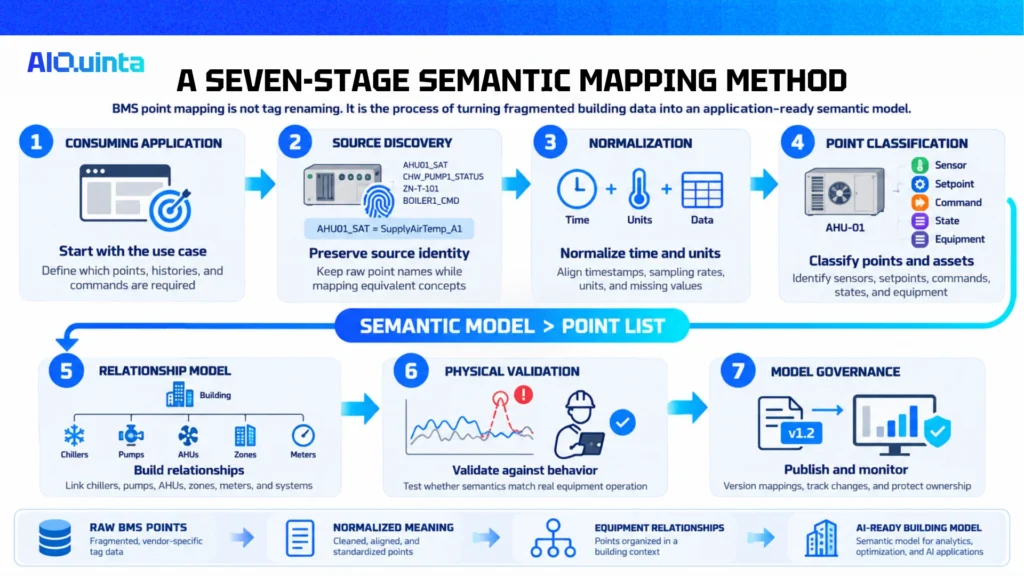
Stage 1: Start with the consuming application
BACnet is designed to support vendor-independent communication among building automation equipment. However, a BACnet logo does not prove that a platform can access the points, histories, commands, and equipment relationships required by its models.
Ask vendors to demonstrate connections to the actual controllers and BMS versions in the target portfolio. Test:
- Which objects and trend histories can be read
- Which setpoints can be written
- How serial or low-bandwidth networks are protected
- Whether local edge buffering handles network loss
- How timestamps, units, sampling rates, and missing values are processed
- Whether integrations and raw data can be exported
The platform should also support secure enterprise data connections to systems such as meters, weather feeds, occupancy tools, CMMS, asset registers, and approved business data.
Stage 2: Discover data without destroying source identity
Multi-site portfolios rarely use one naming convention. A supply-air temperature point may appear as AHU01_SAT, SupplyAirTemp_A1, or a vendor-specific code. These labels must map to the same operational concept before portfolio analytics can work.
Open initiatives such as Brick Schema and Project Haystack exist to standardize building assets, points, and relationships. The buyer does not need to mandate one schema in every case, but the vendor must show a consistent semantic model.
Ask how much mapping requires manual engineering, how mappings are validated, and how templates transfer to similar sites. The resulting model should remain accessible to the building owner.
Stage 3: Normalize units, time, and primitive values
A useful fault should include more than an alarm label. It should identify the affected asset, supporting signals, likely cause, duration, operational impact, confidence, and recommended next check.
During evaluation, introduce known faults or use historical incidents. Test whether the platform can distinguish a failed sensor from a physical equipment fault. Verify how it suppresses duplicate alerts and groups symptoms under one probable root cause.
An unexplained anomaly score may help a data scientist. It gives a facility technician little basis for action.
Stage 4: Classify points and equipment
A vendor should separate four permissions:
- Read data
- Generate recommendations
- Request human approval
- Write approved values within defined limits
Life-safety sequences and hard equipment protections must remain in local deterministic controls. The AI layer should not override smoke control, freeze protection, pressure cut-outs, or other protected logic.
Require setpoint limits, approval rules, timeout behavior, rollback, command logging, and a clear fallback to normal BMS operation when the AI service or network becomes unavailable.
Stage 5: Build relationships, not a flat tag catalog
AI building software for multi-site portfolio operations must support more than a combined dashboard.
Look for reusable equipment templates, portfolio hierarchies, regional access rights, time-zone handling, tariff and weather normalization, cross-site benchmarking, and bulk deployment controls. A local operating exception should not require a separate software fork for each building.
Measure how long it takes to onboard the tenth site, not only the first. The cost and effort curve reveal whether the architecture can scale.
Stage 6: Validate semantics against physical behavior
A fault has no business value until someone resolves it. The platform should connect analysis with the CMMS or service workflow, assign ownership, preserve evidence, and verify whether the repair changed performance.
It should also connect telemetry with manuals, commissioning records, control sequences, service notes, and approved procedures. This is where enterprise knowledge management can help operators understand why a recommendation was produced and what action is permitted.
Stage 7: Publish, version, and monitor the model
A portfolio platform creates a new connection between enterprise software and operational technology. The risk rises when it can write to controllers.
Evaluation should cover asset inventory, network segmentation, identity management, least-privilege roles, multi-factor authentication, encryption, audit logs, vulnerability management, remote support, data residency, retention, and incident response. CISA treats an accurate OT asset inventory as a foundation for risk assessment and secure operations.
Contracts should state that the operator owns its raw data, semantic mappings, histories, decisions, and derived records. Confirm the format and cost of a full export at termination.
Automate BMS point mapping without removing accountability
Automation should narrow the engineering search space, not eliminate engineering judgment.
A strong pipeline combines several methods:
- Deterministic rules handle known abbreviations, object types, units, and naming patterns.
- Equipment templates reuse verified mappings across repeated AHUs, VAVs, meters, or packaged units.
- Time-series features help distinguish sensors, commands, status points, schedules, and cumulative values.
- Retrieval-assisted language models interpret irregular labels and supporting documents.
- Ontology constraints reject impossible classes or relationships.
- Confidence routing sends ambiguous or high-risk candidates to a reviewer.
An NREL-associated study combining point names and time-series methods correctly applied approximately 85-90% of tags in a retail dataset, but 70-75% in an office-building dataset. The variation is the operational lesson: accuracy does not transfer uniformly across sites and naming conventions. Review the research methodology.
Recent approaches such as Point2Brick and BMS-RAG show how confidence-aware agents and retrieved examples can improve classification. Enterprises should still calibrate acceptance thresholds using a representative, engineer-reviewed validation set. A model’s self-reported confidence is not evidence of correctness.
Normalize data across buildings without erasing local reality
A multi-site model should have a canonical core and controlled local overlays.
The core defines shared equipment classes, point roles, units, relationship types, asset identifiers, and quality states. Local overlays capture legitimate differences such as tenant-specific zones, unusual plant arrangements, proprietary equipment, regional units, and inherited naming conventions.
Reusable templates should be organized by equipment family, control sequence, vendor, and deployment generation. When a template is reused, the system should record which mappings were inherited and which were locally overridden.
This approach supports portfolio comparison while preventing a common failure: forcing two mechanically different assets into the same model simply because both are called an AHU.
How to evaluate a BMS normalization platform
| Decision criterion | Evidence to request | Warning sign |
|---|---|---|
|
Source lineage |
Demonstration from canonical point back to controller and protocol address |
Raw identities are replaced or difficult to export |
|
Semantic depth |
Queries that traverse equipment, spaces, systems, and points |
Product supports labels but not relationships |
|
Automated mapping quality |
Held-out validation results, confusion matrix, confidence calibration, and reviewer workflow |
Accuracy claims are based only on the training portfolio |
|
Data validation |
Unit, range, relationship, duplication, telemetry, and regression tests |
Quality is measured only as percentage of points tagged |
|
Portability |
Export in documented, non-proprietary formats with stable identifiers |
The normalized model works only inside one vendor application |
|
OT safety |
Read-only deployment, scoped credentials, audit logs, and separate write permissions |
Analytics credentials receive unrestricted control access |
|
Lifecycle management |
Version history, diffs, approvals, rollback, and drift alerts |
Mapping is treated as a one-time onboarding service |
|
Application readiness |
Tests showing that FDD, reporting, or maintenance workflows can retrieve required points |
Successful ingestion is presented as successful deployment |
The business case should track engineering hours per building, time to onboard a repeated equipment type, unresolved high-impact points, mapping rework, model drift, and downstream application pass rates. A portfolio with 98% tagged points can still fail if the missing 2% contains the status and command points required by its primary use case.
Where normalization programs fail
Programs tend to fail when they:
- Attempt to map every available point before choosing a business application.
- Treat BMS point names as authoritative evidence.
- Ignore the distinction among commands, states, feedback, and setpoints.
- Accept automated labels without a site-specific validation set.
- Build tags without equipment, spatial, and flow relationships.
- Lose source lineage while cleaning identifiers.
- Omit ownership, versions, and change detection.
- Grant AI applications write access before proving read-only recommendations.
The corrective principle is simple: validate the model through the workflow that will consume it.
From normalized telemetry to enterprise AI
A semantic data layer allows analytics and agents to retrieve information by operational meaning instead of vendor-specific addresses. A maintenance agent can identify an AHU fault, connect the affected point to its asset, retrieve the relevant procedure, review prior work orders, and draft a technician-ready recommendation.
That context can be retained through an enterprise AI memory layer so approved mappings, exceptions, and operator corrections are reused. Governed agent archetypes can separate diagnostic specialists from agents allowed to initiate workflows.
The BMS should remain the deterministic control plane. As discussed in AI for building management systems, autonomy should expand only after data quality, operational boundaries, and measurement methods have been proven.
Conclusion
BMS data normalization succeeds when it produces application-ready operational meaning, not when it produces the largest tag catalog.
Structured extraction is not only a document automation task. In building data onboarding, it converts point exports, control drawings, sequences, manuals, and commissioning records into governed machine-readable context. Combined with telemetry, asset relationships, validation, and controlled task execution, that context becomes part of a wider enterprise AI capability.
Start with one measurable workflow, model only the data it requires, test every high-impact mapping, and expand through reusable templates once the model works in production.
FAQs
What is BMS data normalization?
BMS data normalization converts inconsistent point names, units, structures, and relationships into a common machine-readable model. A complete implementation preserves raw source identity while adding canonical point classes, asset context, units, spatial and system relationships, provenance, and quality status.
How do you map BMS points across different vendors?
Extract each vendor’s point inventory and contextual metadata, preserve its source identifiers, normalize units and states, classify equipment and point roles, and map them to a canonical ontology. Validate the result against telemetry, drawings, and sequences of operation rather than relying on point names alone.
Can BMS point mapping be fully automated?
Routine mappings can be highly automated, especially for repeated equipment and consistent naming patterns. Ambiguous points, unusual systems, safety-related signals, and control-write candidates still require engineering review. The goal should be confidence-routed automation rather than universal automatic acceptance.
Turn Enterprise Knowledge Into Autonomous AI Agents
Your Knowledge, Your Agents, Your Control
Your Knowledge, Your Agents, Your Control
Related Articles
Latest Articles