
Building Analytics vs FDD vs AI Agents: Core Differences
- Publised September, 2026
-
Duc Nguyen (Dwight)
Compare building analytics vs FDD and AI agents. How each layer handles BMS telemetry, diagnostic depth, and closed-loop operational control.
Table of Contents
Toggle Key Takeaways
- Building analytics visualizes historical trends but shifts the entire diagnostic burden onto human operators.
- FDD systems excel at rule-based diagnosis of BMS anomalies but lack the capability to execute physical or administrative repairs.
- AI agents introduce probabilistic risks to hardware control; they should orchestrate repair workflows rather than replace deterministic FDD sensor rules.
- Enterprises should evaluate these technologies by the decision they need to improve, not by which platform has the most AI features.
- The strongest architecture is usually layered: BMS for deterministic control, analytics and FDD for evidence, then governed AI agents for cross-system reasoning and execution.
Why AI Should Not Replace Deterministic FDD
Before evaluating the integration of AI into facility management, organizations must recognize a fundamental engineering constraint: AI should not handle primary fault detection. Traditional FDD software relies on deterministic rules. If a Variable Air Volume (VAV) box damper is stuck open at 100% while the zone temperature drops below 68°F, the FDD software triggers an alert. This logic is binary, testable, and mathematically rigid.
Large Language Models (LLMs) and AI agents operate probabilistically. Replacing a deterministic FDD rule engine with a probabilistic model introduces catastrophic failure modes. If an AI agent hallucinates or misinterprets a sudden temperature spike, it might override a hardcoded safety protocol that an FDD system would explicitly enforce.
Enterprise adoption of operational AI requires bounding the intelligence. The agent should receive the validated fault output from the FDD system via webhook, rather than attempting to discover the fault directly from raw, uncontextualized sensor telemetry. Organizations must use FDD to generate the deterministic trigger and deploy an Agentic Enterprise Platform strictly for workflow orchestration, ensuring that hardware safety remains governed by strict engineering thresholds.
Building Analytics vs FDD vs AI Agents: What Does Each Layer Actually Do?
| Capability | Building Analytics | FDD Software | Agentic AI |
|---|---|---|---|
|
Primary Function |
Historical reporting and energy visibility |
Real-time mechanical fault diagnosis |
Autonomous workflow execution and orchestration |
|
Input Data |
Utility meters, monthly bills, aggregate BMS data |
High-frequency BMS telemetry (BACnet/Modbus) |
FDD fault payloads, ERP data, OEM manuals |
|
Output Generated |
Dashboards, variance charts, energy reports |
Root cause diagnosis, cost estimates, CMMS tickets |
Verified work orders, vendor dispatches, API control actions |
|
Operational Risk |
Low (read-only visualization) |
Low (read-only diagnostics) |
High (requires strict boundary controls for physical actuation) |
|
Business Value |
Identifies macro-level energy waste |
Prevents equipment failure and calculates exact losses |
Eliminates administrative bottlenecks and closes the repair loop |
Architectural Deconstruction: Building Analytics vs FDD vs AI Agents
Navigating vendor claims requires stripping away marketing labels and examining how software processes input data, executes analysis, and delivers outputs.
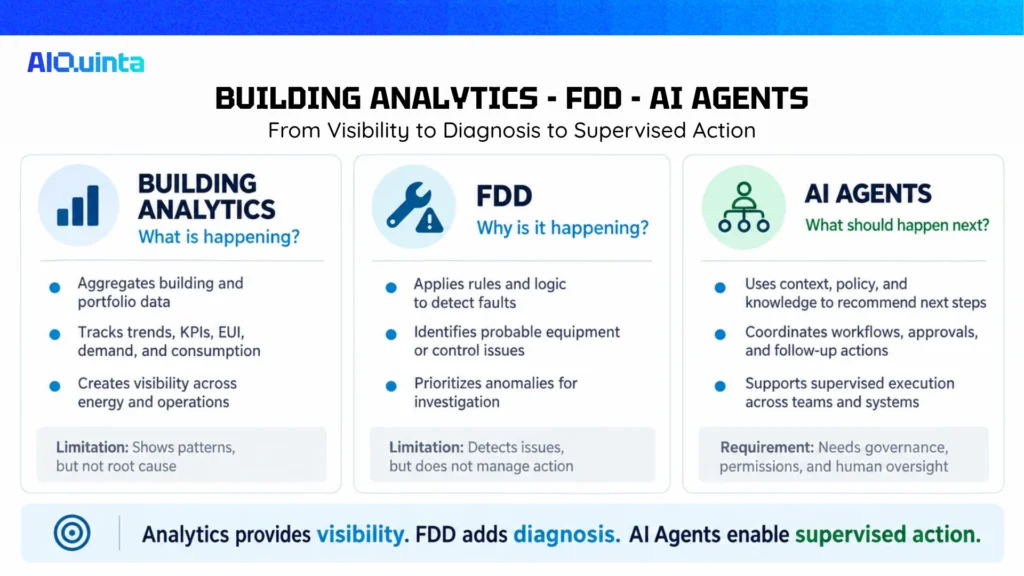
Layer 1: Building Analytics (Portfolio Visibility and Baseline Tracking)
Building analytics software operates as an aggregation and reporting umbrella. It ingests data from utility billing meters, sub-meters, IoT environmental sensors, weather feeds, and centralized BMS servers. Its primary objective is trend analysis, energy normalization, and portfolio-wide carbon accounting.
Analytics engines typically process data in batch intervals, ranging from 15 minutes to monthly utility cycles. The underlying calculations rely on statistical regression, degree-day weather normalization, and benchmarking against standards such as ASHRAE 90.1 or ENERGY STAR.
-
Input Data: Interval meter readings, utility rates, monthly consumption bills, occupancy counts, and high-level BMS status points.
-
Core Output: Consumption trend lines, Energy Use Intensity (EUI) metrics, peak demand profiles, tenant sub-metering invoices, and Scope 1 and 2 emissions summaries.
-
Operational Limitation: Building analytics indicates where capital or energy is being lost at a macro level, but cannot determine why a specific piece of equipment is underperforming. A facilities director can see that Tower B consumed 22% more chilled water this July than last July, but the dashboard cannot isolate whether that surge stemmed from economizer damper failure, simultaneous heating and cooling, or bypass valve leakage.
Layer 2: Fault Detection and Diagnostics (Root-Cause Isolation)
Fault Detection and Diagnostics (FDD) software operates closer to the equipment physical layer. Rather than analyzing high-level utility consumption, FDD platforms continuously ingest high-frequency telemetry directly from the BMS over industrial protocols such as BACnet/IP, Modbus, or OPC-UA.
The core of traditional FDD is algorithmic and rule-based. It applies thermodynamic equations, engineering principles, and deterministic logic to evaluate whether equipment components operate within expected physical envelopes.
The diagnostic component isolates probable causes by correlating multiple telemetry streams. For example, if a VAV box reports an open damper, a high discharge air temperature, and an unsatisfied space setpoint while the central AHU supply air temperature remains steady at 55°F, the system diagnoses a failed reheat valve actuator or a jammed damper assembly.
-
Input Data: Raw BMS controller points at 1-minute to 15-minute intervals, including actuator control signals, temperature sensors, pressure transducers, fan variable frequency drive (VFD) speeds, and operating states.
-
Core Output: Prioritized fault logs, estimated cost impact of energy waste, identified root-cause failure modes, and automated preventive maintenance work requests.
-
Operational Limitation: FDD platforms are diagnostic, not therapeutic. They identify faults, calculate the financial cost of inaction, and generate an alert. The system relies entirely on manual intervention to adjust setpoints or dispatch contractors, leaving the loop open.
Layer 3: AI Agents for Buildings (Contextual Reasoning and Supervised Actuation)
AI agents represent a fundamental architectural shift from passive reporting and deterministic rules to autonomous operational loops. An AI agent does not replace the BMS or FDD engine; it acts as an intelligent supervisory layer orchestrating both.
Unlike static rules that evaluate sensors in isolation, agentic architectures incorporate multi-step reasoning, persistent memory, and tool-calling capabilities. When an agent detects an anomaly or receives an FDD diagnosis, it interrogates adjacent systems to evaluate context:
-
What is the current outdoor enthalpy and forecasted wet-bulb temperature?
-
Does real-time badge data indicate high occupancy in this zone over the next three hours?
-
What are the current peak demand tariff thresholds for the utility billing cycle?
-
What does the physical thermal lag model of this specific building envelope dictate?
Once context is established, an AI agent evaluates remediation strategies and executes closed-loop adjustments. Operating through governed API interfaces or BACnet write commands, the agent can modulate static pressure setpoints, trim chilled water supply temperatures, or implement dynamic pre-cooling sequences.
Crucially, the agent verifies the outcome. If a setpoint modification fails to resolve the underlying inefficiency within an expected timeframe, the agent rolls back the change and escalates the ticket with pre-populated diagnostics to human operators. To model these interactions safely, teams must maintain clear distinctions between discrete agent skills vs capabilities, ensuring each tool call is independently verifiable.
When to Buy, When to Combine, and Where Each Layer Breaks Down
Deploying building technology without matching software capabilities to organizational maturity guarantees poor capital allocation.
The Limits of Pure Building Analytics
Energy management software and analytics dashboards are valuable for portfolio benchmarking, sustainability reporting, and executive visibility. They succeed when used to identify macro-trends across dozens of properties or verify that capital retrofits achieved projected energy reductions.
However, organizations fail when they expect analytics dashboards to drive daily operational maintenance. Dashboards present lagging indicators. By the time a cooling tower water spike shows up on an energy dashboard at the end of the billing cycle, thousands of gallons of water and significant treatment chemicals have already been lost. Relying on high-level analytics to diagnose mechanical failure modes is an architectural error.
The Limits of Standalone FDD Platforms
FDD platforms are essential for enterprise portfolios with extensive HVAC plant operations, such as hospitals, research laboratories, corporate headquarters, and universities. They excel at exposing hidden equipment faults—such as simultaneous heating and cooling in dual-duct systems or hunting chilled water control valves—that run unnoticed while occupants remain comfortable.
The failure mode of standalone FDD is organizational, not mathematical:
-
Rule Maintenance Decay: As equipment degrades, gets replaced, or undergoes temporary operational overrides during maintenance, static rules begin misfiring. If the facility team does not invest continuous engineering hours into recalibrating threshold rules, false alarms rise, and staff ignore the system.
-
The Manual Labor Deficit: If an FDD tool identifies $80,000 in annual energy waste across 150 discrete mechanical faults, realizing those savings requires certified HVAC technicians to inspect, test, and repair each component. In organizations suffering from maintenance staffing shortages, FDD reports simply accumulate in inboxes.
The Limits and Boundaries of AI Agents
Deploying AI agents for buildings is viable only when an organization has established a stable digital telemetry foundation. If the underlying BMS network experiences intermittent BACnet communication drops, or if 30% of field temperature sensors are uncalibrated, an AI agent will optimize against corrupted data inputs.
Furthermore, autonomous agents fail when deployed without clear semantic context. If an agent cannot verify physical boundaries through structured schemas, it risks causing space conditioning instability. Advanced enterprises utilize agentic technology not to bypass FDD, but to act upon FDD findings: using the FDD engine as a deterministic verification tool while the AI agent plans and executes adjustments.
This multi-layered approach reflects modern implementations of operational intelligence for building management systems, where machine reasoning augments rather than destabilizes physical building controls.
Practical Decision Framework for Enterprise Technology Leaders
To determine the appropriate operational stack, enterprise facilities and IT leaders should evaluate their assets against four concrete operational criteria.
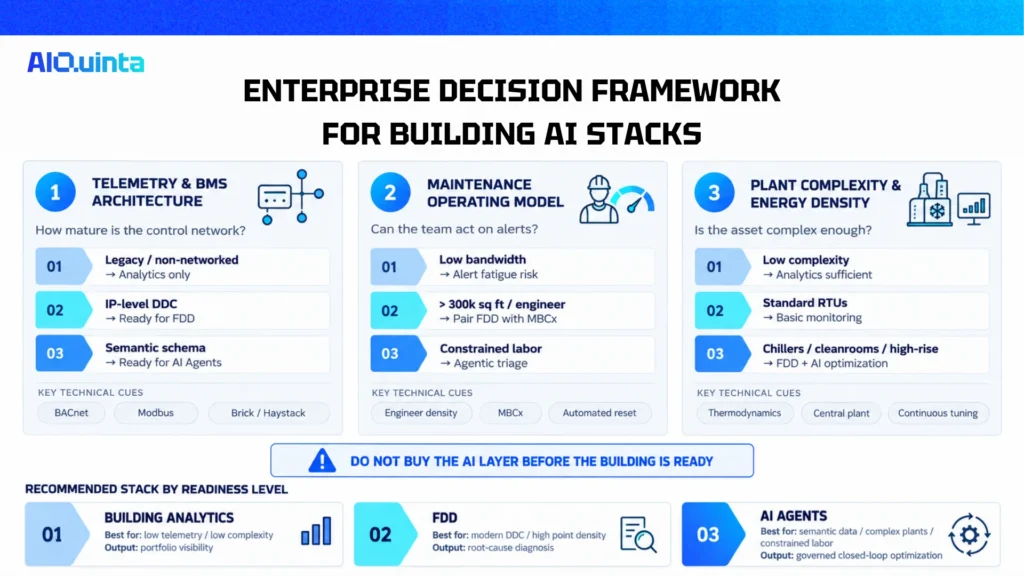
Criterion 1: Telemetry and BMS Architecture
Audit the state of local direct digital control (DDC) controllers across your facilities portfolio:
-
If your facilities rely on legacy, proprietary, stand-alone pneumatic or non-networked controllers, prioritize capital upgrades to modern open-protocol BACnet or Modbus controllers before procuring advanced software. Analytics platforms that ingest utility bills are the only layer capable of extracting value from un-networked sites.
-
If your portfolio features modern, IP-level DDC controllers with high point density (measuring supply, return, setpoints, actuator feedbacks, and zone states), the facility is prepared for FDD software integration.
-
If your points are normalized under a structured semantic schema (Brick Schema or Project Haystack), you can bypass standalone rule engines and evaluate agentic systems capable of autonomous supervisory control.
Criterion 2: Maintenance Operating Model and Labor Bandwidth
Assess the operational capacity of your facilities engineering workforce:
-
Calculate your engineering density ratio: square footage per dedicated building technician.
-
If your team operates above 300,000 square feet per engineer, deploying standalone FDD software will cause severe alert fatigue unless paired with an outsourced monitoring-based commissioning (MBCx) service provider.
-
If internal engineering labor is constrained, prioritize software platforms that incorporate agentic triage and automated supervisory reset capabilities, reducing the manual burden required to resolve control-level inefficiencies. Integrating AI in enterprise energy management enables facilities to capture demand-response value without diverting technician hours from critical mechanical repairs.
Criterion 3: Plant Complexity and Energy Density
The financial return of diagnostic and agentic layers correlates directly with mechanical plant complexity:
-
Low-complexity real estate (e.g., single-story retail branches or warehouse distribution centers conditioned by standard rooftop units) rarely justifies the integration overhead of complex FDD and agentic pipelines. Cloud building analytics monitoring interval power meters and smart thermostats provide sufficient operational visibility.
-
High-complexity environments (e.g., central chiller plants, district cooling networks, cleanrooms, and multi-tenant commercial high-rises) yield rapid payback from FDD and agentic optimization. In these assets, complex thermodynamic interactions between central plant staging, primary-secondary pumping systems, and air-side distribution create significant opportunities for continuous autonomous tuning.
How Agentic AI Closes the Maintenance Loop
To move from diagnostics to autonomous operations, enterprises deploy multi-agent systems designed to execute specific Agentic AI workflow patterns. The architecture relies on separation of duties among different agent personas.
-
Ingestion and Triage: The FDD system pushes a JSON payload containing the fault parameters (equipment ID, fault duration, estimated cost) to the AI platform.
-
Knowledge Retrieval: A specialized retrieval agent accesses the corporate knowledge base. It locates the piping and instrumentation diagrams (P&ID) and the specific OEM maintenance manual for the faulty asset.
-
Coordination: An Orchestrator Agent synthesizes the FDD payload and the OEM manual. It determines the skill level required for the repair (e.g., standard HVAC technician vs. specialized electrical contractor).
-
Execution: The agent executes an API call to the CMMS, generating a fully populated work order that includes the root cause, the financial impact, the required replacement parts, and the step-by-step repair instructions.
In mature, highly governed environments, the agent can also execute a temporary BMS override—such as adjusting a secondary cooling unit to compensate for the lost capacity—while the physical repair is pending.
Conclusion
The progression from building analytics to FDD to AI agents represents the shift from observing a facility to autonomously operating it. While dashboards provide visibility and FDD identifies the mechanical root cause, neither technology physically resolves the issue. Agentic architecture is required to absorb the massive volume of diagnostic alerts and translate them into executed repairs.
Ultimately, deploying AI in facility operations proves that structured extraction is not only a document automation task. When an agent pulls precise failure codes from a continuous FDD data stream and maps them to enterprise procurement workflows, it transforms raw telemetry into cognitive action. This positions operational intelligence as part of a larger enterprise AI capability, bridging the gap between mechanical hardware and corporate IT. To scale building efficiency, organizations must stop paying for software that only generates more work, and start investing in systems capable of resolving it.
FAQs
Is FDD the same as building analytics?
No. Building analytics is a broader category that can include energy dashboards, benchmarking, trend analysis, anomaly detection and other analytical functions. FDD focuses specifically on detecting abnormal equipment or system behavior and assisting with diagnosis.
What data does an AI building agent need?
Typical sources can include BMS telemetry, equipment metadata, FDD findings, work orders, operating procedures, manuals, occupancy information and other approved enterprise systems. More data is not automatically better. Relationships, permissions, freshness and provenance matter.
What should enterprises implement first: analytics, FDD or AI agents?
Start where the operational bottleneck exists. Fix visibility with analytics, diagnosis with FDD, and cross-system coordination with agents. If basic BMS data quality and equipment context are unreliable, address those first.
Turn Enterprise Knowledge Into Autonomous AI Agents
Your Knowledge, Your Agents, Your Control
Your Knowledge, Your Agents, Your Control
Related Articles
Latest Articles