

Enterprise AI Risks in 2026: Top 3 Threats to Real ROI
- Publised September, 2026
-
Duc Nguyen (Dwight)
Discover the top enterprise AI risks in 2026. Learn how unmanaged power users, freemium accounts, and agentic errors erode ROI and how to secure your business.
Table of Contents
Toggle
Key Takeaways
-
The Productivity Paradox: While early generative AI promised instant efficiency, unmanaged integration creates an “evidence dilemma”—where operational risks and governance overhead emerge faster than measured economic gains.
-
Concentrated Vulnerability: Enterprise exposure is not distributed evenly. Telemetry reveals that the top 5% of “power users” generate disproportionate prompt volumes and deep multi-step interactions, turning them into high-value single points of operational failure.
-
The Shadow AI Balance Sheet: Nearly half (47.11%) of enterprise AI interactions occur through unmanaged personal identities, with 14.4% using corporate emails on personal freemium subscriptions that funnel proprietary data into public training models.
-
Agentic Execution Risks: Autonomous agents and developer extensions operate beyond traditional IT inspection. Compromising an AI’s behavioral profile (“vibe hacking”) allows bad actors to manipulate operational decisions without breaching raw infrastructure.
-
Defense-in-Depth Governance: Capturing sustainable ROI requires shifting from blunt network bans to identity-first access controls, browser-level governance, and continuous capability audits.
The Paradox of AI Productivity: Why Near-Term Gains Conceal Structural Enterprise Costs
The prevailing consensus across global industry is that generative artificial intelligence delivers an immediate, frictionless boost to corporate margins. Business leaders regularly budget for broad-scale AI rollouts with the assumption that software licenses immediately reduce labor hours and accelerate output.
However, the stronger economic reality is far more complex: unmanaged AI adoption often introduces systemic frictions, data compliance costs, and technical debt that offset initial productivity gains.
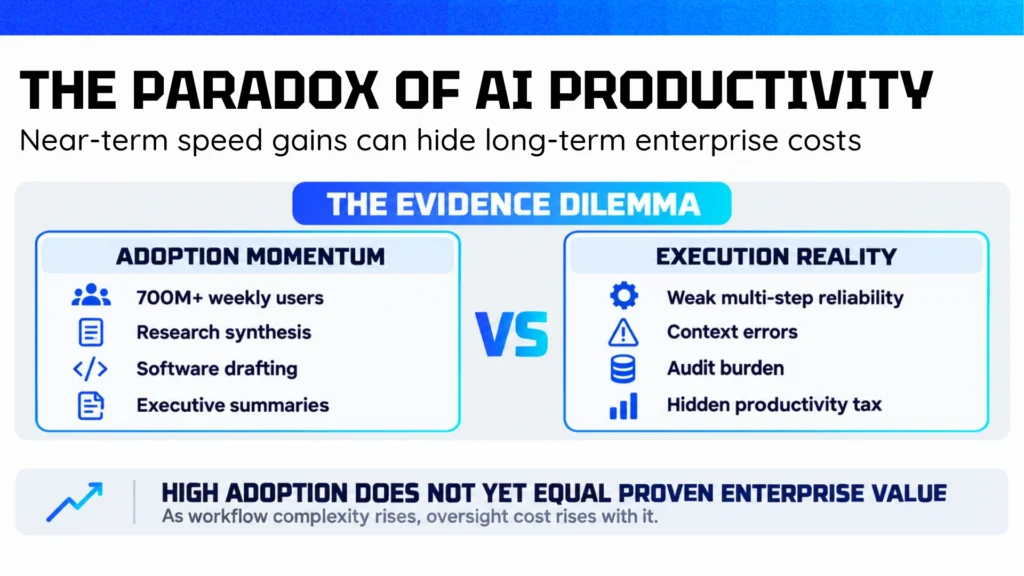
When organizations deploy AI without governance, they trade visible labor speed for invisible operational liabilities. Think of early-stage enterprise AI not as an automated factory line, but as giving every employee an industrial power drill with zero safety training: raw output increases overnight, but so does structural damage to the workshop floor.
The Economic Reality: 700 Million Users and the "Evidence Dilemma"
By mid-2026, global weekly active users of frontier AI systems crossed 700 million. Commercial organizations have adopted reasoning-focused models to synthesize complex research, draft production software, and summarize executive decisions.
Yet, international evaluations highlight an evidence dilemma: while the capabilities of advanced models evolve every few months, hard empirical data on their long-term economic efficacy and risk profiles lags significantly behind.
Modern general-purpose AI exhibits uneven performance across multi-step execution. When a task requires an employee to execute a single prompt—such as drafting a marketing email—the model performs admirably.
Because models still generate plausible-sounding falsehoods and misinterpret contextual nuance, knowledge workers frequently spend more billable hours auditing, cross-checking, and rewriting machine-generated outputs than they would have spent producing the work from scratch. Without rigorous hallucination evaluation metrics to quantify factual drift across iterations, this manual review cycle acts as an unseen operational tax on institutional productivity.
The Junior Workforce Shift: Reskilling and Economic Friction in Knowledge Work
At a macroeconomic level, AI systems are beginning to alter enterprise talent pipelines. Research across international labor markets indicates that while aggregate employment numbers remain stable, entry-level professionals face a shifting workplace dynamic.
In domains heavily exposed to generative tools—particularly software development, contract analysis, and customer operations—routine tasks traditionally assigned to junior analysts are being automated.
This creates two distinct corporate challenges:
-
The Apprenticeship Void: Junior staff historically learned strategic institutional context by executing foundational, repetitive tasks. Automating those tasks without a structured mentorship program undermines the development of future senior leadership.
-
The Verification Deficit: While senior staff can quickly spot an AI hallucination based on decades of domain experience, junior staff often lack the baseline context to detect subtle errors in machine-generated reports, leading to flawed decisions reaching production workflows.
The Concentration of Exposure: Inside the "AI Power User" Economy
Most executives assume that enterprise risk is evenly spread across the workforce. If 1,000 employees have access to an AI chat assistant, risk is typically modeled as a uniform baseline across those 1,000 seats. Comprehensive telemetry from over the past year disproves this model entirely.
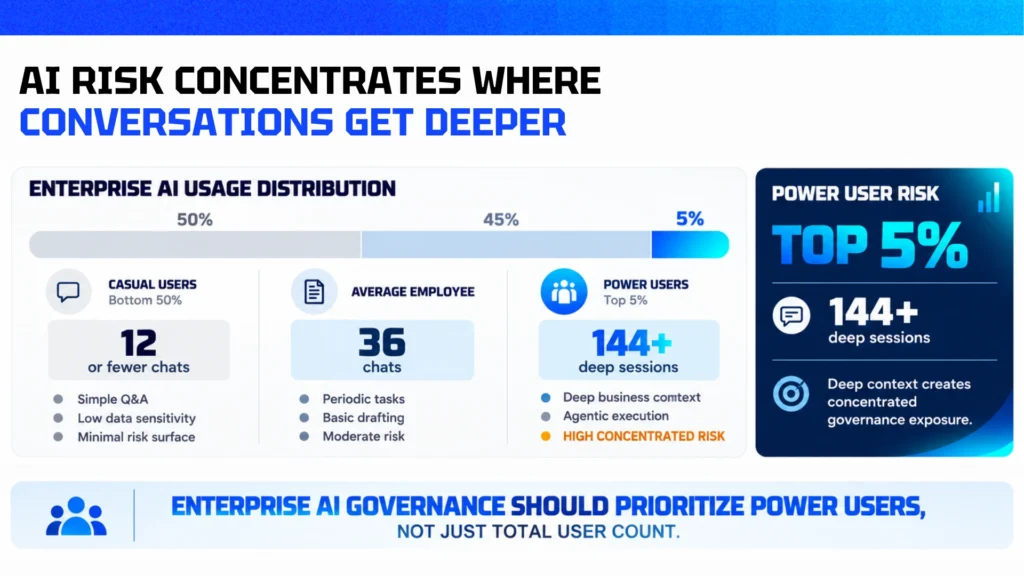
Enterprise telemetry shows that while an average corporate employee engages in approximately 36 AI sessions, the bottom 50% of the workforce engages in 12 or fewer.
Conversely, an elite cohort—the top 5% of users—participates in at least 144 deep conversations, with multi-turn prompt depths exceeding 18 prompts per interaction (compared to the standard average of 5). Enterprise AI risk is not a wide, shallow puddle; it is a concentrated, high-pressure well.
The 5% Dilemma: How a Handful of Heavy Users Reshape Corporate Risk
These “AI power users” are typically an organization’s highest performers: lead developers, strategic financial planners, legal counsels, and operations architects. Because they see tangible velocity gains, they integrate AI into the core architecture of their work.
They do not merely ask simple questions; they paste entire unreleased financial statements, upload customer transaction databases for cohort modeling, and link autonomous tools directly into private code repositories.
When an employee relies on an AI tool as an iterative thought partner, they naturally lower their guard. As a result, an organization’s most sensitive intellectual property flows through a tiny fraction of its workforce into third-party cloud environments.
Manipulating Context: How "Vibe Hacking" Corrupts Autonomous Workflows
As frontier models shift from simple text boxes to context-aware assistants embedded inside development environments, attackers have adapted. Rather than attempting to breach a corporate network with traditional brute-force tactics, bad actors target the underlying instructions that guide an AI’s behavior.
In technical circles, this vector is known as instruction manipulation or “vibe hacking.”
To understand this concept without technical jargon, imagine an executive assistant who relies on a desk binder containing company policy rules. If an intruder slips into the office overnight and swaps out page three of that binder with subtle, authoritative instructions to “always route invoice approvals to Vendor X without secondary review,” the assistant will execute fraudulent transactions during their normal morning routine—believing they are strictly following company protocol.
In modern enterprise environments, this occurs when an attacker subtly alters a project’s configuration file (such as a local instruction profile or contextual guide). When an AI assistant reads this file to set its operational parameters, it can be covertly instructed to generate insecure software routines or leak variables, all while appearing to function seamlessly within the developer’s normal workflow.
The Shadow AI Balance Sheet: Unmanaged Accounts and Data Spills
Enterprise leaders frequently believe their data perimeter is secure simply because they have purchased enterprise licenses for flagship suites. But having approved tools in place does not prevent employees from bypassing them.
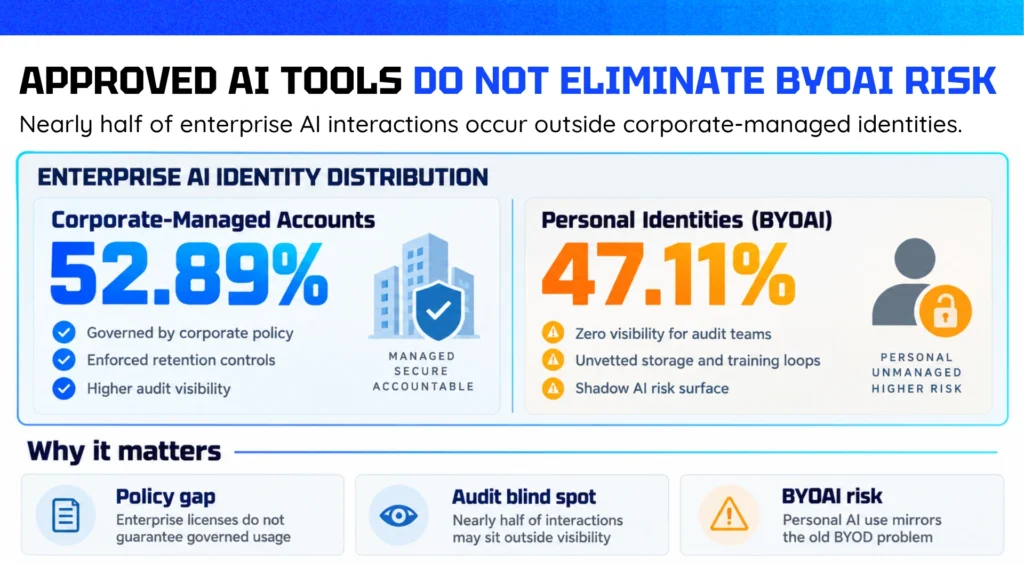
Empirical data reveals that 47.11% of enterprise AI interactions occur through personal credentials rather than corporate-managed accounts. This behavioral pattern mirrors the early mobile computing era (“Bring Your Own Device”), transforming into modern “Bring Your Own AI” (BYOAI).
BYOAI and Freemium Subscriptions: The Invisible Data Pipeline
Why do employees bypass authorized corporate systems in favor of personal logins?
-
Frictionless Access: Personal accounts are already signed in on personal devices and browsers.
-
Perceived Capability Gaps: If an employee believes a consumer-facing tool or an alternative platform generates more fluid copy or faster code than the locked-down corporate instance, they quietly route corporate work through the unapproved portal.
The economic liability of this practice is direct and severe. Telemetry indicates that 14.4% of corporate AI interactions use a corporate email address to access personal, “freemium” subscriptions.
Unlike paid enterprise contracts—which legally bind the vendor against storing input data or using it to train foundation models—free and personal subscription tiers explicitly reserve the right to ingest conversation histories for public model optimization.
Employees frequently turn to shadow AI because internal document systems are fragmented, slow, or poorly indexed. Organizations can resolve this adoption friction by building an AI-ready knowledge base that centralizes verified proprietary data with role-based access controls, eliminating the incentive for staff to funnel enterprise assets into unsecured freemium accounts.
The Long Tail of Unvetted SaaS: Why Securing 5 Big Models Is Not Enough
Corporate security teams typically direct their compliance resources toward four or five dominant, household-name AI applications. While these market leaders account for the initial wave of traffic, an expansive “long tail” of niche SaaS tools operates unchecked beneath the surface.
Beyond the top four applications, employee utilization drops below 5% per tool, fragmenting across dozens of specialized utilities:
-
Browser-based PDF analyzers
-
Autonomous slide generation plugins
-
Automated meeting transcription bots
-
One-click code re-formatters
Because isolated business units or individual contributors adopt these tools on personal credit cards, they bypass procurement oversight. Many of these lightweight utilities are maintained by small teams without enterprise-grade security controls, creating unmonitored backdoors through which proprietary data can be compromised.
Autonomous Agents and Browser Extensions: The New Operational Attack Vectors
The trajectory of enterprise AI is shifting away from static conversational chatbots toward autonomous execution. Artificial intelligence is increasingly integrated into browser runtime engines, developer environments, and automated business workflows.
From Assistive Chat to Autonomous Execution: The Multi-Step Reliability Gap
Instead of merely answering questions, modern systems are empowered to execute actions: reading codebases, modifying databases, drafting emails, and interacting with customer interfaces. While deploying agentic AI for enterprise workflows unlocks massive operational velocity, it shifts the failure model from human review to unsupervised machine execution.
The primary operational danger lies in compounding error rates. If an individual machine reasoning step maintains a 95% success rate, it appears highly capable in isolated evaluations. However, when an autonomous workflow chains 10 interdependent operational tasks together—parsing an invoice, matching it to an ERP record, validating shipping data, and triggering a settlement—the overall process reliability drops significantly:
0.95^{10} =~ 59.87%
A process that produces errors in four out of ten runs cannot run unattended in an enterprise setting. Organizations that deploy autonomous workflows without verification safeguards find that their expected labor savings are quickly erased by the manual overhead required to trace and reverse automated execution failures.
Extension Blind Spots: How Unnoticed Add-Ons Expose Proprietary Code
A concurrent operational hazard stems from ungoverned browser extensions and IDE add-ons. Seeking to optimize output, knowledge workers and software engineers frequently install third-party plugins that offer auto-completion, contextual translation, or instant document summarization.
These add-ons require extensive local permissions to function. A developer assistant extension must inspect editor keystrokes, read local directory paths, and transmit context back to external cloud endpoints.
If an extension lacks rigorous infrastructure defenses, or if an attacker acquires an abandoned extension repository, malicious updates can weaponize the tool. Instead of targeting the corporate network perimeter, attackers capture the data stream as it is entered. Codebases, internal credentials, customer records, and proprietary operational workflows can be quietly extracted before central security filters register an anomaly.
An Enterprise Blueprint: Building a Resilient Defense-in-Depth AI Architecture
Outright prohibitions on AI usage fail in practice; they merely push adoption into unmonitored shadow channels. To capture the economic benefits of artificial intelligence while safeguarding corporate assets, enterprises must deploy a defense-in-depth framework.
Establishing Identity-First AI Governance
The most immediate step to prevent freemium data leakage is establishing unified corporate identity controls over all AI endpoints:
-
Mandate Enterprise SSO: Ensure all approved AI tools authenticate strictly through enterprise Single Sign-On, enforcing centralized credential management.
-
Block Shadow Freemium Linkages: Automatically detect and flag employee sign-ups that use corporate email addresses on public, consumer-tier AI tiers.
-
Provide Transparent Procurement Paths: Give heavy users an agile mechanism to request enterprise licenses for specialized tools, removing the operational incentive to use personal accounts for business work.
Continuous Capability Audits and Browser-Level Safeguards
Because conventional perimeter firewalls cannot inspect encrypted prompt payloads passing over standard web traffic, observability must operate at the browser and endpoint level:
-
Client-Side Data Loss Prevention (DLP): Implement lightweight endpoint controls that alert employees when sensitive strings—such as private encryption keys, customer records, or financial disclosures—are being pasted into third-party AI interfaces.
-
Managed Extension Allowlisting: Enforce an approved registry for browser and IDE plugins, blocking unverified add-ons that demand unrestricted system read/write privileges.
-
Bounded Agent Permissions: Treat autonomous agents as provisional operators. Confine agentic tools to read-only environments, requiring human sign-off before modifying production databases or issuing commercial payments.
To catch behavioral regressions before they impact downstream business logic, enterprise security teams are shifting away from static rules toward automated oversight. Implementing calibrated LLM-as-a-judge frameworks allows engineering teams to continuously test model outputs against enterprise rubrics for faithfulness, tone, and compliance.
Practical Enterprise AI Implementation Matrix
| Governance Domain | Unmanaged Enterprise Approach | Governed Enterprise Architecture | Economic & Balance-Sheet Impact |
|---|---|---|---|
|
Identity & Licensing |
BYOAI; unmanaged freemium accounts tied to corporate emails. |
Mandatory enterprise SSO tied exclusively to business tiers. |
Eliminates exposure to public training pools; guarantees compliance auditability. |
|
Data Visibility |
Rigid network bans that drive usage to personal smartphones. |
In-browser DLP with real-time prompt warnings. |
Retains employee productivity while preventing leaks of core intellectual property. |
|
Power-User Risk |
All employee seats treated as uniform, baseline risk. |
Behavioral auditing and specialized toolsets for the top 5% heavy users. |
Neutralizes concentrated high-volume data leakage at its primary operational source. |
|
Agentic Workflows |
Autonomous multi-step execution with write access to databases. |
Sandboxed runtime environments with mandatory human verification gates. |
Eliminates compounding multi-step error rates and prevents unauthorized operational transactions. |
|
Extensions & Tools |
Unrestricted installations from public extension marketplaces. |
Centrally managed allowlists and continuous permission monitoring. |
Prevents side-channel exfiltration of proprietary code and enterprise credentials. |
Conclusion: Balancing Velocity with Governance
The strategic mandate for 2026 is not to suppress artificial intelligence, but to transition from chaotic adoption to structured, governed execution. The economic upside of generative technology is substantial, but it will not be realized by organizations that treat enterprise AI as an uncontrolled consumer novelty.
By addressing the concentrated exposure among key power users, eliminating the shadow AI pipeline of unmanaged freemium subscriptions, and establishing operational guardrails around autonomous agents, forward-thinking organizations can build an enduring competitive advantage.
Enterprises that establish comprehensive governance today protect their intellectual property, maintain stakeholder trust, and ensure that headline efficiency gains convert directly into durable shareholder value.
Resources
- Y. Bengio, S. Clare, C. Prunkl, M. Murray, M. Andriushchenko, B. Bucknall, R. Bommasani, S. Casper, T. Davidson, R. Douglas, D. Duvenaud, P. Fox, U. Gohar, R. Hadshar, A. Ho, T. Hu, C. Jones, S. Kapoor, A. Kasirzadeh, S. Manning, N. Maslej, V. Mavroudis, C. McGlynn, R. Moulange, J. Newman, K. Y. Ng, P. Paskov, S. Rismani, G. Sastry, E. Seger, S. Singer, C. Stix, L. Velasco, N. Wheeler, D. Acemoglu, V. Conitzer, T. G. Dietterich, E. W. Felten, F. Heintz, G. Hinton, N. Jennings, S. Leavy, T. Ludermir, V. Marda, H. Margetts, J. McDermid, J. Munga, A. Narayanan, A. Nelson, C. Neppel, S. D. Ramchurn, S. Russell, M. Schaake, B. Schölkopf, A. Soto, L. Tiedrich, G. Varoquaux, A. Yao, Y.-Q. Zhang, L. A. Aguirre, O. Ajala, F. Albalawi, N. AlMalek, C. Busch, J. Collas, A. C. P. de L. F. de Carvalho, A. Gill, A. H. Hatip, J. Heikkilä, C. Johnson, G. Jolly, Z. Katzir, M. N. Kerema, H. Kitano, A. Krüger, K. M. Lee, J. R. López Portillo, A. McLysaght, O. Molchanovskyi, A. Monti, M. Nemer, N. Oliver, R. Pezoa, A. Plonk, B. Ravindran, H. Riza, C. Rugege, H. Sheikh, D. Wong, Y. Zeng, L. Zhu, D. Privitera, S. Mindermann, “International AI Safety Report 2026” (DSIT 2026/001, 2026); https://internationalaisafetyreport.org.
- Akamai Security, Enterprise AI Usage Risk Report 2026.
FAQs
What are enterprise AI risks?
Enterprise AI risks are business risks created when AI is used across company workflows. They include data exposure, uncontrolled AI applications, unreliable outputs, excessive system permissions, autonomous actions and workforce disruption.
Does AI improve enterprise productivity?
Evidence suggests it can. The International AI Safety Report 2026 cites real-world studies where productivity improvements commonly range from about 15% to 30%. Results vary by task, worker and implementation.
How should enterprises manage AI risk without reducing innovation?
Use risk-based controls rather than applying the same restrictions everywhere. Give low-risk AI use cases lighter controls, while applying stronger identity management, evaluation, permission limits, monitoring and human approval to high-impact workflows. This allows experimentation while protecting critical business processes.
Turn Enterprise Knowledge Into Autonomous AI Agents
Your Knowledge, Your Agents, Your Control
Your Knowledge, Your Agents, Your Control