

AI Building Management Software: Multi-Site Buyer Guide
- Publised September, 2026
-
Duc Nguyen (Dwight)
Evaluate AI building management software for multi-site portfolios with clear criteria for data, controls, security, ROI, and rollout.
Table of Contents
Toggle
Key Takeaways
- Do not buy the highest level of AI automation by default. Match monitoring, FDD, optimization, or agent-based workflows to each site’s readiness.
- Protocol connectivity alone does not create portfolio intelligence. The platform must standardize assets, points, units, relationships, and operational context.
- Closed-loop control creates value and risk. Require bounded write access, local safety controls, rollback, approval rules, and full audit logs.
- Test scale during the pilot. Measure onboarding effort, reusable mappings, fault accuracy, operator adoption, and normalized outcomes across representative sites.
AI BMS software is a category, not one product
The market often applies the same “AI building platform” label to systems with very different levels of control and operational depth.
| Operating layer | Main output | Best fit | Main limitation |
|---|---|---|---|
|
Portfolio monitoring |
Dashboards, alarms, energy trends, benchmarking |
Sites with limited telemetry or early centralization needs |
Shows problems but may not explain or resolve them |
|
FDD and analytics |
Fault detection, probable causes, prioritization |
Buildings with stable, detailed BMS data |
Value depends on staff acting on findings |
|
Supervisory optimization |
Forecasts and bounded setpoint adjustments |
Complex, controllable HVAC plants |
Adds integration, safety, and measurement demands |
|
Agent-based operations |
Work orders, evidence gathering, recommendations, follow-up |
Mature portfolios with integrated data and workflows |
Poor permissions or context can create operational risk |
What to look for in AI BMS software
A feature checklist can confirm that a platform has dashboards, alerts, machine learning, and APIs. It cannot show whether those features will work across a mixed estate.
The following criteria focus on operational proof.
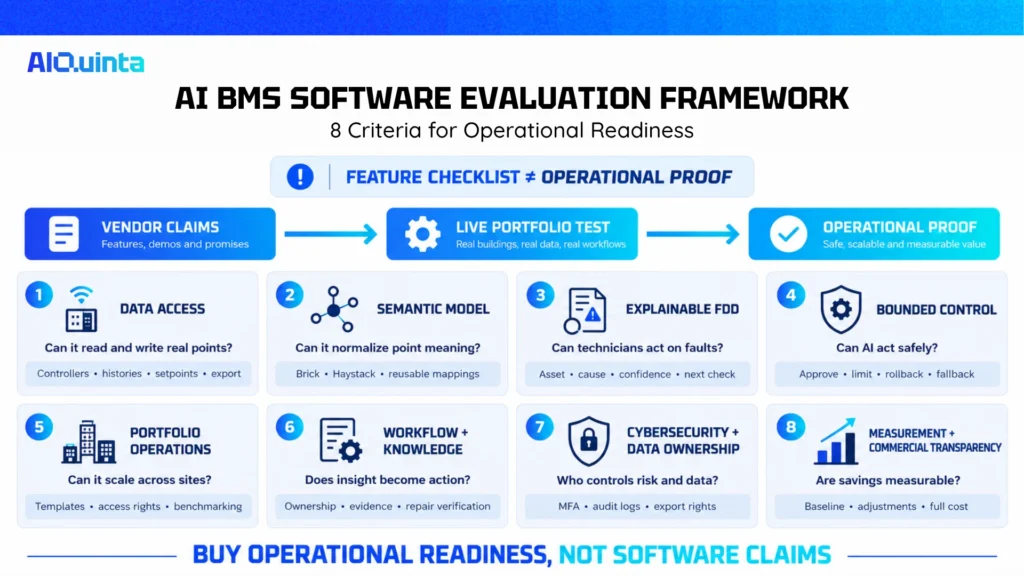
Data access and interoperability
BACnet is designed to support vendor-independent communication among building automation equipment. However, a BACnet logo does not prove that a platform can access the points, histories, commands, and equipment relationships required by its models.
Ask vendors to demonstrate connections to the actual controllers and BMS versions in the target portfolio. Test:
- Which objects and trend histories can be read
- Which setpoints can be written
- How serial or low-bandwidth networks are protected
- Whether local edge buffering handles network loss
- How timestamps, units, sampling rates, and missing values are processed
- Whether integrations and raw data can be exported
The platform should also support secure enterprise data connections to systems such as meters, weather feeds, occupancy tools, CMMS, asset registers, and approved business data.
A reusable semantic model
Multi-site portfolios rarely use one naming convention. A supply-air temperature point may appear as AHU01_SAT, SupplyAirTemp_A1, or a vendor-specific code. These labels must map to the same operational concept before portfolio analytics can work.
Open initiatives such as Brick Schema and Project Haystack exist to standardize building assets, points, and relationships. The buyer does not need to mandate one schema in every case, but the vendor must show a consistent semantic model.
Ask how much mapping requires manual engineering, how mappings are validated, and how templates transfer to similar sites. The resulting model should remain accessible to the building owner.
Explainable fault detection
A useful fault should include more than an alarm label. It should identify the affected asset, supporting signals, likely cause, duration, operational impact, confidence, and recommended next check.
During evaluation, introduce known faults or use historical incidents. Test whether the platform can distinguish a failed sensor from a physical equipment fault. Verify how it suppresses duplicate alerts and groups symptoms under one probable root cause.
An unexplained anomaly score may help a data scientist. It gives a facility technician little basis for action.
Bounded control and safe fallback
A vendor should separate four permissions:
- Read data
- Generate recommendations
- Request human approval
- Write approved values within defined limits
Life-safety sequences and hard equipment protections must remain in local deterministic controls. The AI layer should not override smoke control, freeze protection, pressure cut-outs, or other protected logic.
Require setpoint limits, approval rules, timeout behavior, rollback, command logging, and a clear fallback to normal BMS operation when the AI service or network becomes unavailable.
Portfolio operating functions
AI building software for multi-site portfolio operations must support more than a combined dashboard.
Look for reusable equipment templates, portfolio hierarchies, regional access rights, time-zone handling, tariff and weather normalization, cross-site benchmarking, and bulk deployment controls. A local operating exception should not require a separate software fork for each building.
Measure how long it takes to onboard the tenth site, not only the first. The cost and effort curve reveal whether the architecture can scale.
Workflow and knowledge integration
A fault has no business value until someone resolves it. The platform should connect analysis with the CMMS or service workflow, assign ownership, preserve evidence, and verify whether the repair changed performance.
It should also connect telemetry with manuals, commissioning records, control sequences, service notes, and approved procedures. This is where enterprise knowledge management can help operators understand why a recommendation was produced and what action is permitted.
Cybersecurity and data ownership
A portfolio platform creates a new connection between enterprise software and operational technology. The risk rises when it can write to controllers.
Evaluation should cover asset inventory, network segmentation, identity management, least-privilege roles, multi-factor authentication, encryption, audit logs, vulnerability management, remote support, data residency, retention, and incident response. CISA treats an accurate OT asset inventory as a foundation for risk assessment and secure operations.
Contracts should state that the operator owns its raw data, semantic mappings, histories, decisions, and derived records. Confirm the format and cost of a full export at termination.
Measurement and commercial transparency
Energy savings cannot be observed directly because they represent energy that was not consumed. The IPMVP framework therefore compares measured consumption with an adjusted baseline.
Require the vendor to define:
- Baseline period and exclusions
- Weather, occupancy, schedule, and floor-area adjustments
- Treatment of simultaneous control and equipment projects
- Demand-charge and tariff calculations
- Confidence ranges and data gaps
- Software, integration, gateway, commissioning, support, and managed-service costs
Avoid a business case built from one percentage applied across every site. Buildings with poor schedules may have large savings opportunities. Efficient plants may produce more value through reliability, comfort, or labor productivity.
Match the platform to portfolio readiness
The right first purchase depends on telemetry maturity, workforce capacity, and plant complexity.
| Portfolio condition | Recommended starting point | Avoid |
|---|---|---|
|
Legacy controls, sparse sensors, weak connectivity |
Meter analytics, controls renewal, sensor repair, commissioning |
Advanced optimization based on incomplete data |
|
Networked BMS with inconsistent point names |
Central monitoring and semantic normalization |
Portfolio benchmarking before data is comparable |
|
Stable telemetry with repeated operational faults |
FDD with ranked recommendations and CMMS integration |
Unfiltered alarm expansion |
|
Complex plant with reliable controls and skilled operators |
Advisory optimization followed by bounded write-back |
Immediate autonomous control |
|
Mature data, workflows, knowledge, and governance |
Agent-supported coordination across sites |
Unrestricted agent permissions |
This model also explains why operators should not deploy the same capability at every property. A hospital central plant, a small retail store, and a leased office floor have different control opportunities and failure consequences.
How the decision changes by portfolio type
- A retail operator with 200 small sites may gain more from schedule correction, remote visibility, rooftop-unit fault detection, and reusable site templates than from detailed digital twins. The winning platform minimizes per-site engineering and converts a small saving at each location into a portfolio result.
- A hospital campus may justify detailed FDD and supervisory optimization because its central plant is complex and continuously staffed. However, control limits, approval roles, infection-control requirements, and equipment redundancy must enter every recommendation.
- An office portfolio with outsourced facility management may need workflow visibility before automated control. The platform should show whether recommendations were accepted, who completed the work, how long it took, and whether the fault returned.
These cases show why vendor selection should start with operating constraints, not a universal feature score.
Run a pilot that tests scale, not a showcase building
Do not let the vendor choose only the cleanest, newest building. Select several representative sites, such as one high-opportunity building, one average site, and one difficult integration.
A 12 to 16-week pilot can test connectivity, mapping effort, fault quality, operator use, workflow integration, and control safety. It may not prove annual energy savings when weather and loads are seasonal. Use a longer measurement period or an agreed normalization model for financial validation.
The pilot scorecard should include:
- Required-point availability and mapping accuracy
- Verified faults, false positives, and duplicate-alert reduction
- Recommendation acceptance and rejection reasons
- Time from detection to verified resolution
- Normalized energy, demand, comfort, and reliability outcomes
- Engineering hours and cost required for each added site
- Percentage of mappings, rules, and workflows reused
- Security events, failed commands, rollback tests, and audit completeness
The contract should link later rollout stages to these results. A successful pilot proves repeatability, not only that one model produced an attractive dashboard.
Where AI building platforms fail
Most failures occur outside the model.
Data quality can decline after sensors are replaced or control points are renamed. Alerts can accumulate faster than technicians can close them. Operators may reject recommendations that ignore tenant commitments or maintenance constraints. Savings may be claimed against an invalid baseline. Proprietary mappings can lock the portfolio into one vendor.
Agent-based interfaces add another failure mode. An LLM may retrieve an outdated manual, misread an alarm, or propose an action outside the user’s authority. Versioned knowledge, citations, permissions, approval gates, and complete action logs should be mandatory.
The building must also remain operable when the AI layer fails. Graceful degradation is a core requirement, not an optional resilience feature.
From analytics to governed agentic operations
The next stage of building intelligence will connect real-time signals with operational history and enterprise knowledge.
A building agent could collect alarm evidence, retrieve the correct procedure, review similar past incidents, create a work order, propose a bounded setpoint change, and verify the result. A memory layer in enterprise AI systems can preserve which actions worked under specific conditions.
The agent should coordinate decisions without owning unrestricted control. Different governed agent archetypes can separate technical diagnosis, workflow execution, validation, and approval.
This structure allows operators to expand automation while keeping decision rights visible.
Conclusion
The best AI building management software is not the platform with the largest model or the longest feature list. It is the system that can improve a defined operating decision across mixed buildings, prove the result, and keep control within approved boundaries.
Structured extraction is not only a document automation task. In building operations, it converts alarms, trend logs, manuals, work orders, and operator notes into governed operational context. That context becomes part of a larger enterprise AI capability spanning knowledge, decisions, workflows, and controlled action.
Start with representative sites, measurable use cases, open data, and advisory operation. Increase autonomy only after the evidence supports it.
FAQs
What should operators look for in AI BMS software?
Prioritize proven access to existing BMS data, semantic normalization, explainable FDD, portfolio templates, workflow integration, cybersecurity, data ownership, bounded write-back, and a transparent measurement method. Ask vendors to demonstrate each capability using your own building data.
Does AI building management software replace an existing BMS?
Usually not. Most retrofit platforms act as a supervisory layer above existing controllers. The BMS continues to run local equipment and safety logic. The AI layer analyzes data, recommends changes, or writes approved supervisory setpoints. Operators with outdated pneumatic or non-networked controls may need an infrastructure upgrade first.
What is the best AI building software for a multi-site portfolio?
The best fit depends on site readiness and operating goals. Mixed estates often benefit from vendor-neutral overlays with reusable connectors, semantic templates, central workflows, and low per-site engineering effort. Complex campuses may need deeper FDD and optimization. Smaller sites may need remote monitoring and schedule control.
Turn Enterprise Knowledge Into Autonomous AI Agents
Your Knowledge, Your Agents, Your Control
Your Knowledge, Your Agents, Your Control
Related Articles
Latest Articles