















 Duc Nguyen (Dwight)
Discover why a low perplexity score doesn’t guarantee AI accuracy and how enterprises should combine it with task and risk metrics.
Table of Contents
Toggle To understand the limitations of the metric, we must clearly define what it measures and how it is calculated.
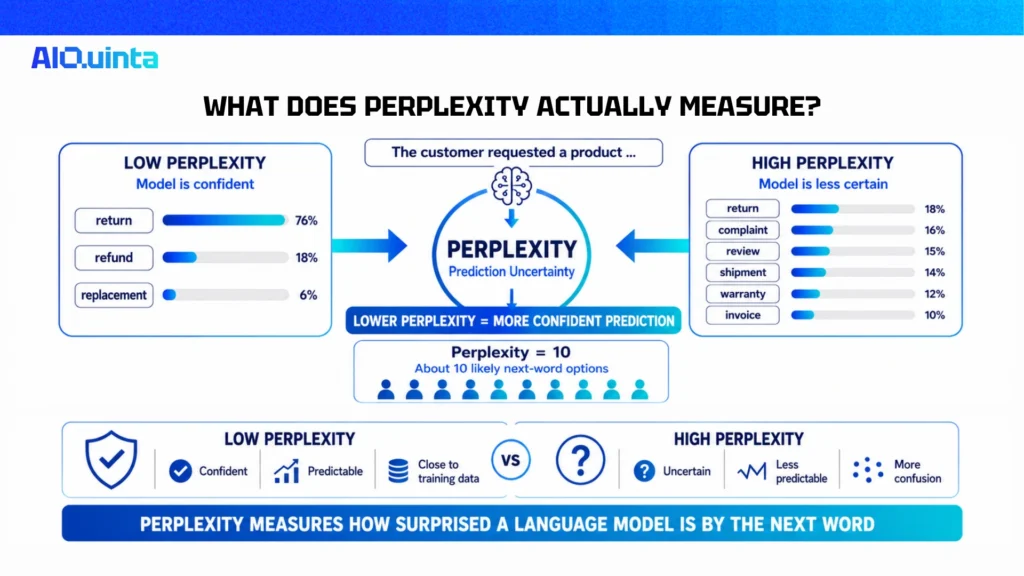
In information theory, perplexity quantifies how well a probability model predicts a sample. In the context of NLP, it measures the model’s “uncertainty” when generating new text. A lower score indicates that the model is highly confident in its predictions and that the text resembles the data it was trained on.
Mathematically, perplexity is the exponentiated cross-entropy of a sequence of words. For a sequence of words $W = (w_1, w_2, …, w_N)$, the perplexity $PP(W)$ is calculated as:
Alternatively, expressed using logarithmic probabilities:
If an LLM perplexity score is 10, it means that, on average, the model is choosing the next word from a set of 10 equally likely options. A lower number means less confusion.
Perplexity evaluates the internal state of the model, completely independent of any human reference text. This sets it apart from other common text generation metrics:
BLEU (Bilingual Evaluation Understudy): Originally designed for machine translation, BLEU compares the model’s output to one or more human reference texts by measuring exact word and phrase overlaps (n-grams).
ROUGE (Recall-Oriented Understudy for Gisting Evaluation): Commonly used for summarization, ROUGE focuses on recall—how much of the human reference text is successfully captured in the model’s output.
While BLEU and ROUGE attempt to measure alignment with a known “good” answer, they are notoriously rigid. They penalize models for using synonyms or restructuring sentences, even if the meaning remains perfectly accurate. Perplexity, on the other hand, ignores accuracy entirely in favor of fluency.
To build a robust enterprise strategy, teams must delineate where statistical metrics provide value and where they introduce risk.
Architecture Comparisons: When deciding between an open-source model like Llama 3 and a proprietary model for a specific internal deployment, baseline perplexity scores on standardized datasets (like WikiText) provide a rough gauge of baseline language competency.
Monitoring Catastrophic Forgetting: If an enterprise fine-tunes an LLM on proprietary legal data, tracking perplexity on general language tasks helps ensure the model hasn’t “forgotten” how to speak standard English during the fine-tuning process.
Language Identification: Perplexity is highly effective at detecting anomalies. If an English-trained model is fed a German text, the perplexity score will spike dramatically, allowing the system to flag or route the input appropriately.
The most significant risk of relying on a low perplexity score is the illusion of fluency. Because large language models are trained on vast swaths of the internet, they are incredibly adept at mimicking the tone of authority.
Consider a scenario where an AI is asked to generate a summary of a highly technical, proprietary manufacturing procedure. The model might state: “The SCADA system requires a baseline calibration of 450°C before initiating the primary centrifuge sequence.”
To the underlying algorithm, this sentence is highly probable. The words “SCADA,” “calibration,” and “centrifuge” frequently appear together in technical literature. The syntax is flawless. The perplexity score would be exceptionally low. However, if the actual internal operating procedure dictates a maximum safe calibration temperature of 250°C, the output is not just wrong—it is operationally dangerous. The metric measures the grammatical arrangement, blinding developers to the fatal factual error.
The core business problem with perplexity is its disconnect from the user’s definition of success. In an enterprise environment, a user queries an AI system to solve a problem, retrieve a fact, or automate a process. The success of that interaction is binary: either the AI provided the correct, actionable answer, or it did not. Perplexity, as a continuous statistical probability, cannot map to this binary operational requirement.
Consider an AI agent deployed to assist customer support representatives. If a representative asks the agent for the refund policy on a specific discontinued product, the agent might output a beautifully written, grammatically flawless paragraph explaining the general corporate refund philosophy. The perplexity score for this output would be excellent. However, the business quality is zero, because the agent failed to retrieve the specific policy required to resolve the customer’s issue.
| Metric Focus | Perplexity Score | Business Quality Assessment |
|---|---|---|
|
Objective |
Predicts the next word based on training data distribution. |
Solves the user’s specific operational problem accurately. |
|
Sensitivity |
Highly sensitive to grammar, syntax, and vocabulary patterns. |
Highly sensitive to factual accuracy, reasoning, and context. |
|
Failure Mode |
Hallucinates incorrect facts with high statistical confidence. |
Provides safe, correct answers but may occasionally use clunky phrasing. |
|
Evaluation Stage |
Pre-training, fine-tuning, and model convergence testing. |
Application deployment, agent orchestration, and user acceptance. |
Relying on perplexity to gauge readiness for production guarantees a misalignment between technical deliverables and business expectations. AI product owners must mandate that technical teams prove model quality through scenario-based testing rather than relying on statistical convergence charts.
A reliable evaluation program should state what perplexity is allowed to influence. It should not become a general quality gate simply because it is easy to calculate.
The following framework places the metric inside a broader enterprise control system.
This approach reflects a broader principle in practical LLM evaluation: teams must curate representative data, select metrics that correspond to real requirements, and evaluate the complete system rather than an isolated model score.
The risk grows when agents can take action:
This is why an agentic workflow must be evaluated as a sequence of reasoning, retrieval, tool use, validation, and action rather than as a text generator alone.
Perplexity in NLP remains useful because it gives teams a compact view of how confidently a language model predicts a controlled corpus. Its value ends when organizations treat predictive confidence as a substitute for correctness or business quality.
Language-model evaluation is not only a benchmarking task. It is part of a larger enterprise AI capability that connects models, knowledge, workflows, controls, human judgment, and measurable outcomes.
Use perplexity to diagnose probabilistic fit. Use task-specific and risk-based evidence to decide whether an AI system is ready to operate.
What is a good perplexity score?
There is no universal good perplexity score. A useful score must be interpreted against a baseline that uses the same dataset, tokenizer, preprocessing rules, context method, and model type.
Is a lower perplexity score always better?
No. Lower perplexity means the model assigned higher probability to the evaluated tokens. It does not guarantee factual accuracy, semantic quality, safety, task completion, or user value.
Why is perplexity a useful metric for engineers?
It provides an automated, objective, and mathematically sound way to measure a model’s learning progress during the pre-training phase, allowing engineers to compare the efficiency of different architectures without manual human review.