












 Duc Nguyen (Dwight)
Organizational Memory vs Knowledge Management: learn what changes in the AI era, why it matters economically, and how firms turn knowledge into business value.
Table of Contents
Toggle Knowledge management is the discipline of capturing, organizing, sharing, and maintaining company knowledge.
Its goal is to make knowledge easier for people to find and reuse. A strong knowledge management system helps employees avoid starting from zero. It gives teams access to approved information, past work, standard procedures, and expert insights.
Knowledge management often includes:
The economic case for knowledge management is clear: it reduces time wasted on search, repeated questions, and avoidable mistakes.
When employees cannot find trusted answers, they ask colleagues, recreate old work, or make decisions based on partial information. Each small delay looks harmless on its own. Across hundreds or thousands of employees, it becomes a real cost center.
A practical way to think about it:
If a 500-person company loses only 30 minutes per employee per day to searching, checking, and asking for information, that is 250 hours lost per day. Over a year, the cost becomes large enough to affect margins, service speed, and growth capacity.
Knowledge management is still useful. But in many companies, it has a limit: it waits for people to search.
Organizational memory is the company’s ability to retain, connect, and reuse knowledge, experience, decisions, and context over time.
In the AI era, organizational memory becomes more than a record of past knowledge. It becomes a working layer that AI systems can use to support decisions and actions.
It includes what the company knows, what happened before, what was approved, what changed, who owns the answer, and how work should move forward.
A simple comparison:
This is a major shift.
Traditional knowledge management is document-centered. Organizational memory is context-centered. It connects information to time, people, processes, systems, and business rules.
A strong organizational memory layer may remember:
The key difference is not technology. It is the business outcome.
| Area | Knowledge Management | Organizational Memory |
|---|---|---|
|
Main purpose |
Store and share knowledge |
Apply knowledge in work |
|
Main user |
Human employee |
Human employee plus AI system |
|
Main unit |
Document or article |
Context, rule, decision, workflow |
|
Value driver |
Faster search |
Faster and better execution |
|
Risk |
Outdated or unused content |
Wrong action from poor context |
Knowledge management helps people get information. Organizational memory helps people and AI use information.
That distinction matters because AI does not work like a normal search bar. It needs context. If the context is weak, the output is weak. If the company gives AI ten versions of the same policy, the AI may not know which one to trust. If a process rule is stored in a slide deck but not connected to the actual workflow, the AI may give an answer but fail to help execution.
In the AI era, knowledge quality becomes a direct input into business performance.
Knowledge moves from passive content to active input
In the past, a knowledge article was useful when someone opened it. In the AI era, that same knowledge can become an input for answers, drafts, recommendations, workflows, and automated checks.
This changes the role of content.
A policy is no longer just a PDF. It becomes a rule that can guide an AI assistant. A project lesson is no longer just a retrospective note. It becomes context that can prevent repeated mistakes. A customer history note is no longer just CRM data. It becomes a signal that helps sales, service, and operations respond with more accuracy.
Search becomes less important than retrieval quality
Many companies think the problem is search. But the deeper problem is trusted retrieval.
Search finds things. Retrieval selects the right thing for the task.
For example, a sales manager asks, “Can we offer this discount to this customer?” A normal search tool may return several pricing documents. An AI system with organizational memory should know which pricing rule is current, which customer segment applies, and whether approval is needed.
The economic gain comes from avoiding slow checks and wrong decisions.
Knowledge ownership becomes a financial control
In traditional knowledge management, content ownership is often treated as an admin task. In AI-era organizational memory, ownership becomes a control point.
Someone must own the accuracy of product definitions, pricing rules, process steps, and customer-facing answers. Without ownership, AI systems may reuse outdated knowledge at scale.
That creates economic risk. One wrong answer from one employee may cause a small issue. One wrong answer repeated by an AI system across hundreds of users can create a much larger cost.
Tacit knowledge becomes easier to capture
Tacit knowledge is the know-how employees carry in their heads. It includes judgment, shortcuts, exceptions, and lessons from experience.
Traditional knowledge management struggles to capture tacit knowledge because people rarely document everything they know. AI can help by turning meeting notes, support tickets, project updates, and workflow activity into structured memory.
For example, if senior engineers keep correcting the same issue during implementation, an AI system can help capture the pattern and turn it into a reusable checklist. This reduces the burden on experts and shortens onboarding time for new employees.
AI makes knowledge debt visible
Knowledge debt is the hidden cost of messy, old, duplicated, or missing knowledge.
Before AI, this debt was painful but often invisible. Employees worked around it by asking colleagues. With AI, the debt becomes clear. The system may retrieve outdated content, miss context, or give answers that require review.
This is not only a technical problem. It is an economic problem. Poor knowledge increases review time, slows adoption, and weakens return on AI investment.
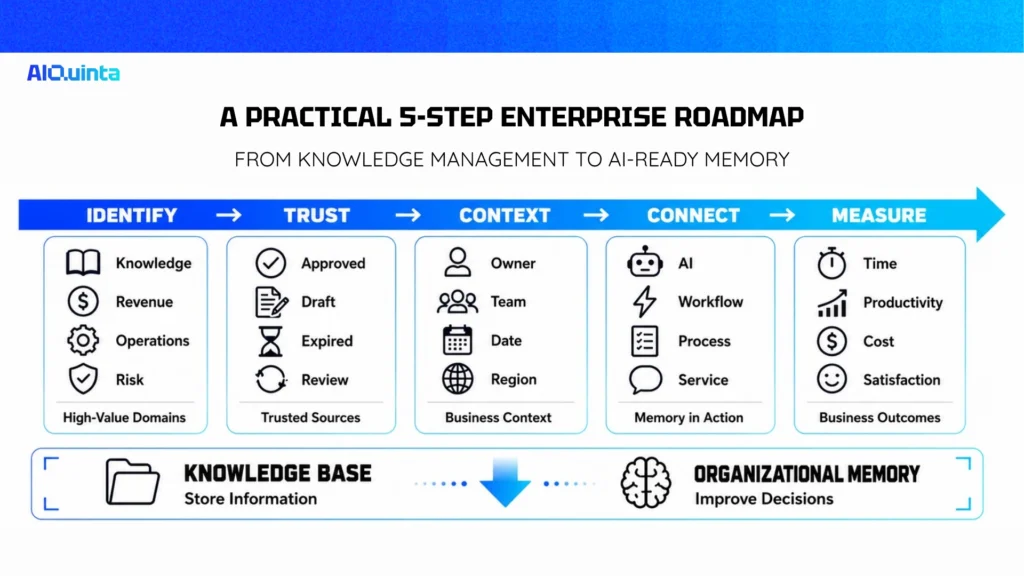
Companies do not need to rebuild everything at once. A practical roadmap has five steps.
Start with knowledge that affects revenue, cost, service speed, or risk.
Good starting points include:
Avoid starting with all company documents. That creates noise and slows progress.
AI needs trusted inputs. Identify which documents are approved, which are outdated, and which should not be used.
A simple content status model helps:
This step improves retrieval quality and reduces wrong answers.
Documents alone are not enough. Add context that explains when and how knowledge should be used.
Useful context includes:
This turns static content into usable memory.
The real value appears when memory supports work.
For example, a customer service agent should not only get an answer. The system should help draft the reply, check the policy, log the case, and suggest escalation if needed.
This is the shift from “knowledge base” to “execution layer.”
Do not measure only AI usage. Measure economic outcomes.
Useful metrics include:
The goal is not to prove that employees used AI. The goal is to prove that work became faster, cheaper, and more consistent.
Mistake 1: Treating AI as a new search box
If AI only searches documents, it creates limited value. The stronger opportunity is to connect knowledge to tasks and decisions.
Mistake 2: Uploading everything into the AI system
More content does not mean better memory. It often means more confusion. Start with high-value, trusted knowledge.
Mistake 3: Ignoring ownership
Every critical knowledge domain needs an owner. Without ownership, content becomes stale and AI trust drops.
Mistake 4: Measuring adoption instead of ROI
High usage does not always mean high value. A chatbot can be popular and still fail to improve business results. Measure time, cost, quality, and decision speed.
Mistake 5: Separating memory from governance
AI-era memory must respect access rights, approval rules, and data quality standards. Otherwise, companies may scale errors faster than they scale value.
Organizational memory and knowledge management are related but serve different purposes. Knowledge management stores and shares information, while organizational memory helps people and AI apply that knowledge in real work.
In the AI era, strong organizational memory is essential because AI depends on accurate, trusted, and contextual information. Companies that improve knowledge quality, connect it to workflows, and measure business outcomes are more likely to realize value from AI investments.
Ultimately, successful enterprise AI depends not only on better models but also on better organizational memory.
Is organizational memory the same as knowledge management?
No. Knowledge management focuses on storing, organizing, and sharing knowledge. Organizational memory includes that, but goes further. It connects knowledge to decisions, workflows, history, and business context so people and AI systems can use it in real work.
Does organizational memory replace knowledge management?
No. It upgrades knowledge management. Knowledge management remains the foundation. Organizational memory makes that foundation more active, connected, and useful for AI-powered work.
Why does organizational memory matter for AI?
AI needs context to give useful answers. If company knowledge is outdated or scattered, AI may return weak results. Organizational memory gives AI a trusted base of company-specific knowledge, rules, and past decisions.