








 Duc Nguyen (Dwight)
Learn how a Web search AI agent plans queries, retrieves sources, validates evidence, and turns live web data into reliable agent outputs.
Table of Contents
Toggle A web search AI agent is an AI system that can use web search as part of its task workflow. It does not rely only on the knowledge stored in the model. Instead, it can decide when it needs live information, send search queries, inspect web sources, extract relevant content, compare evidence, and produce a grounded response.
The counterpoint is important: a web search AI agent is not always more accurate by default. If it searches poorly, reads weak sources, or trusts shallow snippets, it can still return wrong answers. Web access expands the agent’s reach, but it also introduces noise, bias, spam, paywalls, crawler blocks and prompt injection risks.
This is why “web search” should be treated as an agent capability, not a simple feature. In enterprise AI, the business question is not “Can the agent search?” The better question is: “Can the agent search with control, explain what it found, cite the source, and avoid acting on weak evidence?”
Large language models are strong at reasoning over context, but they have limits. They may not know recent facts. They may not have access to niche market data. They may not know the latest product pricing, regulations, company updates, research papers, or competitor announcements.
A web search agent skill solves this gap by giving the agent access to current external information. This matters for use cases such as:
For example, if a user asks, “What are the latest AI search APIs for agent workflows?” the agent should not answer from memory. It should search, compare current sources, check publish dates, and explain the trade-offs.
Traditional keyword matching and semantic search retrieval return results in approximately 200 to 500 milliseconds. In contrast, an agentic web search workflow natively takes between 10 and 30 seconds per query. This latency is not a bug; it is an inherent requirement of the architecture. The agent must formulate a query, wait for the search API to return URLs, initiate a scraping tool to read the DOM, process thousands of tokens of scraped Markdown, and run inference to determine if the goal is met. Consequently, utilizing reasoning agents for standard consumer-facing chatbots is often a misallocation of resources.
A critical failure mode in web search agent capabilities is the infinite reasoning loop. If an agent fails to find the target information in its initial query, a poorly constrained system will continually generate synonymous queries, burning token budgets and compounding latency. Furthermore, because agents read the raw extracted text of web pages, they are highly susceptible to parsing SEO-optimized filler, cookie banners, or advertorial content as factual data, leading to grounded, yet entirely inaccurate, hallucinations.
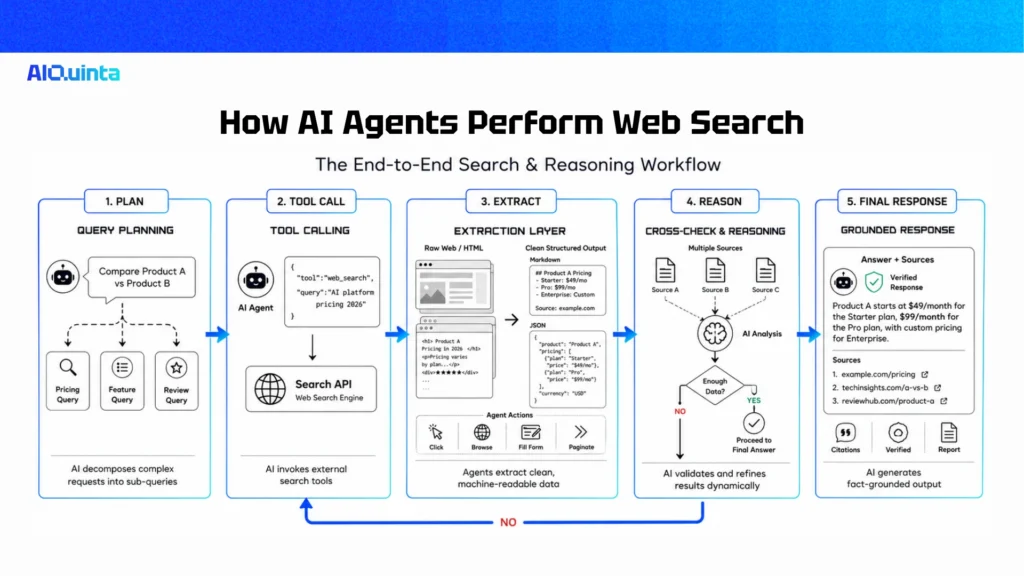
When implemented with strict guardrails, the web search agent skill allows systems to access live data, verify facts, and synthesize external knowledge. The workflow operates as a multi-step loop rather than a single-shot retrieval.
The workflow begins when the orchestrating model receives a prompt that requires external grounding. The foundational model determines that its internal weights are insufficient or stale. Instead of executing a single search, the planning module breaks the complex request into discrete sub-queries. For example, if tasked with comparing the pricing of two competitor products, the agent plans two distinct search trajectories rather than one bloated query.
Once the sub-queries are defined, the agent utilizes tool calling. Through interfaces like the Model Context Protocol (MCP) or native tool arrays in the OpenAI Responses API, the model outputs a structured JSON command (e.g., {"type": "web_search", "query": "Enterprise AI platform pricing 2026"}). This command is intercepted by the application layer, which routes it to an AI-native search engine.
Traditional search engines return HTML designed for human rendering. AI agents require clean, structured data. At this stage, specialized tools execute the search and simultaneously scrape the target URLs. They strip away visual formatting and return raw Markdown or JSON. Advanced agents also utilize interaction tools at this stage—operating headless browsers via frameworks like Playwright to click through pagination, bypass pop-ups, or fill out forms to access gated data.
The extracted Markdown is fed back into the agent’s context window. The agent initiates a reasoning phase to evaluate the data against the original objective. If the data is sufficient, the loop closes, and the final response is generated with inline citations. If the data is contradictory or incomplete, the agent dynamically adjusts its strategy, formulates a new, more specific query, and triggers Step 2 again.
The efficiency of how AI agents perform web search heavily depends on the underlying orchestration architecture.
Most basic web search agents utilize the ReAct (Reasoning and Acting) framework. The agent reasons about the problem, takes an action (searches the web), observes the result, and reasons again. This interleaving is highly adaptable to unexpected search results (e.g., a 404 error or a paywall).
Alternatively, the Plan-and-Solve architecture requires the agent to generate an entire search itinerary upfront before executing any queries. This approach reduces token costs and inference time for highly predictable workflows, but it is brittle; if the first search yields unexpected results, the rest of the pre-planned steps may become irrelevant.
For deep research, single-agent architectures often exceed context windows or lose focus. Multi-agent systems solve this by dividing responsibilities.
In this setup:
Lead Agent: Analyzes the user prompt and delegates tasks.
Search Worker Agents: Execute parallel web searches on specific sub-topics.
Synthesis Agent: Compiles the findings from the workers, cross-checks for contradictions, and formats the final output.
This parallelization allows for exhaustive exploration without overwhelming a single context window, significantly accelerating the research phase.
Not all agentic search functions require the same level of autonomy. Google, OpenAI, and open-source frameworks generally categorize the web search agent skill into three distinct tiers:
This is the fastest, lowest-cost tier. The model receives a prompt, immediately generates a search tool call, and passes the first page of results directly into the generation phase. There is no planning step and no iterative looping. It is ideal for factual lookups (e.g., current exchange rates, stock prices) where speed is paramount and the latency stays within 1 to 3 seconds.
This tier introduces active management of the search process. The model actively decides whether to search, analyzes the returned data, and can choose to search again if the answer is incomplete. It provides a balance between depth and speed, generally returning answers in 10 to 15 seconds. It is best suited for complex enterprise queries and customer support routing.
Deep research represents fully autonomous, long-running investigations. The model will conduct dozens of web searches as part of an extensive chain of thought, tap into hundreds of sources, and navigate site hierarchies. These searches can run asynchronously for several minutes. This tier is strictly reserved for comprehensive market intelligence, academic literature reviews, and due diligence reporting.
To deploy a web search AI agent in a production environment, developers must enforce strict system boundaries to mitigate the architectural limitations discussed earlier.
The quality of an agent’s search is dictated by its tools. Connecting a reasoning model to a standard consumer search API (like a basic Google Custom Search integration) results in high token usage due to HTML bloat. Enterprises must implement neural indexing APIs or extraction tools designed for LLMs. Furthermore, tool descriptions must be explicit. If an agent is given a tool labeled search_web, it may use it erratically. Giving it explicit heuristics—such as search_internal_docs_first followed by search_external_web_for_recent_news—drastically reduces failure rates.
Agents operate with strict context limits. A web search agent performing a deep research task will quickly exhaust its context window if it attempts to hold every scraped page in its short-term memory. Production architectures require a robust retrieval-augmented generation (RAG) backend. As the agent searches and extracts data, the information must be vectorized and stored in long-term memory (a vector database). The agent then queries its own compiled database to synthesize the final report, ensuring that historical context is maintained across multi-session tasks without overflowing token limits.
Understanding how AI agents perform web search requires acknowledging the trade-offs between processing speed and reasoning depth. While the integration of multi-hop reasoning, parallelized multi-agent execution, and autonomous tool calling unlocks deep research capabilities previously impossible for static LLMs, it also introduces unavoidable latency and the risk of recursive failure loops. By structuring robust tool interfaces and applying strict architectural boundaries, enterprises can leverage the web search agent skill to transform static chat interfaces into dynamic, real-time research engines.
What is a web search AI agent?
A web search AI agent is an AI system that can search the web, read sources, extract relevant content, and use that evidence to answer questions or complete tasks.
How do AI agents perform web search?
AI agents perform web search by detecting when live information is needed, rewriting the user query, retrieving search results, opening selected pages, extracting content, validating evidence, and generating a grounded answer.
What is a web search agent skill?
A web search agent skill is a reusable capability that lets an AI agent search, fetch, extract, crawl, rank, and cite web content within a controlled workflow.