


Harness Engineering: Complete Guide to Reliable AI Agents
- Publised April, 2026
-
Duc Nguyen (Dwight)
Harness engineering is the discipline of building systems, guardrails, and feedback loops around AI models to create reliable coding agents.
Table of Contents
Toggle
Key Takeaways
- Harness engineering defines the execution framework that connects AI agents, tools, and workflows.
- It separates reasoning (LLM intelligence) from execution (system orchestration).
- A well-designed harness improves reliability, observability, and governance of AI systems.
- Modern enterprise AI platforms use harness architectures to enable multi-agent coordination.
What is Harness Engineering in AI Systems?
Harness engineering refers to the design of the runtime framework that orchestrates AI models, tools, and execution logic.
It acts as a control layer between an AI model and the real-world systems it interacts with.
Rather than allowing the model to execute arbitrary instructions, the harness:
- Validates outputs
- Routes tasks to appropriate tools
- Manages execution order
- Monitors results
- Handles errors and retries
This approach ensures that AI agents operate within safe, predictable system boundaries.
Simple Definition
Harness engineering is the infrastructure that manages how AI systems execute tasks and interact with external capabilities.
Why the Term “Harness”?
The term comes from engineering and robotics, where a harness refers to a framework that controls and stabilizes system behavior.
In AI, the harness:
- connects AI reasoning to system execution
- constrains unsafe actions
- ensures reliability and repeatability
Harness Engineering vs. Context Engineering vs. Prompt Engineering
| Feature | Prompt Engineering | Context Engineering | Harness Engineering |
|---|---|---|---|
|
Focus |
Single input crafting |
What the model sees now |
Full execution environment |
|
Scope |
One-shot interaction |
Single session |
Multi-session, production |
|
When It’s Enough |
Simple tasks |
Short workflows |
Complex, autonomous coding |
Why Harness Engineering is critical for AI Systems
As AI systems move from experimentation to production, reliability becomes a major concern.
Without a harness, AI agents suffer from several problems.
Uncontrolled Tool Usage
Language models may:
- call the wrong API
- hallucinate tool parameters
- execute tasks in the wrong order
Lack of Observability
Without orchestration, developers cannot easily track:
- tool usage
- agent decisions
- system failures
Weak Governance
Enterprises require control over:
- data access
- permissions
- execution policies
Harness engineering solves these challenges by introducing structured execution pipelines.
Core Components of a Harness Architecture
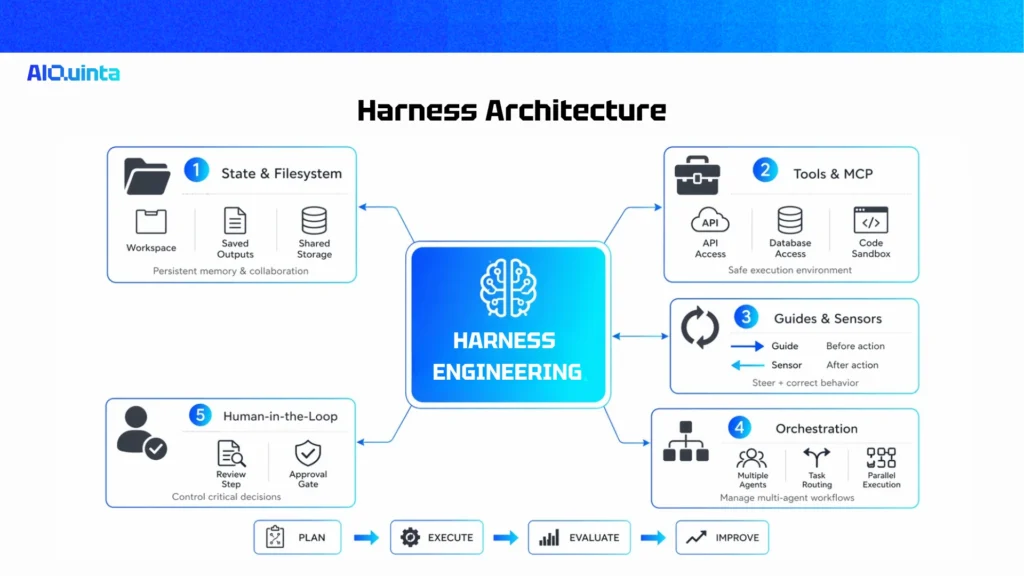
The Filesystem and State Management
Context is a scarce and expensive resource. Forcing an AI to hold all project context in its immediate prompt window leads to hallucination and “context crowding,” where the model forgets its original constraints.
A modern harness provides the agent with a durable filesystem.
Workspaces: Agents get a dedicated workspace to read data, document code, and review architecture.
State Persistence: Work can be incrementally saved. The agent can store intermediate outputs, allowing state to outlast a single interaction.
Collaboration: A shared filesystem allows multiple specialized sub-agents to collaborate on a larger objective.
The Tool Shed (Execution Environments & MCPs)
An enterprise agent needs to take action, but it shouldn’t have a master key to your entire infrastructure. The harness defines a strict, pre-approved set of tools.
Code Execution Sandboxes: Modern harnesses provide isolated, containerized environments (sandboxes) where the AI can write, test, and execute code safely without risking the host system.
Model Context Protocol (MCP): Integrating standard MCPs allows the harness to dynamically connect the agent to continuous integration (CI) statuses, deployment logs, and live metrics.
The Steering Loop: Guides and Sensors
Guides (Feed-forward): These anticipate the agent’s behavior and steer it before it acts. Examples include rigid architectural templates, strict system prompts, and predefined linters. They increase the probability that the agent gets it right on the first try.
Sensors (Feed-back): These observe the agent after it acts. Did the code compile? Did the generated test suite achieve high coverage? Sensors automatically trigger the agent to self-correct before human intervention is required.
Orchestration and Routing Logic
In an enterprise setting, a single agent rarely completes a massive workflow alone. The harness contains the orchestration logic necessary to spawn sub-agents, delegate tasks in parallel, and route specific sub-tasks to smaller, faster, or specialized models (e.g., routing complex reasoning to a massive model, and simple data formatting to a smaller, cost-effective model).
Human-in-the-Loop Checkpoints
A safe harness never fully eliminates the human; it simply optimizes where human intervention occurs. A well-engineered harness places review checkpoints strategically—such as reviewing the AI’s execution plan before it spends hours writing code. Catching a wrong assumption in a short plan costs far less than fixing a massive pull request.
The Harness Engineering Lifecycle: Best Practices
Implementing a harness engineering strategy within your AI solution requires a fundamental shift in how your development teams operate.
Step 1: Define Strict Boundaries
Agents are most effective in environments with predictable structures. Do not give the AI an open-ended objective. Instead, build your application around a rigid architectural model. Require the AI to parse data shapes at the boundary and enforce constraints mechanically via custom linters and structural tests. The more you constrain the solution space, the more predictable the AI’s output becomes.
Step 2: Employ Progressive Disclosure
Do not overwhelm the agent with massive instruction files on the first prompt. Utilize “progressive disclosure.” Start the agent with a small, stable entry point and teach it where to look next in the filesystem or API directory. Let it query for the context it needs dynamically.
Step 3: Treat the Harness as Software
Skills, system prompts, middleware, and MCP configurations are code. They must be treated with the same rigor as your core product.
Version-control your harness configurations.
Review prompt changes in Pull Requests (PRs).
Refactor the harness when it drifts. A stale system prompt creates technical debt just like stale application code.
Step 4: Analyze Traces to Fix the Harness, Not the Output
When an agent generates a bad plan or fails a task, the instinct is often to tell the agent to “try again” or to manually fix the output. In harness engineering, you must trace the mistake back to the input environment. Was a constraint missing? Was a required symbol hidden from the AI’s view? Fix the harness so the error never happens again.
Harness Engineering in Multi-Agent Systems
Many advanced AI systems now rely on multiple specialized agents working together.
Harness engineering enables coordination between these agents.
Example architecture:
- Research agent retrieves information
- Analysis agent processes data
- Reporting agent generates insights
- Action agent executes tasks
The harness controls:
- communication between agents
- execution order
- resource access
Without a harness, multi-agent systems quickly become unpredictable and fragile.
Harness Engineering and Tool-Using AI Agents
Modern AI agents often rely on external tools.
Examples include:
- database queries
- web search
- code execution
- document retrieval
- workflow automation
Harness engineering ensures that tool usage follows strict schemas and protocols.
Typical flow:
- AI decides a tool is required
- Harness validates parameters
- Tool executes
- Results return to AI
- AI continues reasoning
This controlled loop prevents tool misuse.
The Future of Harness Engineering
Harness engineering will likely become a core discipline in AI system design.
Future developments include:
- agent operating systems
- capability graphs for intelligent routing
- policy-driven AI governance
- distributed agent infrastructures
As AI agents become more autonomous, harness architectures will act as the control plane that governs intelligent systems.
Organizations that invest in harness engineering today will gain a significant advantage in building scalable, safe, and reliable AI platforms.
Conclusion
Harness engineering is the foundation that transforms large language models into reliable AI systems capable of executing real-world tasks.
By introducing structured orchestration, capability management, validation layers, and observability, harness architectures ensure that AI agents operate safely and predictably.
As enterprises deploy increasingly complex AI systems, harness engineering will become essential for scaling intelligent automation while maintaining control, governance, and reliability.
FAQs
What is harness engineering in AI?
Harness engineering is the design of the execution framework that connects AI models with tools, APIs, and workflows, ensuring reliable task execution.
Why do AI agents need a harness?
AI agents require a harness to manage tool usage, validate outputs, enforce safety policies, and coordinate multi-step workflows.
What technologies are used to build AI harness systems?
Common technologies include orchestration frameworks, capability registries, workflow engines, API gateways, and observability platforms.
Turn Enterprise Knowledge Into Autonomous AI Agents
Your Knowledge, Your Agents, Your Control
Your Knowledge, Your Agents, Your Control