

Context Engineering: The Next Evolution of Prompting
- Publised April, 2026
-
Duc Nguyen (Dwight)
Explore Context Engineering: Learn why it outperforms Prompt Engineering and how to optimize LLM context windows for enterprise AI.
Table of Contents
Toggle
Key Takeaways
Beyond the Prompt: While prompt engineering focuses on how to ask a Large Language Model (LLM) a question, context engineering dictates what information the model can access before it answers.
The Attention Budget: LLMs possess a finite “attention budget.” Context engineering optimizes this by filtering noise and delivering only high-signal data.
Agentic Power: Multi-step AI agents require robust context engineering (memory, tool access, and state management) to function autonomously without losing track of their goals.
Combating Hallucinations: By dynamically retrieving real-time data and proprietary knowledge (often via RAG or GraphRAG), context engineering grounds AI responses in verifiable truth.
Solving Context Rot: Long conversations suffer from “context rot” or semantic drift. Effective context architecture uses pruning and compaction to maintain focus over extended interactions.
Introduction: The Limitations of "Clever" Prompting
For the past few years, prompt engineering was heralded as the ultimate skill for taming Large Language Models (LLMs). Teams spent countless hours tweaking adjectives, applying rigid formatting rules, and injecting “expert personas” into their system prompts to coax better outputs from AI. However, as organizations transition from building simple chatbots to deploying complex, multi-agent enterprise applications, a stark reality has emerged: prompt engineering alone is no longer enough.
When an AI system needs to remember user preferences across sessions, execute multi-step workflows, query external databases, and navigate compliance guardrails, static instructions inevitably fail. The prompt becomes a bloated, unmanageable monolith, and the model begins to hallucinate or “forget” earlier instructions.
Enter Context Engineering.
Context engineering represents a fundamental shift from model-centric optimization (wordsmithing prompts) to architecture-centric optimization (managing the information ecosystem). This comprehensive guide explores what context engineering is, why it serves as the critical backbone for production-ready AI, and how you can implement it to build highly reliable, autonomous AI systems.
What is Context Engineering?
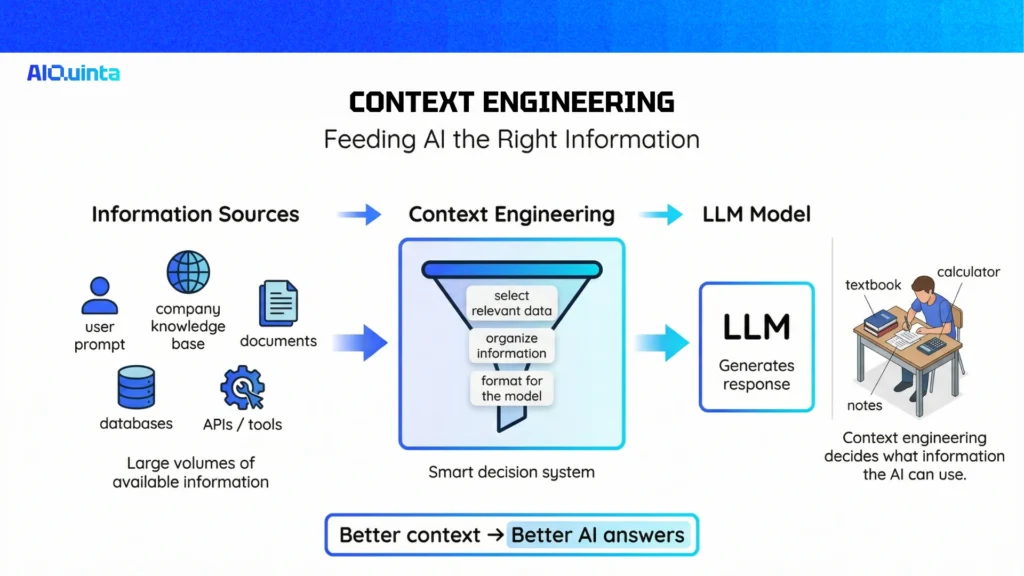
Context engineering is the systematic discipline of designing, curating, and managing the information environment that surrounds an AI model during inference. It is the process of treating the LLM’s context window – the total amount of text a model can process at one time – as a scarce and highly valuable resource.
If prompt engineering is writing the exact instructions for an open-book exam, context engineering is curating the textbook, the calculator, and the reference notes the student is allowed to bring into the room.
The goal of context engineering is to ensure the model is fed the right information, in the right format, at the exact right time, maximizing the likelihood of an accurate, grounded, and task-specific response. This involves dynamically orchestrating several moving parts behind the scenes before the user’s prompt ever reaches the LLM.
The LLM "Attention Budget"
Under the hood, LLMs are built on the transformer architecture. As the number of tokens (words or word pieces) in a context window increases, the computational complexity scales quadratically. More importantly, the model’s ability to focus degrades.
Models suffer from an “attention budget.” If you dump thousands of pages of unstructured data into a massive two-million-token context window, the model will struggle to pinpoint the relevant facts – a phenomenon often referred to as the “lost in the middle” problem. Good context engineering strictly manages this attention budget, delivering the smallest possible set of high-signal tokens required to execute the immediate task.
Context Engineering vs. Prompt Engineering: The Paradigm Shift
To truly grasp the value of context engineering, you must understand how it differs from its predecessor. Prompt engineering is a crucial subset of context engineering, but the two disciplines operate on entirely different strategic levels.
| Feature | Prompt Engineering | Context Engineering |
|---|---|---|
|
Focus |
Wordsmithing instructions and structuring output. |
Architecting the flow of information, memory, and tools. |
|
Scope |
Single input-output pairs (user-facing). |
The entire information ecosystem (system-facing). |
|
Data Nature |
Static (hardcoded rules and examples). |
Dynamic (retrieved databases, API responses, live state). |
|
Scalability |
Struggles to scale; requires constant manual tweaking. |
Highly scalable; relies on automated pipelines and logic. |
|
Primary Risk |
The model gives a poorly formatted or generic answer. |
The model hallucinates, uses the wrong tool, or loses state. |
|
Core Tools |
Playgrounds, ChatGPT interface, prompt templates. |
RAG frameworks, Vector Databases, Knowledge Graphs, APIs. |
You can engineer a flawless prompt, but if it gets buried beneath 10,000 tokens of irrelevant chat history or noisy database retrieval, the system will fail. Prompt engineering gets you the first good output; context engineering ensures the 1,000th output is just as reliable.
The Core Pillars of Context Architecture
Effective context engineering relies on an interdependent system of components that control what data reaches the model and when.
Retrieval-Augmented Generation (RAG)
Instead of relying solely on the LLM’s pre-trained (and potentially outdated) knowledge, RAG systems fetch relevant, proprietary data from a vector database and inject it into the context window. Advanced context engineers are now moving toward Hybrid RAG (combining keyword and semantic search) and GraphRAG (using knowledge graphs to surface interconnected facts and entity relationships), ensuring the model receives a highly structured, accurate data package.
Memory Systems and State Management
Agents must retain context over time without blowing up the token limit. Context engineers design memory architectures split into:
Short-Term Memory: The immediate, recent turns in a conversation or the active steps in a current workflow.
Long-Term Memory: Persistent user profiles, historical preferences, or past resolutions stored in an external database and retrieved only when topically relevant.
Tool Calling and Orchestration
Modern AI acts as an agent capable of interacting with the outside world (e.g., searching the web, querying SQL databases, sending emails). Context engineering involves defining these tools clearly, teaching the model when to trigger them, and crucially formatting the outputs of those tools so they cleanly integrate back into the model’s context for the next reasoning step.
Dynamic System Instructions
System instructions shouldn’t be static. Based on the user’s intent, a context routing engine should dynamically assemble the system prompt. If the user asks a billing question, the system injects compliance guardrails and billing APIs; if they ask a technical question, it injects documentation and code execution tools.
Why Enterprise AI Depends on Context Engineering
Transitioning from prototypes to enterprise-grade AI requires solving hard problems related to reliability, security, and complex logic. Context engineering is the key to unlocking these capabilities.
Reducing Hallucinations and Grounding Truth
When an LLM is forced to guess, it hallucinates. By engineering the context to strictly provide validated, up-to-date, and domain-specific evidence – and prompting the model to only answer based on that evidence – organizations can drastically reduce hallucination rates, making the AI trustworthy enough for customer-facing deployment.
Enabling Multi-Step Agentic Workflows
AI agents utilize the “Reason, Act, Observe” loop. To do this successfully, the context must be updated at every phase. The agent needs its goal and constraints to reason, the API specs to act, and the cleanly parsed results to observe. Without robust context engineering, the agent will loop infinitely or forget its original objective by step three.
Ensuring Security and Access Control
In enterprise environments, not all users have the same data permissions. Context engineering pipelines intercept the user’s query, check their authentication tokens, and filter the retrieved data before it enters the LLM’s context window. This ensures the AI never summarizes a confidential document for an unauthorized user.
Common Pitfalls and How to Fix Them
Even with the best tools, managing context is fraught with challenges. Here are the most common pitfalls and their engineered solutions.
Context Rot (Semantic Drift)
The Problem: In long-running interactions, the context window fills with minor conversational tangents, outdated goals, or past errors. The model loses focus on the primary objective and performance degrades.
The Fix (Compaction): Implement context summarization routines. Periodically have an auxiliary LLM compress the chat history into a dense summary of “key facts established,” freeing up tokens and removing noise.
Context Confusion (Tool Overload)
The Problem: Giving an agent access to 50 different tools simultaneously clutters the context. The model gets confused by overlapping tool descriptions and selects the wrong one.
The Fix: Use RAG for tool loadouts. When a user asks a query, retrieve only the top 3-5 most relevant tool specifications and inject only those into the context window.
Prompt Injection Vulnerabilities
The Problem: When pulling context from the open web or untrusted user files, malicious instructions embedded in that data can “hijack” the agent, overriding the system prompt.
The Fix: Isolate untrusted context. Use structural delimiters, data quarantine techniques, and strict formatting schemas to separate core instructions from dynamic external data.
Best Practices for Implementing Context Engineering
To build a robust context architecture, keep these strategic best practices in mind:
-
Prioritize Signal Over Noise: Do not fall for the trap of massive context windows. Just because a model can process two million tokens doesn’t mean it should. Smaller, highly relevant context payloads consistently yield faster, cheaper, and more accurate responses.
-
Embrace Graph-Aware Retrieval: Move beyond standard vector chunks. Use Knowledge Graphs to feed the LLM structured context about how entities relate to one another. This allows the model to perform multi-hop reasoning with explainable decision paths.
-
Evaluate Systematically: You cannot engineer what you cannot measure. Set up continuous evaluation pipelines to measure context relevance, context precision, and groundedness.
-
Adopt a Modular Architecture: Separate your prompts, your retrieval logic, your tool definitions, and your memory state. This allows you to update policies or swap out underlying embedding models without having to rewrite monolithic prompts.
Conclusion
The era of relying solely on “magic words” to steer Large Language Models is ending. As we push AI to handle increasingly complex, autonomous, and high-stakes tasks, the discipline of context engineering takes center stage. By systematically architecting the knowledge, memory, and tools available to the model, teams can bridge the gap between impressive technical demos and highly reliable, enterprise-grade AI solutions. Moving forward, the most successful AI developers won’t just be asking “how do I phrase this?”—they will be asking “what information ecosystem does this model need to succeed?”
FAQs
What is the difference between a prompt and context?
A prompt is the direct instruction or question provided to the AI (e.g., “Summarize this document”). Context encompasses all the background information, historical memory, tool outputs, and guardrails surrounding that prompt to help the AI understand how to answer it accurately.
Does a larger context window eliminate the need for context engineering?
No. While modern LLMs have massive context windows (up to millions of tokens), filling them with unstructured data causes “attention degradation.” The model struggles to find the needle in the haystack, leading to hallucinations and slow response times. Context engineering filters the noise to provide only the most relevant data.
How does context engineering improve AI agents?
AI agents need to make autonomous decisions, use external tools, and plan multi-step workflows. Context engineering provides the necessary infrastructure—such as injecting the right tool specifications at the right time and storing past observations in a structured memory—allowing the agent to act logically without getting stuck in infinite loops.
Turn Enterprise Knowledge Into Autonomous AI Agents
Your Knowledge, Your Agents, Your Control
Your Knowledge, Your Agents, Your Control
Latest Articles