


Stanford AI Index Report 2026: Economic Trends Explained
- Publised April, 2026
-
Duc Nguyen (Dwight)
Explore the economic impact of AI in 2026, covering jobs, productivity, wages and enterprise ROI, based on the AI Index insights from Stanford HAI.
Table of Contents
Toggle
Key Takeaways
-
Unprecedented Mass Adoption: Generative AI has rapidly penetrated the global market, reaching nearly 53% population-level adoption in just three years, while organizational adoption has surged to an impressive 88%.
-
Investment and Revenue Surge: Global corporate investment in artificial intelligence more than doubled in 2025. Consequently, leading AI companies are reaching massive revenue milestones faster than any previous technology generation.
-
The AI Job Market Explosion: Demand for AI skills is fundamentally reshaping the labor force. AI-related skills are now explicitly requested in 2.5% of all U.S. job postings—a staggering 297% increase over the past decade.
-
The Shift to Agentic AI: The corporate focus is moving away from simple chatbots toward “Agentic AI”—systems capable of independent task execution. Mentions of this specific skill in job postings skyrocketed by over 280% in just one year.
-
Global Talent Shifts: Singapore currently leads the world in AI job demand concentration, followed closely by Hong Kong and Luxembourg, signaling a geographical shift in where the new AI-driven economy is being built.
Executive Overview: AI as an Economic Multiplier
For close to a decade, the Stanford Institute for Human-Centered Artificial Intelligence (HAI) has published the AI Index Report, widely regarded as the most authoritative and comprehensive data-driven snapshot of the artificial intelligence landscape. While previous iterations heavily emphasized theoretical research, model parameters, and technical benchmarks, the Stanford AI Index Report 2026 tells a distinctly different story: the story of a technology that has firmly left the laboratory and fundamentally rewired the global economy.
We are no longer waiting for the economic impact of AI to arrive; we are standing in the middle of it. From skyrocketing corporate investments to a massive restructuring of the global labor market, the 2026 report provides undeniable proof that artificial intelligence is scaling at a pace that dwarfs previous technological revolutions.
This comprehensive guide distills the most critical economic and business-focused insights from the Stanford AI Index Report 2026. Stripping away the technical jargon, we will explore exactly how AI is reshaping corporate revenue, global workforce demands, and operational infrastructure, providing you with actionable insights to navigate this rapidly evolving landscape.
The Surging AI Economy: Adoption and Investment
Unprecedented Organizational and Consumer Adoption
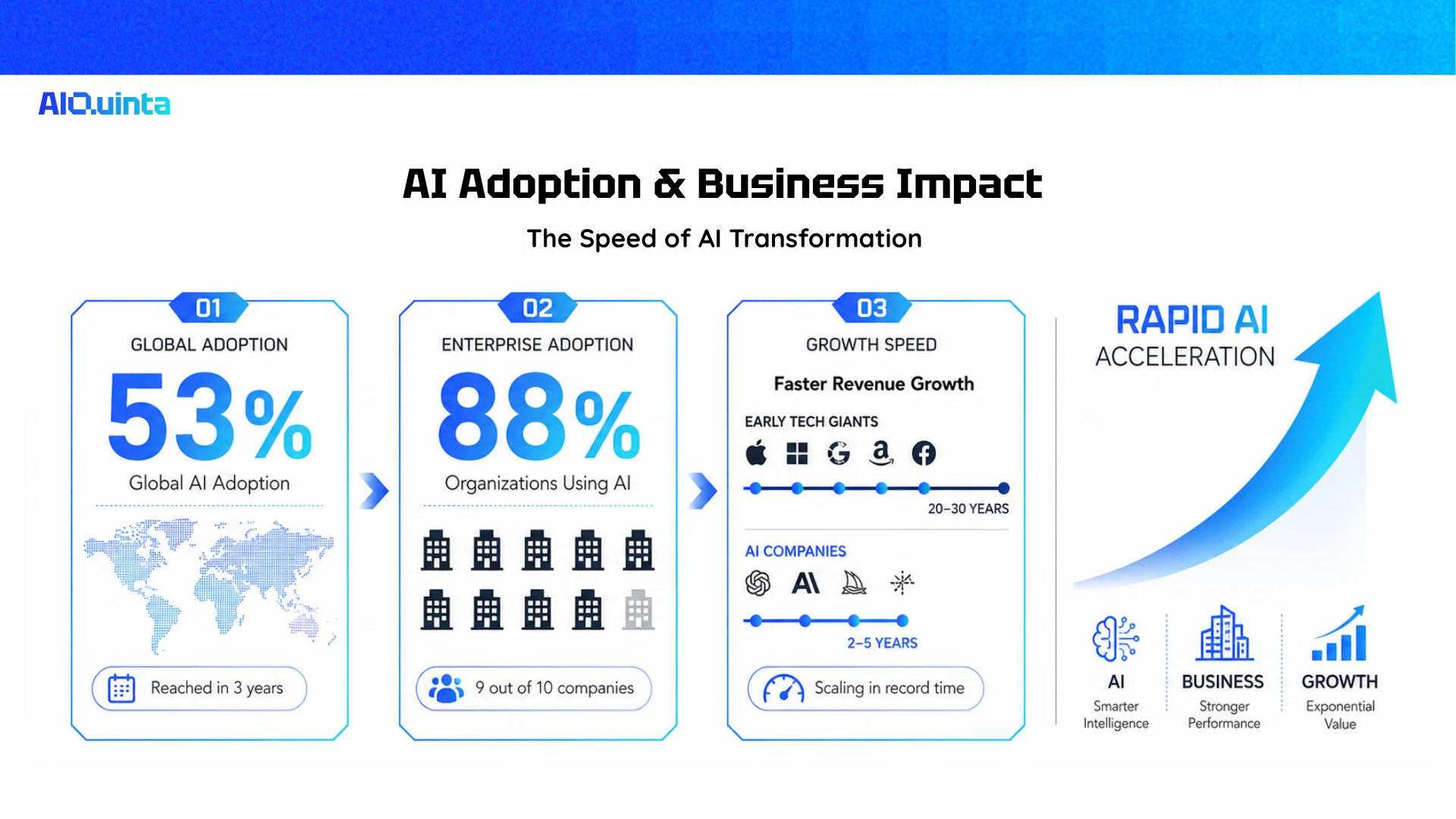
According to the latest data, generative AI achieved nearly 53% population-level adoption globally within just three years of mainstream introduction. However, the most profound economic indicator lies in the enterprise sector: organizational adoption of AI has now risen to 88%. This means nearly nine out of ten organizations are actively utilizing artificial intelligence within their business models. This rapid integration is translating directly into financial velocity. The report highlights that leading AI companies are reaching meaningful, sustainable revenue scales in a fraction of the time it took the tech giants of the early 2000s.
A Historic Surge in Corporate Investment
To fuel this rapid expansion, financial capital is flowing into the AI sector at an unprecedented rate. Global corporate investment in AI more than doubled in 2025. This isn’t just venture capital funding speculative startups; this represents massive, sustained enterprise investments by legacy companies overhauling their existing operations.
Analogy: Think of this investment phase not as buying new software, but as industrial electrification. A century ago, factories didn’t just buy a lightbulb; they spent millions rewiring their entire manufacturing plants to run on electricity instead of steam. Today’s corporate investments are the digital equivalent—companies are fundamentally “rewiring” their data and operations to run on AI.
Transforming the Global Labor Market
The Staggering Surge in AI Skill Demand
Employers are no longer just looking for traditional computer science degrees; they want highly specific, applied AI capabilities. As of the 2026 report, AI skills are explicitly mentioned in 2.5% of all U.S. job postings.
To put this growth into perspective:
-
Year-over-Year Growth: Up 55% compared to 2025.
-
Short-Term Growth: Up 72% compared to 2022.
-
Long-Term Growth: Up 297% compared to a decade ago.
The foundational language of AI remains dominant. Python, the programming language most closely associated with AI development, is the most in-demand specialized skill, appearing in nearly 260,000 job postings—a 30% jump from the previous year.
Moving Beyond the Chatbot: The Era of "Agentic AI"
Perhaps the most fascinating economic trend identified in the 2026 report is what kind of AI skills businesses are demanding. There has been a massive, visible shift in employer demand away from basic conversational interfaces toward autonomous systems.
Mentions of skills related to “ChatGPT,” “Conversational AI,” and “Chatbots” actually decreased from 2024 to 2025. In their place, a new skill cluster has emerged as a massive hiring signal: Agentic AI.
Mentions of the “Agentic AI” skill cluster—which includes technologies like LangGraph and AI Agents—increased by over 280% in a single year, representing roughly 90,000 job postings in the U.S. alone.
Analogy: To understand this economic shift, think of a traditional chatbot as a brilliant librarian. You ask the librarian a question, and they instantly hand you the exact book you need. That is helpful, but you still have to read the book and write your report. “Agentic AI,” on the other hand, is like hiring an executive assistant. You don’t just ask them a question; you give them an objective. You tell the assistant, “Plan my business trip to London,” and they independently research the flights, book the hotel, schedule your meetings, and hand you a finished itinerary. Businesses are shifting their hiring budgets toward Agentic AI because they want systems that execute full workflows, not just answer questions.
Table: The Evolution of AI Talent Demand
| Skill Category | Trend (2024-2026) | Economic Implication |
|---|---|---|
|
Conversational AI / Chatbots |
Decreasing |
The market for basic text generation and Q&A interfaces has become saturated and commoditized. |
|
Agentic AI / AI Agents |
Increasing (+280%) |
High demand for systems that can autonomously execute complex, multi-step business workflows. |
|
Python |
Steady High Growth (+30%) |
Foundational programming language remains the bedrock of customized enterprise AI solutions. |
|
Cloud & Deployment (AWS, etc.) |
High Long-Term Growth |
Companies need talent that can build the infrastructure to deploy AI reliably at scale. |
Regional Powerhouses: Where is the AI Economy Booming?
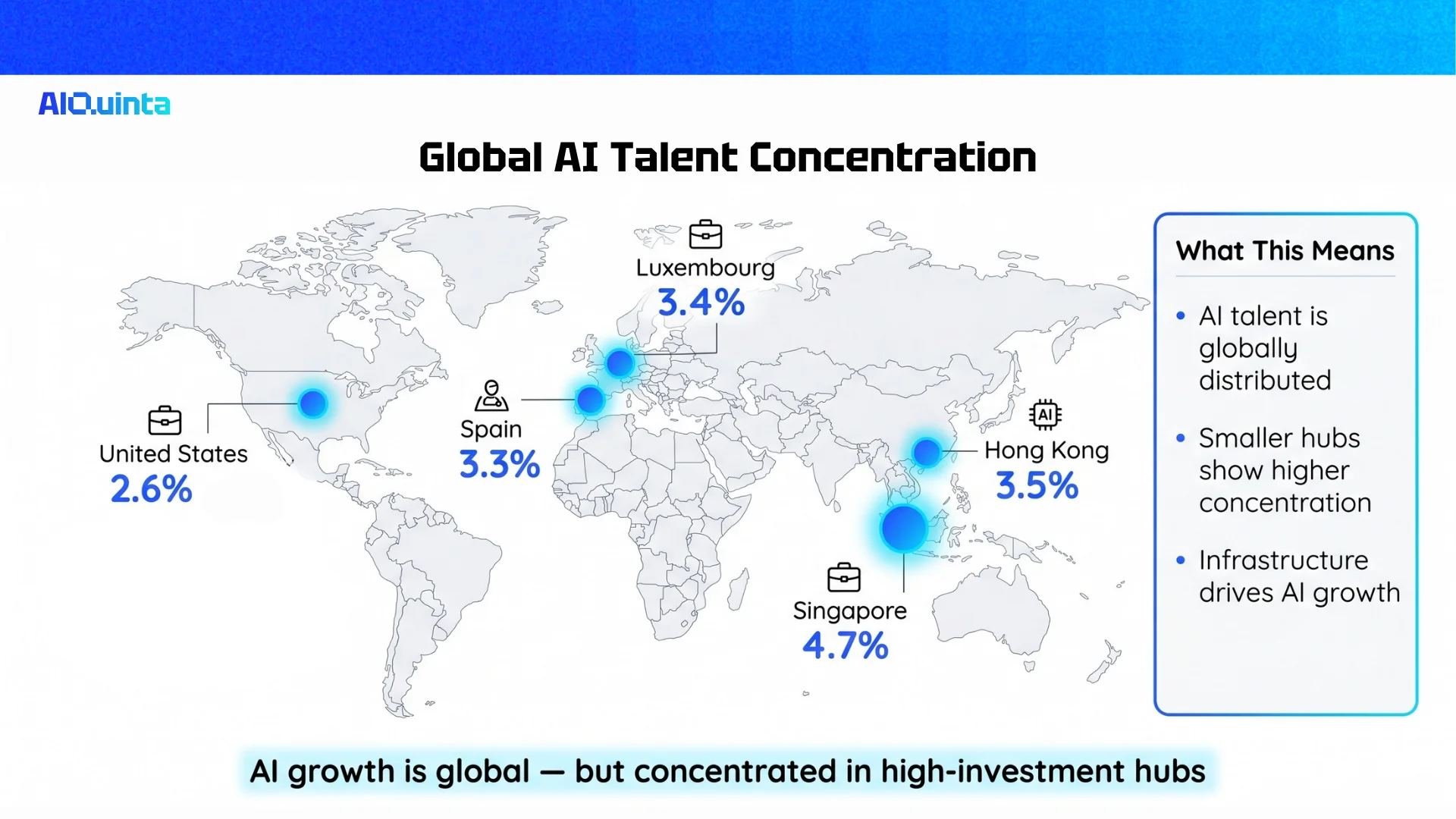
The economic benefits of artificial intelligence are profound, but they are not evenly distributed. The Stanford AI Index Report 2026 highlights a fascinating geographic landscape of where AI talent is most intensely concentrated.
By analyzing the share of overall job postings that mention AI skills, the report identifies clear international leaders driving the AI economy:
-
Singapore (4.7%): Leading the world, nearly 1 in 20 jobs posted in Singapore requires AI skills. This reflects the nation’s aggressive, forward-thinking investments in digital infrastructure and its status as a premier global financial and tech hub.
-
Hong Kong (3.5%): Serving as a critical bridge in international finance and tech, Hong Kong shows massive integration of AI into its corporate sector.
-
Luxembourg (3.4%): A surprising but logical powerhouse, driven by its massive financial services sector utilizing AI for risk assessment, compliance, and quantitative analysis.
-
Spain (3.3%): Demonstrating strong growth in European tech adoption.
-
United States (2.6%): While the U.S. leads in total volume of AI jobs and raw private investment, its larger, more diversified economy means the concentration of AI jobs is slightly lower than the hyper-focused city-states. (Notably, within the U.S., Washington D.C. boasts the highest concentration of AI jobs, reflecting heavy government and defense contracting investments).
This data proves that the AI economy is inherently global. Countries that create favorable environments for digital infrastructure and tech education are capturing a disproportionate share of the economic value generated by this revolution.
The Real-World Business Value of AI Integration
As the initial novelty of artificial intelligence wears off, corporate boards and executives are demanding rigorous ROI (Return on Investment). The 2026 report indicates that the economic narrative is shifting from “What can AI do?” to “How efficiently can AI do it?”
Moving from Experimentation to Execution
In previous years, companies invested in AI primarily for experimental pilot programs. Today, the fastest long-term growth in job skills surrounds deployment-oriented capabilities—specifically Amazon Web Services (AWS), system scalability, and workflow management.
This signifies a maturation of the AI economy. Businesses have successfully built the models; now, they are heavily investing in the robust operational infrastructure required to run them securely, reliably, and profitably 24/7.
Analogy: Imagine the AI models as an incredible, futuristic high-speed train engine. The early years of the AI boom were entirely focused on designing the fastest possible engine. But a fast engine is economically useless sitting in a laboratory. The current economic phase—the massive demand for cloud deployment, scalability, and workflow skills—is the equivalent of laying down thousands of miles of steel tracks, building the train stations, and designing the ticketing systems. Businesses are building the real-world infrastructure so these engines can actually transport goods and generate revenue.
Efficiency Gains and Economic Dashboards
With organizational adoption at 88%, the focus has shifted toward careful measurement. Companies are building high-frequency “AI economic dashboards” to track, at a granular level, exactly where AI is boosting productivity, streamlining supply chains, and augmenting human workers. Whether it’s reducing the time required for medical clinical documentation, automating complex software coding, or entirely handling customer service pipelines, AI is no longer a peripheral tool—it is the core engine of modern corporate efficiency.
Checklist: Preparing Your Business for the AI Economy
Based on the economic data and labor trends from the Stanford AI Index Report 2026, here is a strategic checklist for business leaders looking to stay competitive:
-
Audit Existing Workflows: Identify repetitive, multi-step processes in your business that could be fully automated by Agentic AI, rather than just accelerated by basic chatbots.
-
Shift Hiring Strategies: Look beyond basic prompt engineering. Prioritize hiring talent skilled in Python, cloud deployment (AWS/Azure), and system scalability to ensure your AI initiatives can be executed in production.
-
Invest in Data Infrastructure: AI models are only as valuable as the data they process. Ensure your company’s proprietary data is clean, organized, and securely housed.
-
Establish ROI Dashboards: Stop measuring AI success by “cool factor.” Implement strict economic dashboards to measure time saved, cost reductions, and revenue generated by AI deployments.
-
Upskill the Current Workforce: With AI adoption at 88%, your competitors are already using it. Provide comprehensive training for your non-technical staff to integrate AI tools into their daily operations securely and efficiently.
Conclusion
The Stanford AI Index Report 2026 delivers a resounding economic message: the experimental phase of artificial intelligence is over. We have entered an era of massive infrastructure building, aggressive commercial deployment, and profound labor market transformation. With corporate investments doubling, Agentic AI taking center stage, and specialized AI skills becoming a mandatory requirement across global job markets, the financial implications are staggering. For businesses and professionals alike, understanding and adapting to these data-driven trends is no longer optional—it is the baseline requirement for economic survival and success in the late 2020s.
Resources
- Sha Sajadieh, Loredana Fattorini, Raymond Perrault, Yolanda Gil, Vanessa Parli, Lapo Santarlasci, Juan Pava, Nestor Maslej, Russ Altman, Erik Brynjolfsson, Carla Brodley, Jack Clark, Virginia Dignum, Vipin Kumar, James Landay, Terah Lyons, James Manyika, Juan Carlos Niebles, Yoav Shoham, Elham Tabassi, Russell Wald, Toby Walsh, Dan Weld. “The AI Index 2026 Annual Report,” AI Index Steering Committee, Institute for Human-Centered AI, Stanford University, Stanford, CA, April 2026.
- Lightcast: The Stanford AI Index Report 2026
FAQs
Does AI reduce jobs overall?
No. AI mainly replaces tasks within jobs rather than eliminating entire roles. Many new roles are also being created.
How much productivity improvement can AI deliver?
In many cases, AI improves efficiency by 20–60% in tasks that can be automated or assisted.
How can companies maximize AI ROI?
Focus on high-impact use cases, integrate AI into workflows, and build strong data infrastructure.
Turn Enterprise Knowledge Into Autonomous AI Agents
Your Knowledge, Your Agents, Your Control
Your Knowledge, Your Agents, Your Control
Latest Articles