


How to add AI to an existing BMS without replacing it?
- Publised September, 2026
-
Duc Nguyen (Dwight)
Execute an AI integration with BMS without replacing controls, including architecture, protocols, governance, rollout steps, risks, and ROI criteria.
Table of Contents
Toggle
Key Takeaways
- AI integration with BMS should usually preserve the existing BMS as the deterministic control and safety layer while AI operates at the supervisory level.
- Protocol compatibility is only the first gate. Poor point naming, missing equipment relationships, weak trend data, and unclear write permissions often create more work than connecting BACnet or an API.
- Start with read-only monitoring and recommendation workflows. Grant AI write access only after its recommendations have been validated against real operating conditions.
- Evaluate an AI overlay for BMS based on measurable operational outcomes, fallback behavior, semantic data quality, cybersecurity, and operator control rather than the model alone.
The Counterargument: Why AI Overlays Fail
Before detailing how to layer AI onto a legacy building management system, we must address why existing BMS AI integration often fails.
-
The automation myth: Industry claims of automatic double-digit energy savings ignore the hard constraints of physics and legacy data architectures.
-
Hardware and telemetry limits: AI cannot optimize what physical systems cannot measure or execute. Sluggish actuators, degraded sensors, and slow polling rates (e.g., 15-minute delays on older MS/TP networks) cause optimization models to misalign with real-time building states.
-
Fragmented data ontologies: Legacy networks lack uniform labeling (e.g.,
AHU1_SATvs.Air_Temp_Unit_1). Without semantic tagging frameworks like Project Haystack or Brick Schema to structure the data, the AI lacks context and simply automates flawed decisions. -
The “rip-and-replace” threshold: Wholesale replacement is rarely necessary for enterprise environments. It is only required when underlying controllers are completely proprietary without documented APIs, or if mechanical components physically cannot perform the micro-adjustments dictated by the algorithm.
BMS AI Integration: The Supervisory AI Overlay Architecture
The engineering solution that avoids hardware replacement is the supervisory control overlay. In this topology, the existing BMS remains fully operational as the base layer, while an intelligent agent operates above it.
Decoupling Supervisory Optimization from Deterministic Execution
A common hesitation among plant operators is the fear that an AI agent will cause equipment failure. If a machine learning model encounters edge-case weather conditions and issues a zero-hertz command to a running pump, it could trip a chiller on high pressure.
The supervisory architecture neutralizes this risk by maintaining strict functional separation:
-
Local Controllers Handle Safety and Velocity: The installed DDCs retain exclusive ownership over fast-acting feedback loops (1-to-10-second response times). They manage motor ramps, anti-cycling timers, minimum flow rates, damper end-switches, and freeze-protection stats.
-
Supervisory AI Handles Boundary Conditions: The AI overlay for BMS operates on a 10-to-30-minute control horizon. It does not pulse actuators or throttle valves directly. Instead, it adjusts the setpoints that the local PID loops target, such as chilled water supply temperature, condenser water relief setpoints, duct static pressure, and zone temperature deadbands.
Safe Bidirectional Write-Back via the BACnet Priority Array
BACnet-compliant systems feature an internal safeguarding mechanism: the 16-level Priority Array. Every writable object (such as an analog value setpoint) reserves specific priority slots for different system demands:
| Priority Level | Standard Assignment | AI Overlay Usage |
|---|---|---|
|
Priority 1 |
Manual Life Safety |
AI Execution Locked Out |
|
Priority 2 |
Automatic Life Safety |
AI Execution Locked Out |
|
Priority 3-5 |
Critical Equipment Protection |
AI Execution Locked Out |
|
Priority 6 |
Minimum On/Off State |
AI Execution Locked Out |
|
Priority 8 |
Manual Operator Override |
Human Operator Dominance |
|
Priority 9-15 |
Available Automation Levels |
Optional Staging |
|
Priority 16 |
Default / Supervisory Control |
TARGET FOR AI WRITE-BACK |
When integrating an AI layer, the external system writes exclusively to Priority 16 (or an agreed-upon non-critical tier like Priority 14).
If a building engineer walks up to the field panel or workstation and manually overrides a setpoint at Priority 8, the DDC obeys the human operator immediately, ignoring the Priority 16 value. If smoke control triggers a Priority 1 life-safety override, the AI output is superseded instantly by the hardware controller.
Where AI Integration Creates the Most Value
The best first use cases combine measurable waste with enough historical and real-time data to evaluate the result.
Central HVAC plants are strong candidates because chillers, pumps, towers, weather, load, and energy consumption interact dynamically.
Other practical targets include:
- Fault detection and diagnostics. AI can correlate multiple trends instead of waiting for individual threshold alarms.
- Optimal start and stop. Models can estimate when conditioning should begin based on thermal response rather than fixed schedules.
- Occupancy-aware operation. Booking, occupancy, weather, and BMS data can help adapt ventilation and zone schedules.
- Predictive maintenance. Equipment trends can be linked with work orders, manuals, and previous failures.
- Energy anomaly investigation. AI can distinguish schedule drift, overrides, sensor errors, load changes, and equipment degradation.
The last two become more powerful when operational telemetry is connected with enterprise knowledge. An AI system that sees an abnormal AHU value is useful. An agent that can also retrieve the equipment manual, previous technician notes, work history, and approved SOP has more context for diagnosis.
That is where an enterprise AI memory layer becomes relevant to building operations.
Technical Implementation: Adding an AI Layer on BMS
Executing a successful existing BMS AI integration requires a sequenced, four-stage technical approach designed to prevent network failure and protect mechanical equipment.
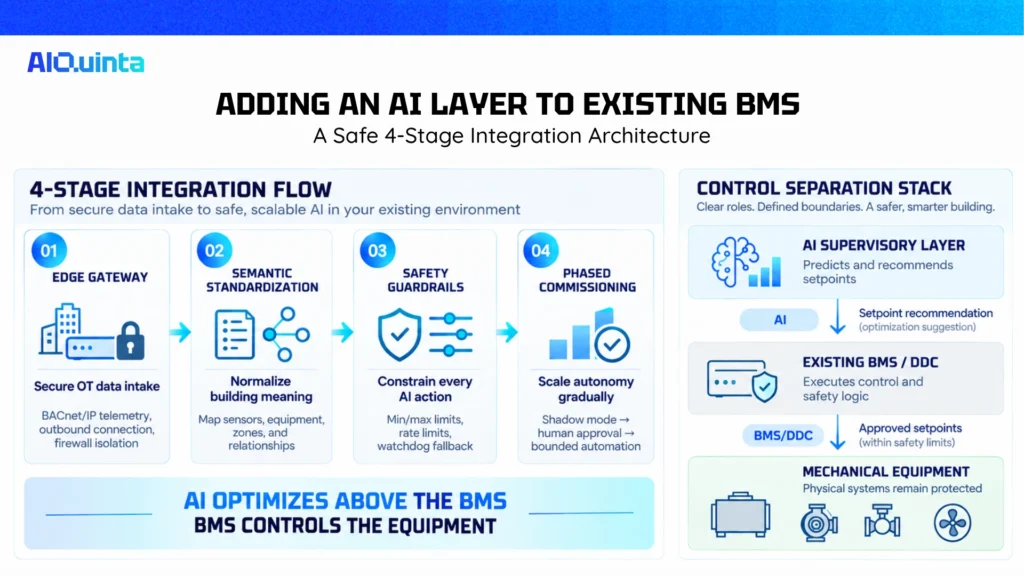
Telemetry Ingestion via Edge Gateways
Integration begins with the physical interface. Rather than running open queries from a public cloud directly into building field networks, installers deploy a hardened on-premises edge gateway on the building’s supervisory operational technology (OT) network:
The gateway binds directly to the primary BACnet/IP backbone, bypassing serial fieldbuses where possible.
The gateway handles local polling of field panels at configured rates, batching and encrypting telemetry before transmitting it outbound over TLS 1.3 to the AI control service.
Inbound ports on the building firewall remain closed; the edge gateway establishes a secure outbound websocket or MQTT connection, maintaining OT network isolation.
For enterprises handling broader operational modernization across diverse plants, leveraging secure OT and IT enterprise data integration simplifies this physical-to-digital layer without compromising on-premises firewalls.
Semantic Standardisation
Once telemetry streams to the processing environment, incoming points pass through a semantic mapping engine:
-
Data points are ingested into an ontology model (Brick Schema).
-
Sensor relationships are established: which chillers supply which cooling loops, which pumps correspond to which heat exchangers, and which thermal zones map to specific handling units.
-
The system constructs a digital twin of the thermal and mechanical infrastructure, allowing the AI to understand the physical consequences of every proposed adjustment.
Safety Guardrails, Clamps, and Watchdogs
Before granting any write-back authority to the AI model, engineers program three non-negotiable safety harnesses into the edge bridge:
-
Hardware Clamping (Min/Max Bounds): Even if the algorithm requests a chilled water setpoint of 38°F (3.3°C) to satisfy a sudden cooling peak, the edge gateway intercepts and clamps the value to the chiller manufacturer’s absolute lower safety limit (e.g., 42°F / 5.5°C) to prevent evaporator tube freezing.
-
Rate-of-Change Limiters (Slew-Rate Clamping): Abrupt setpoint swings degrade mechanical components. The gateway limits the maximum rate of change for any variable. For example, duct static pressure setpoints may shift no faster than 0.1 inches of water column (in. w.g.) every ten minutes, allowing actuator motors to adjust smoothly without excessive hunting or gear wear.
-
Watchdog Heartbeat Timers: The supervisory layer must continuously send a cryptographic keep-alive pulse to the edge gateway. If the internet connection fails, cloud services stall, or the gateway loses contact with the AI optimization model for more than fifteen minutes, the gateway triggers an automated fallback routine:
-
It releases all active writes on BACnet Priority 16 (sending a
NULLcommand). -
The local DDCs automatically revert to their factory baseline schedules and reset curves stored in permanent EEPROM memory.
-
Closed-Loop Optimization and Phased Commissioning
When organizations ask, can AI work with existing BMS networks safely, the answer depends on their deployment discipline. Autonomous execution should never be enabled across an entire facility on day one.
Commissioning follows three phased gates:
-
Shadow Mode (Weeks 1 to 4): The AI ingests real-time weather forecasts, utility tariff schedules, occupancy patterns, and building telemetry. It computes ideal setpoints and logs what it would have written. Engineers review these logs against actual conditions to identify model drift or anomalies.
-
Semi-Autonomous Mode (Weeks 5 to 8): The system generates daily setpoint schedules that human facility operators review and approve via a single-click dashboard. Writes are dispatched through the edge gateway only upon manual confirmation.
-
Fully Autonomous Closed-Loop (Week 9 onward): The model writes directly to Priority 16 within bounded safety limits. Human operators receive summary performance reports and retain the ability to disable supervisory control portfolio-wide using a physical or digital emergency-stop switch.
Enterprises scaling this capability across multiple facilities often use reusable AI agent frameworks to standardize guardrails and control protocols consistently across varied sites.
Risk Mitigation, Cyber Boundaries, and Actuator Protection
Connecting industrial networks to modern intelligence models introduces two major concerns: physical mechanical wear and network security vulnerabilities.
Mechanical Integrity and Actuator Degradation
In traditional PID operation, valve and damper actuators adjust position gradually in response to continuous error signals. Poorly tuned supervisory algorithms, however, can introduce high-frequency oscillations.
If an AI recalculates building thermal loads every sixty seconds and shifts the cooling coil setpoint by tiny fractions, the local PID loop continuously readjusts the pneumatic or electric actuator.
This behavior, known as “actuator hunting,” can increase mechanical cycles tenfold, leading to stripped gear trains, blown seals, and premature motor failure.
To mitigate this, supervisory models must apply hysteresis bands and enforce calculation intervals between 10 and 30 minutes. HVAC systems respond slowly due to substantial thermal mass; updating setpoints faster than the building’s thermodynamic time constant yields no additional energy savings while causing unnecessary mechanical wear.
Cybersecurity and OT Network Isolation
Legacy BMS devices lack native encryption, modern authentication, and brute-force defenses. Bridging these field networks to cloud infrastructure requires strict segmentation:
-
Zero Direct Inbound Traffic: Edge devices must never accept incoming public IP traffic. Communication must use outbound TLS tunnels initiated by the edge gateway.
-
Network Micro-segmentation: The BMS supervisory server and edge gateway must sit in an isolated VLAN, strictly separated from corporate IT networks and tenant Wi-Fi.
-
Least Privilege Point Access: The edge gateway’s BACnet client should only be granted write access to specific, designated setpoint objects. Direct write capabilities to equipment start/stop commands, life-safety points, and VFD safety interlocks must be blocked at the network interface layer.
The Role of Structured Extraction in Building Operations
A significant portion of legacy BMS data is unstructured. Alarm logs, maintenance schedules, and operator override histories exist in text formats that standard time-series databases struggle to parse.
Structured extraction is not only a document automation task; it is a critical requirement for training facility-specific AI models. By extracting fault patterns from historical alarm logs and converting them into structured JSON or tabular formats, enterprises enable predictive maintenance algorithms. The AI can correlate a specific sequence of unstructured warnings with a subsequent mechanical failure, allowing operators to intervene before an outage occurs.
Expanding into Enterprise AI Memory
Integrating a BMS with AI is rarely an isolated project. The data generated by building operations holds immense value for broader enterprise planning.
When BMS telemetry is ingested into an enterprise AI memory system, agentic AI workflows can cross-reference physical building data with corporate databases. For example, an AI agent could analyze conference room occupancy sensors via the BMS, cross-reference the data with the corporate exchange server to identify “ghost meetings” (booked but unattended), and automatically adjust HVAC schedules while notifying the facility management team.
This requires robust knowledge management practices to ensure the BMS data ontology aligns with the enterprise’s broader data architecture. The AI integration transforms the building from an isolated operational cost center into a node within the enterprise’s strategic data network.
Conclusion
Layering an AI overlay onto an existing BMS provides a highly effective alternative to expensive hardware replacements. The success of this integration hinges on accurate semantic data tagging, clear boundary limits at the local control level, and a realistic assessment of the physical actuators’ capabilities. By treating structured extraction as a core component of this process, organizations can unlock predictive maintenance capabilities hidden within unstructured logs. Ultimately, the integration of legacy building systems into a broader enterprise AI framework bridges the gap between physical operations and digital decision-making, transforming static infrastructure into an adaptive asset.
FAQs
Can AI work with an existing BMS?
Yes, if the BMS exposes the required operational data through BACnet, Modbus, APIs, MQTT, gateways, or another supported interface. AI can begin with read-only analytics and later receive bounded write permissions where operational and security requirements allow.
Does legacy BMS AI integration require new hardware?
Not always. Some systems can expose sufficient data through existing networks and software interfaces. Older proprietary systems may require an edge gateway, protocol converter, additional metering, or new sensors where existing data is inaccessible or unreliable.
What is the biggest barrier to AI integration with BMS?
Protocol compatibility receives most of the attention, but poor data semantics is often the larger scaling problem. AI needs to know what points represent, which equipment they belong to, how systems interact, and which values it may safely influence. Without that context, adding more models does not solve the integration problem.
Turn Enterprise Knowledge Into Autonomous AI Agents
Your Knowledge, Your Agents, Your Control
Your Knowledge, Your Agents, Your Control
Related Articles
Latest Articles