





 Duc Nguyen (Dwight)
AI agent skills help agents execute scripts, tools and workflows. Learn how to govern skill scripts safely with permissions, approvals and sandboxing.
Table of Contents
Toggle Skill scripts execution allows agents to run deterministic operations (like Python or Bash scripts) without exhausting large language model (LLM) context windows.
Unmanaged script execution introduces significant security risks, making comprehensive agent governance an absolute necessity for modern enterprises.
To run scripts safely, organizations must adopt advanced scanning, cryptographic signing, sandboxing, and centralized skill registries.
An AI agent skill can package instructions, metadata, templates, reference files, and scripts into a reusable unit. Instead of asking users to explain the same process each time, the enterprise can encode that process into a skill. The agent can then load the right skill when the task requires it.
For business teams, this creates scale. For technology and security teams, it creates risk.
Once an agent can run scripts from a skill, it is no longer just producing text. It can take action in a system environment. It may read files, process data, trigger commands, call internal tools, or write outputs. That moves AI agent skills into the domain of enterprise governance.
The core question is no longer: “Can the agent do the task?”
The better question is: “Can the agent do the task safely, with the right permissions, controls, and accountability?”
AI agent skills are reusable capability modules that help an AI agent complete a defined type of task.
A comprehensive agent skill typically consists of three foundational layers:
Instructions: Procedural knowledge, best practices, and specialized workflows dictated by internal policies, often configured via YAML frontmatter or Markdown.
Resources: Reference materials such as database schemas, application programming interface (API) documentation, and operational templates that agents can retrieve on demand.
Executable Code: Automated scripts that allow the agent to interact deterministically with external systems, local file systems, or databases.
This modular architecture allows a single foundational model to perform specialized tasks—such as evaluating supplier risks, closing end-of-month financial books, or triaging IT incidents—by simply loading the appropriate skill package at runtime.
Skill scripts execution means an AI agent can run a script included in, or referenced by, an AI agent skill.
That script may perform simple tasks, such as cleaning a CSV file or formatting a document. It may also perform sensitive actions, such as calling an API, updating a database, moving files, or triggering a workflow.
This is where AI agent skills become powerful.
Scripts give agents access to deterministic execution. Instead of relying only on natural language generation, the agent can use code to complete repeatable tasks with more consistency.
This is useful because scripts reduce manual work. They also reduce the need for long, fragile prompts.
However, script execution introduces a control problem. If the agent can run a script, the enterprise must know what the script can access, what it can change, and what happens if the output is wrong.
My position is simple: enterprises should allow script execution only when the execution environment is governed by design.
Running scripts from AI agent skills creates value, but it also expands the enterprise risk surface. The key risks include:
For IT leaders, security architects, and enterprise AI solution providers, mitigating the risks of autonomous execution is the highest priority. If you want to know how to run scripts from agent skills safely, you must implement a multi-layered defense-in-depth strategy. Here is the definitive framework for securing skill scripts execution in the enterprise.
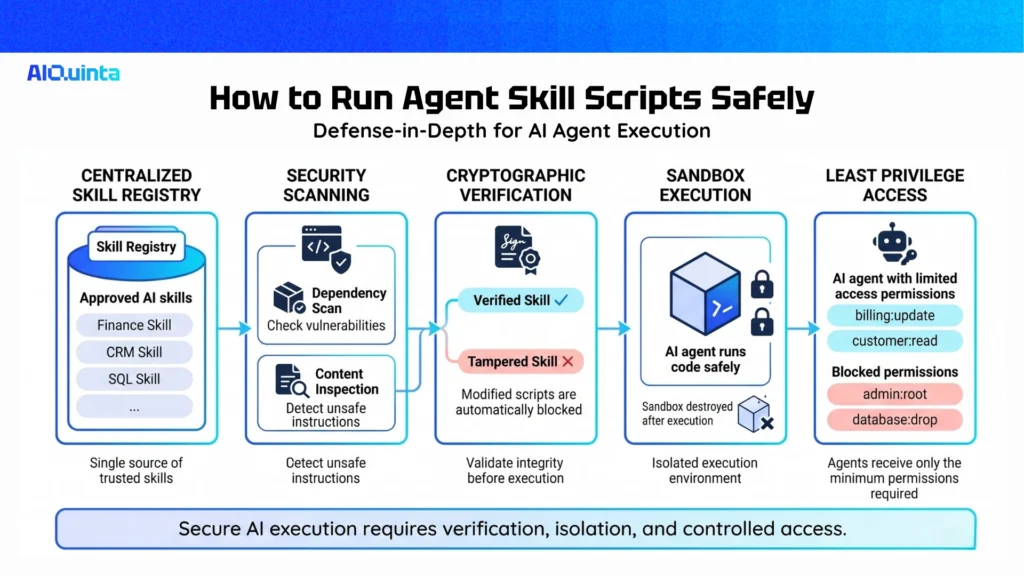
Just as developers use artifact repositories to manage software dependencies, AI teams must utilize an Agent Skills Registry. A registry acts as a single, governed source of truth for all organizational skills. Before any agent can load a skill, that skill must be published, verified, and hosted within the central repository. This entirely eliminates the risk of agents pulling unverified or malicious open-source skills directly from the public internet. By adopting repository standards, organizations benefit from rich metadata extraction, comprehensive APIs, and strict version control.
Security must begin before the script is ever executed. When a new skill is published to the registry, it should undergo a rigorous two-stage scanning process:
Dependency Scanning: The system must evaluate the script’s dependencies and binaries for known vulnerabilities (CVEs) and malicious code patterns.
Content Inspection: Ensure that the embedded instructions and reference data do not inadvertently instruct the agent to bypass security protocols.
To guarantee the integrity of a skill from creation to execution, implement cryptographic signing. If a skill passes the scanning phase, a cryptographically signed provenance evidence entity should be generated and stored alongside the skill. At runtime, the agent execution platform validates this signature. If the script or the skill’s instructions have been tampered with since they were approved, the execution is automatically blocked.
Never allow an agent to execute scripts directly on a host machine’s root file system without boundaries. Scripts should be executed within ephemeral, tightly controlled sandbox environments (such as isolated containers). These environments must have restricted network access—capable of reaching only the specific internal APIs or databases required for the task. Once the script completes its deterministic operation and returns the output to the agent, the sandbox should be immediately destroyed.
An AI agent should never operate with blanket administrative privileges. Implement granular Role-Based Access Control (RBAC) specifically tailored for agentic execution. If a customer service agent is executing a script to process a refund, that specific execution thread should only have the database permissions necessary to alter the billing ledger for that exact customer, and nothing more.
A safe AI agent skills architecture should include five core layers.
1. Skill Registry
The skill registry stores approved skills, owners, versions, metadata, and risk levels. It answers the question: “What skills are allowed in the enterprise?”
2. Policy Engine
The policy engine checks whether a specific user, agent, skill, script, and action are allowed. It answers the question: “Should this execution be permitted?”
3. Execution Sandbox
The sandbox runs scripts in a controlled environment. It answers the question: “Can this script run without exposing the broader system?”
4. Approval Layer
The approval layer pauses sensitive actions for human review. It answers the question: “Does this task need accountable human consent?”
5. Observability Layer
The observability layer captures logs, events, outputs, errors, and policy decisions. It answers the question: “Can we audit what happened?”
Together, these layers create a practical governance model for safe script execution.
Before allowing AI agent skills to run scripts in production, check the following:
This checklist should become part of the enterprise AI release process.
AI agent skills are one of the most important patterns in enterprise AI because they turn agent behavior into reusable operating logic.
But this power changes the governance baseline.
When a skill includes script execution, the enterprise must stop thinking in terms of prompts alone. It must think in terms of runtime control, permission design, software supply chain, auditability, and operational risk.
My recommendation is direct: do not block script execution, but do not allow uncontrolled execution either.
The winning model is governed execution.
Use a central skill registry. Scope every permission. Run scripts in sandboxes. Enforce allowlists. Validate inputs. Require approval for sensitive actions. Capture structured logs.
That is how enterprises can use AI agent skills to move faster while keeping control where it belongs.
What is skill scripts execution?
Skill scripts execution means an AI agent can run a script from a skill to process data, call tools, generate outputs, or complete workflow steps.
How do you run scripts from agent skills safely?
Run scripts in a sandbox, apply least privilege, validate inputs, use allowlisted tools, restrict network access, require approval for sensitive actions, and log every execution.
Why are AI agent skills a governance risk?
They can give agents access to scripts, tools, files, APIs, and business systems. Without governance, skills may create security, compliance, or operational risk.