
Google Cloud Next 2026: How Agentic AI Drives True ROI
- Publised April, 2026
-
Duc Nguyen (Dwight)
Explore the top economic highlights, how agentic AI, 8th-Gen TPUs and modern data platforms drive enterprise ROI from Google Cloud Next 2026.
Table of Contents
Toggle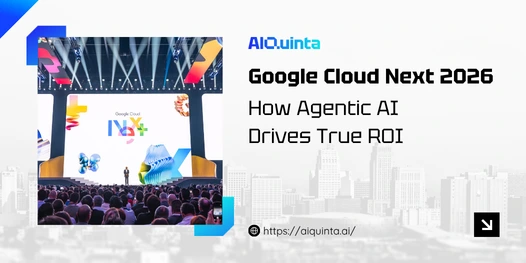
Key Takeaways
The Shift to Digital Workforces: Businesses are moving from isolated AI chatbots to the Gemini Enterprise Agent Platform, deploying networks of automated “agents” that execute complex, multi-step workflows to save hundreds of employee hours.
Slashed Computing Costs: Google’s dual-chip TPU v8 architecture effectively breaks the “memory wall,” offering nearly three times better performance per dollar and making high-volume AI financially viable.
Zero-Waste Data Storage: The new Cross-Cloud Lakehouse functions as a unified corporate warehouse, eliminating the high costs of duplicate data storage and vendor lock-in.
Flat-Budget Cybersecurity: With the integration of Wiz and new Agentic SOC systems, companies can automate threat detection, effectively tripling their security response speed without ballooning their IT budgets.
Instant Everyday ROI: Google Workspace’s new custom “skills” act like an assembly line for office work, automating mundane operational procedures to reclaim millions of dollars in lost productivity annually.
Introduction
The era of experimenting with artificial intelligence is officially over. Coming out of Las Vegas, the announcements from Google Cloud Next 2026 delivered a clear, resounding message: enterprise AI must now prove its worth on the balance sheet. Instead of dazzling crowds with theoretical science fiction, the technology giant focused entirely on operationalizing AI to drive measurable business value, lower infrastructure costs, and secure corporate assets.
For business leaders, investors, and operations managers, the highlights from Google Cloud Next 2026 represent an economic blueprint. The conversation has decisively shifted from “What can AI do?” to “How much time and money will this save my company?” Here is a comprehensive breakdown of the most significant economic and productivity transformations unveiled at the event, explained without the dense technical jargon.
The Dawn of the "Agentic" Enterprise: Redefining Workforce Productivity
The most fundamental shift announced in 2026 is the transition to the “Agentic Enterprise.” In the past, interacting with artificial intelligence was largely transactional. You typed a prompt, and the AI generated an answer. But answering questions does not necessarily complete a business process.
Gemini Enterprise Agent Platform: Moving Beyond Chatbots to a Digital Workforce
At Next 2026, Google introduced the Gemini Enterprise Agent Platform. To understand its economic power, think of early AI as an incredibly smart but isolated consultant locked in a room; they can give you great advice, but they can’t physically file your paperwork. The new “Agentic” AI is like hiring a fully integrated team of digital interns. They know your company’s filing system, they communicate with each other, and they can be trusted to execute multi-step tasks from start to finish.
The return on investment (ROI) here is profound. The platform shifts the economic model from assisting with tasks to delegating outcomes. For example, instead of a marketing manager using AI to write a single email, they can deploy a specialized agent that analyzes campaign data, drafts the brief, builds the interactive dashboard, and schedules the review meetings. Companies like Databricks are already utilizing this framework to automate 80% of campaign brief generation in just five minutes, saving senior employees half a day of labor per project. Time is quite literally money, and agentic workflows are manufacturing more of it.
The Financial Power of Context
One of the biggest historical bottlenecks to enterprise AI has been the “Context Gap.” An AI without corporate context is an economic liability. It’s like asking a brilliant new hire to audit your finances without giving them the passwords to your accounting software.
Through tools like the Knowledge Catalog, AI agents now instantly extract the true meaning of your secure, proprietary data. If a marketing agent sees the acronym “PR,” it knows your company means “Press Release,” while the engineering agent knows it means “Pull Request.” By providing this deep situational awareness, companies drastically reduce errors, eliminate rework, and prevent wasted hours. Telecommunications giants like Vodafone are actively leveraging these context-aware agents to reinvent their core operations, generating multi-million pound operational expenditure (OPEX) savings.
Infrastructure Economics: Doing More with Less Compute
Running thousands of AI agents simultaneously requires an astonishing amount of computing power. Historically, this meant companies faced skyrocketing cloud infrastructure bills. Google’s answer to this economic hurdle is highly specialized hardware designed to maximize performance per dollar.
The 8th-Generation TPU: The Dual-Engine Factory
The headline hardware announcement was the 8th-generation Tensor Processing Unit (TPU v8), featuring a dual-chip approach: the TPU 8t and the TPU 8i.
To visualize why this saves money, imagine running a global logistics empire. The TPU 8t is your massive, centralized R&D headquarters where your top minds analyze years of global traffic data to invent perfect shipping routes. It requires immense power, but you only use it periodically to “train” the system. The TPU 8i, on the other hand, represents your fleet of highly efficient, low-emission delivery trucks that run 24/7 on the actual roads.
The TPU 8i is explicitly designed for the day-to-day “reasoning” (or inference) of AI agents. It effectively eliminates the digital traffic jams that make AI slow, offering near-zero latency. Most importantly for the bottom line, it boasts a price-to-performance ratio nearly three times better than the previous generation. This architectural split slashes the utility bills of the digital era, making enterprise-wide AI economically viable.
Smarter Data Management: Eliminating the Clutter Tax
For years, large organizations have paid a heavy “clutter tax” on their data. Older cloud storage models were akin to renting dozens of expensive, disconnected self-storage units across a city, often keeping identical copies of the same files in different units just in case different teams needed them.
With the announcement of the Cross-Cloud Lakehouse, Google has replaced this model with a single, perfectly organized mega-warehouse. Inside, a master digital inventory system (the AI) knows exactly where every piece of data lives and what it means. This eliminates the need to create and pay for duplicate data copies, drastically reducing raw cloud storage costs. Furthermore, it breaks down vendor lock-in, giving businesses the freedom to seamlessly integrate data across multiple platforms without incurring punishing migration fees.
Protecting the Bottom Line: Autonomous Cybersecurity
As companies deploy more AI agents, the attack surface for cyber threats naturally expands. A single data breach can cost a corporation millions of dollars in immediate damages, regulatory fines, and lost consumer trust. Protecting digital assets is no longer an IT issue; it is a core economic imperative.
The AI-Powered Corporate Immune System
Following its massive $32 billion acquisition of cybersecurity firm Wiz, Google introduced the Agentic Security Operations Center (SOC).
Traditional cybersecurity is like hiring thousands of human security guards to stare at hundreds of camera feeds 24/7. It is incredibly expensive, exhausting, and prone to inevitable human error. The new Agentic SOC operates like an autonomous corporate immune system. It uses specialized AI agents that act as a virtual team of defenders.
If anomalous behavior is detected—such as a user trying to download an unusual amount of data from a remote location—the AI system autonomously investigates, flags the risk, and can even isolate the threat before a human analyst has finished their morning coffee. By automating the heavy lifting of threat detection, security teams can triple their response speed. This allows organizations to massively scale their digital operations without needing to linearly increase their cybersecurity headcount, keeping operational budgets flat while elevating protection.
Everyday Efficiency: Transforming the Digital Office
While massive infrastructure overhauls drive long-term capital efficiency, Google also introduced immediate, day-to-day productivity gains for the average employee through Google Workspace Intelligence.
Automating the Mundane with Workspace Skills
Every business runs on standard operating procedures—the mundane, repetitive tasks like reviewing invoices, reconciling spreadsheets, or updating client logs. Google has introduced deployable “skills” within Workspace to handle this.
Think of a Workspace skill as a custom-built digital assembly line for your office. Instead of an employee manually reviewing 500 invoices line-by-line to check for discrepancies, a custom AI skill can act as an automated quality control scanner, instantly cross-referencing incoming invoices with historical data and only flagging the anomalies for human review. By turning standard procedures into automated skills, a task that once took hours is reduced to seconds. Across a mid-sized enterprise, this equates to tens of thousands of hours reclaimed annually, translating directly into enhanced profit margins.
Democratizing High-End Production
Another major economic leap is the evolution of Google Vids and custom AI avatars. Historically, producing a professional corporate training video or a localized marketing message required renting a studio, hiring talent, setting up lighting, and spending days in post-production.
Now, creating a video is as simple as typing a script into a word processor. The AI generates highly realistic, on-brand avatars—complete with company logos on their virtual clothing—that can present the material seamlessly in dozens of languages. For HR, marketing, and sales departments, this effectively provides an in-house Hollywood studio at a fraction of the cost, dramatically lowering customer acquisition costs and internal training budgets while accelerating time-to-market.
Industry-Specific Economic Transformations
The financial impact of Google Cloud Next 2026 is not limited to tech companies; it is rapidly transforming legacy industries by bridging the gap between old systems and new efficiencies.
Healthcare: Accelerating Patient Services
Major providers like Northwell Health are leveraging the Gemini platform to transition away from clunky, legacy IT environments. By implementing an AI-native stack, they are optimizing clinical workflows—reducing the administrative burden on doctors and nurses. From an economic standpoint, faster and more accurate administrative processing increases patient throughput, minimizes billing errors, and ultimately drives better financial health for the organization.
AIQuinta for Healthcare – Discover the Agentic AI platform that automates clinical workflows and reduces the administrative burden for your medical facility
Supply Chain and Retail: Faster Time-to-Market
In the highly competitive food and retail sectors, speed is a primary economic driver. Global leaders like Cargill are utilizing AI agents to reimagine their research and development processes. By accelerating product discovery and simulating sustainable packaging options digitally before moving to physical prototypes, companies can shave months off the R&D cycle. This rapid innovation allows them to capture market share faster and drastically reduce the capital expenditure traditionally wasted on physical trial-and-error.
Want to optimize your R&D and production cycles like global industry leaders? Explore how agentic AI and real-time operational monitoring can transform your supply chain with AIQuinta for Retail.
Conclusion
The announcements from Google Cloud Next 2026 underscore a pivotal maturation in the technology sector. We have moved past the novelty of conversational chatbots and entered a highly practical, ROI-driven era of enterprise computing.
By unifying tools into the Gemini Enterprise Agent Platform, dramatically lowering computing costs with TPU v8, eliminating storage waste with the Cross-Cloud Lakehouse, and securing it all with an autonomous digital immune system, Google Cloud has provided a comprehensive framework for economic growth. For the modern enterprise, adopting these technologies is no longer about staying trendy; it is a fundamental requirement for maintaining operational efficiency, protecting profit margins, and remaining competitive in an increasingly automated global market.
FAQs
What is the economic benefit of the Gemini Enterprise Agent Platform?
The platform shifts AI from simply answering questions to executing multi-step workflows. By deploying digital “agents” that act like integrated workers, companies can automate highly repetitive, time-consuming tasks (like drafting campaign briefs or processing internal support tickets). This reclaims thousands of employee hours, allowing staff to focus on high-value, revenue-generating activities.
How do the new 8th-Generation TPUs reduce business costs?
Google introduced a dual-chip system to make computing cheaper. The TPU 8t handles the heavy lifting of training AI, while the TPU 8i handles the day-to-day operation (inference). The TPU 8i provides nearly three times better performance per dollar than the previous generation, meaning companies can run complex AI operations at a fraction of their previous cloud utility bills.
What are Workspace “skills,” and how do they impact employee productivity?
“Skills” in Google Workspace allow teams to turn standard, repeatable office procedures into automated routines. For example, a skill can be built to automatically cross-reference new invoices against an inbox to check for billing errors. By automating these mundane tasks, companies save vast amounts of operational time, drastically reducing labor costs associated with manual data entry and review.
Turn Enterprise Knowledge Into Autonomous AI Agents
Your Knowledge, Your Agents, Your Control
Your Knowledge, Your Agents, Your Control