
The AI Skills Gap: Prompt Engineering Trends for 2027
- Publised April, 2026
-
Duc Nguyen (Dwight)
Discover how the AI skills gap will shape prompt engineering by 2027. Explore the economic impact, Agentic AI trends, and multi-agent enterprise solutions.
Table of Contents
ToggleKey Takeaways
Evolution of the Role: Prompt engineering is transitioning from simple text-based interactions to orchestrating complex, multi-agent systems and Enterprise General Intelligence (EGI).
Economic Impact: The shortage of qualified AI professionals leads to higher recruitment costs, slower innovation, and reduced organizational productivity.
Skill Standardization: The future lies in standardized skill frameworks, such as importing agent capabilities via .md files, to democratize AI access across business units.
The Rise of No-Code: Automated prompt optimization and no-code platforms will empower non-technical leaders to deploy AI without requiring advanced programming knowledge.
Introduction
In the modern boardroom, the conversation has definitively shifted from the theoretical potential of artificial intelligence to the immediate economic reality of implementation. As enterprises rush to integrate digital transformation into their core operations, they are colliding with a severe structural barrier: the AI skills gap.
While the technology itself is advancing at an unprecedented rate, the human capital required to direct, manage, and optimize these systems is lagging significantly. Currently, a vast portion of the workforce lacks the specific proficiencies required to operate advanced technological frameworks, with some regional data indicating that only around 42.6% of general graduates possess immediate employability in digital-first roles.
Nowhere is this evolution more pronounced than in the field of “prompt engineering.” What began as a niche skill of typing highly specific text queries into a chatbot is rapidly maturing into a complex discipline of enterprise orchestration. By 2027, prompt engineering will no longer be about coaxing an answer out of a single language model; it will be about architecting intelligent systems that drive measurable business value.
The Current State of the AI Skills Gap
Understanding the trajectory of prompt engineering requires a clear view of the economic environment it exists within. The skills gap is not simply a matter of technical literacy; it is a fundamental misalignment between the output of traditional educational institutions and the immediate operational needs of the enterprise.
The Economic Cost of the Talent Deficit
When approximately 82% of employers report difficulty finding candidates with the right technological skill sets, the consequence is not just a human resources bottleneck – it is a measurable drag on corporate earnings. The Indian economy faces a potential workforce skill deficit of up to 49 million workers by 2027 (Source: Indian Skills Report 2025, WheeBox).
To understand the economic impact, consider the operation of a commercial airline. If an airline purchases a fleet of state-of-the-art aircraft but cannot hire enough certified pilots to fly them, the investment becomes a depreciating liability rather than a revenue generator. Similarly, enterprises are investing billions in AI infrastructure, but without skilled professionals to deploy these tools effectively, the promised efficiency gains remain unrealized. This deficit leads to inflated recruitment costs, extended product development cycles, and a heavier reliance on expensive external consultancies.
Why the Gap is Widening
The gap continues to widen because the pace of technological disruption has accelerated far beyond the natural adaptation cycle of traditional training. Modern business infrastructure is shifting continuously. Roles that were considered stable just five years ago are now being fundamentally reshaped by automation.
Education systems heavily focused on theoretical knowledge are struggling to produce graduates equipped with the critical thinking, digital fluency, and systems-level problem-solving required today. As AI models become more sophisticated, the baseline requirement for entering the workforce shifts from “knowing the answers” to “knowing how to architect the systems that find the answers.”
The Evolution of Prompt Engineering by 2027
By 2027, the term “prompt engineering” may itself feel archaic, replaced by titles that better reflect the strategic nature of the work. The focus is shifting away from isolated interactions toward Enterprise General Intelligence (EGI) and the management of autonomous workflows.
From Single Prompts to the Agentic Enterprise
In its infancy, prompt engineering was a one-to-one relationship: a human asked a question, and an AI provided an answer. By 2027, the standard will be the Agentic Enterprise. Instead of single interactions, professionals will manage “Agent Swarms” – multi-agent systems where different AI models with highly specialized functions collaborate to complete massive, multi-step corporate objectives.
To illustrate this, think of the difference between a freelance graphic designer and a Chief Operating Officer (COO). The early prompt engineer was the freelance designer, painstakingly adjusting individual inputs (pixels) to get a specific output (a logo). By 2027, the prompt engineer will act as the COO. They will not do the granular work; instead, they will define the strategic goal, assign tasks to specialized departments (AI agents), establish the rules of collaboration, and oversee the final assembly of the project. Platforms like AIQuinta are already pioneering this shift, providing the orchestration graphs required to manage these complex agent interactions seamlessly.
Skill-Based Orchestration and Standardization
As the complexity of AI increases, the barrier to entry must decrease for the technology to remain economically viable. By 2027, prompt engineering will rely heavily on standardized frameworks rather than custom-coded commands.
A primary example of this is the transition toward agent skill-based architecture. Enterprises will manage AI capabilities much like a corporate HR department manages employee credentials. Rather than writing complex instructions from scratch, organizations will import specialized skills formatted as lightweight, standardized files, such as .md (Markdown) files.
Think of these skill files like plug-and-play memory cards in a digital camera. You do not need to rebuild the entire camera hardware to take a different style of photograph; you simply insert a new card that holds the specific processing skills required. This modular approach allows businesses to instantly “hire” an AI agent with a specific capability – such as SEO analysis, supply chain forecasting, or financial auditing—and deploy it into the organizational workflow immediately.
Emerging Trends Redefining the Profession
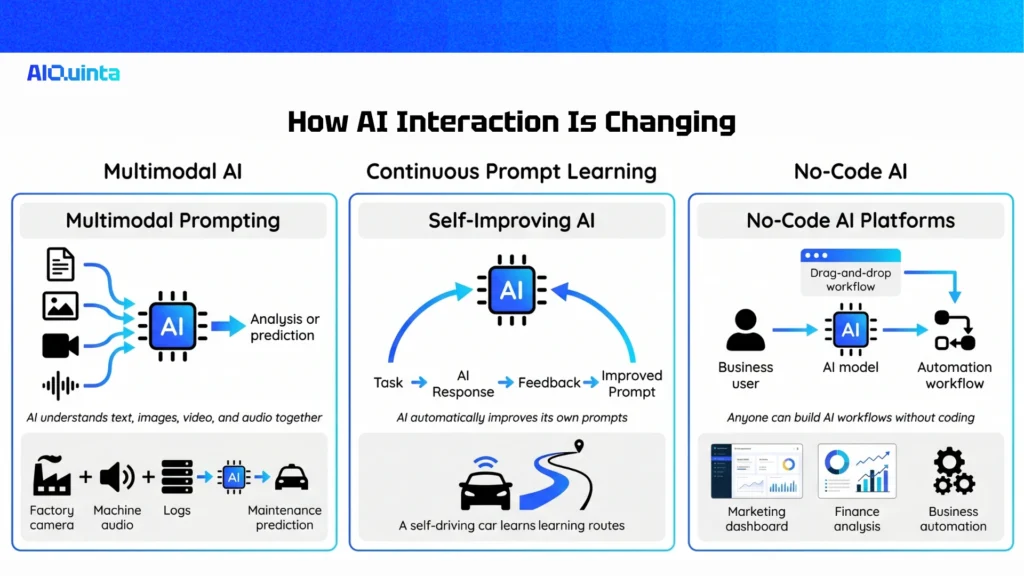
As we look toward 2027, several key trends identified by industry analysts will fundamentally reshape what it means to bridge the AI skills gap.
Multimodal Prompting
Currently, much of the workforce’s interaction with AI is limited to text. However, the future is multimodal. Systems will simultaneously process text, images, real-time video, and auditory data to generate contextually aware outputs.
For the average professional, this is akin to moving from a black-and-white telegraph to a high-definition, interactive video conference. A prompt engineer in manufacturing, for instance, will not just type instructions about factory output. They will feed the AI live video feeds of the assembly line, audio recordings of machine operations, and text-based maintenance logs, asking the system to predict mechanical failures before they impact the bottom line.
Automated and Continuous Prompt Learning
The burden of optimizing inputs will increasingly fall on the AI itself. Continuous prompt learning allows AI models to refine their own instructions based on past interactions, evolving with each iteration to provide better, more accurate responses without constant human intervention.
Consider how a self-driving car operates. It does not require a human to manually program the exact steering angle for every curve on a daily commute. Instead, the car learns the route, analyzes the traffic patterns, and automatically adjusts its driving to achieve the safest, most efficient journey. Similarly, automated prompt engineering tools will analyze task requirements and continuously refine the internal prompts, significantly reducing the learning curve for non-technical employees.
No-Code Democratization
The most significant economic lever for closing the skills gap is the democratization of AI through no-code platforms. By 2027, business leaders, marketing directors, and financial analysts will leverage sophisticated AI models without writing a single line of code. Drag-and-drop interfaces and pre-built templates will allow non-technical professionals to build automated workflows. This shift transfers the power of AI from the IT department to the broader business units, rapidly expanding the pool of employees who can contribute to digital transformation.
Strategies to Bridge the Economic Skill Gap
For enterprises to remain competitive, they must proactively address the skill deficit rather than waiting for the labor market to naturally correct itself.
Aligning Workforce Development with EGI
Organizations must pivot their internal training programs away from legacy software usage and toward systems-level thinking. Employees need to understand how to break down large business problems into modular tasks that an Agentic AI system can execute. Upskilling initiatives should focus on the logic of workflow orchestration, data interpretation, and AI ethics, ensuring that the human workforce acts as the strategic oversight for automated processes.
Forging Industry-Academia Partnerships
Finally, closing the gap requires structural collaboration between the boardroom and the classroom. Enterprises must partner with academic institutions to design curricula that reflect the realities of the modern market. By providing students with access to enterprise-grade AI platforms and live project environments, universities can ensure that graduates enter the workforce not just with theoretical knowledge, but with the practical capability to drive immediate economic value.
Conclusion
The AI skills gap represents one of the most pressing economic challenges of the decade. As the technology evolves from isolated conversational models to comprehensive, multi-agent enterprise systems, the definition of a skilled worker is changing. By 2027, prompt engineering will have matured into an executive-grade discipline focused on architectural strategy, skill standardization, and the seamless orchestration of digital and human labor. Organizations that recognize this shift today—by investing in no-code democratization, modular agent skills, and continuous workforce development—will be the ones that define the economic landscape of tomorrow.
Resources
FAQs
What exactly is the AI skills gap in the current economy?
The AI skills gap refers to the critical mismatch between the advanced digital competencies that employers desperately need to remain competitive and the actual skill sets possessed by the available workforce. This deficit leads to unfilled roles, reduced productivity, and slower technological adoption across industries.
How will prompt engineering change by the year 2027?
By 2027, prompt engineering will evolve from typing text instructions into chatbots toward managing “Agent Swarms.” Professionals will act as orchestrators, guiding multiple specialized AI agents to work together to achieve complex, multi-step enterprise goals.
What is the economic impact of the tech talent shortage?
The shortage of qualified tech professionals significantly inflates recruitment costs and slows down corporate innovation. When companies cannot staff crucial AI roles, they face extended product development cycles, operational inefficiencies, and a heavier reliance on costly external consulting firms.
Turn Enterprise Knowledge Into Autonomous AI Agents
Your Knowledge, Your Agents, Your Control
Your Knowledge, Your Agents, Your Control