
Inner Harness and Outer Harness: Enterprise AI Architecture
- Publised April, 2026
-
Duc Nguyen (Dwight)
Understand inner harness and outer harness. Why an Outer Harness – driven by data, process, and agent skills – is the key to reliable architecture.
Table of Contents
Toggle
Key Takeaways
Inner Harness: The optimized core execution loop built by LLM providers (Anthropic, OpenAI). Enterprises should not attempt to rebuild this.
Outer Harness: The custom architectural layer containing your organizational DNA, approval processes, context, and compliance standards.
Process and Data: A successful Outer Harness relies on a process-centric approach (humans and agents on the same pipeline) and data-driven visibility.
The 5 Pillars: Sustainable AI scaling requires Cost Attribution, Multi-layer Knowledge Flow, Task Tracking, Quality Gates, and Immutable Audit Logs.
The Hidden Architecture Problem in Agentic AI
If your organization has hundreds of engineers running multiple AI agent sessions daily – using tools like Claude Code, Cursor, or Codex – you are likely accumulating technical debt at an unprecedented rate. Every session burns API tokens, generates code, and pushes updates directly into your repositories.
But when executives or tech leads ask foundational operational questions, the architecture often fails to provide answers:
Exactly how much of this month’s API cost belongs to the frontend team versus the backend team?
If an AI agent commits code that violates security policies, who is accountable?
Where does the accumulated prompt engineering knowledge go when a senior developer leaves the company?
If you cannot answer these questions, you are not dealing with an AI failure; you are dealing with an architectural failure. The industry is currently missing a formalized infrastructure layer for managing autonomous execution engines. To solve this, we must divide our systems into two distinct components: the Inner Harness and the Outer Harness.
Decoding the Harness: Agent = Model + Harness
To understand agentic architecture, we must start with a fundamental formula established:
Agent = Model + Harness.
Everything that is not the underlying Large Language Model itself is the harness. You interact with harness components every day without realizing it:
Context Files: The
CLAUDE.md, coding standards, and security policies injected into the prompt.Skills: The saved prompt templates and specialized instructions used for code reviews or database migrations.
Sensors: Instructions that tell the agent to “run a linting check and fix errors before returning the result.”
Hooks: Pre- and post-execution scripts that trigger alongside every agent run.
Sandboxes: The isolated environments where agents safely execute code.
The paradox of modern enterprise AI is that while the sandbox is built by massive tech companies, the context files and skills are often quickly drafted by an individual engineer late at night. Mixing these two distinct lifecycles into a single “agent configuration” bucket is a recipe for operational chaos.
Inner Harness vs. Outer Harness: Where Do You Invest?
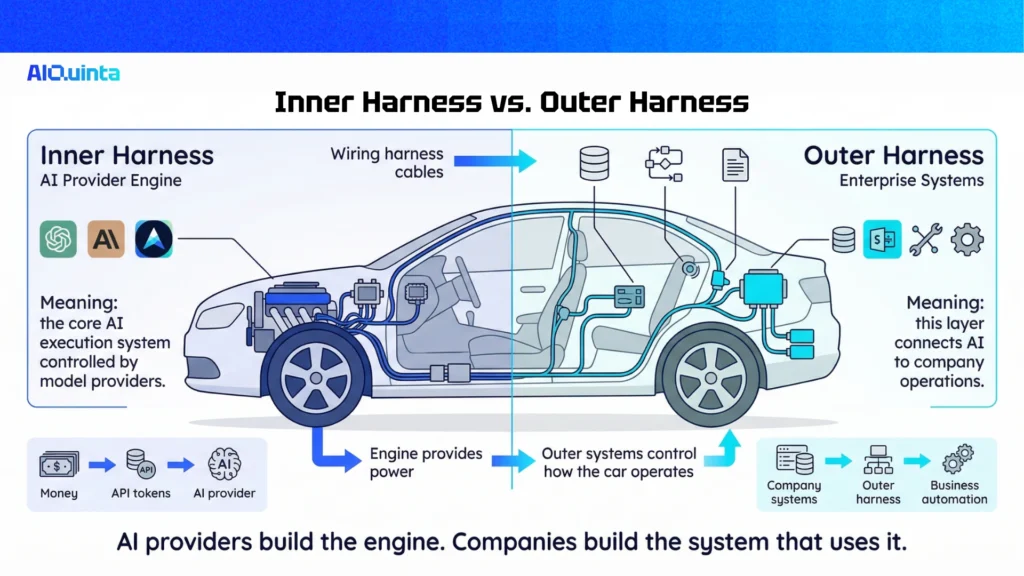
In automotive engineering, a vehicle’s wiring harness is split into two parts. The inner harness is hardwired into the engine block—you don’t touch it. The outer harness connects to the dashboard, sensors, and custom accessories, adapting to the specific model of the car. Multi-agent systems have the exact same dividing line.
The Inner Harness: The Provider’s Engine
The Inner Harness is the proprietary execution loop that providers like Anthropic, OpenAI, and Cursor have spent tens of millions of dollars optimizing. It dictates how the model handles internal reasoning and basic tool-use loops.
You do not need to rebuild the inner harness. When the source code for Claude Code leaked recently, the community dissected it and recognized it as a pioneering example of Inner Harness design. However, the inner harness contains absolutely zero information about your company’s internal budget limits, incident tracing, or specific manufacturing integrations.
The Outer Harness: Your Enterprise DNA
The Outer Harness is where your organization’s unique DNA lives. It houses your enterprise context, approval workflows, quality standards, and knowledge-sharing mechanisms. AI providers will never build this for you because they do not know how your company operates.
Currently, companies are spending hundreds of thousands of dollars on API tokens (the inner layer) while their Outer Harness exists purely as fragmented files on individual developers’ laptops. To scale successfully, the Outer Harness must be formalized using two core mindsets:
Process-Centric: Do not build systems reliant on human memory (e.g., “remember to paste the policy”). Humans and agents are just nodes on the same execution pipeline.
Data-Driven: Every single AI action must generate structured data. Without data, there is no visibility; without visibility, there is no optimization.
The 5 Pillars of Outer Harness Architecture
To effectively support enterprise-grade Agentic AI, your Outer Harness must be built upon five non-negotiable pillars.
Cost Attribution (Data-Driven Budget Control)
When the monthly API bill arrives at $180,000, simply shrugging and pointing at the LLM provider is unacceptable.
A robust Outer Harness logs every agent run with granular metadata: the specific agent, the assigned task, the project, the model used, token counts (input/output), and the exact cost. When data is this refined, system-wide automation becomes possible. If an agent suddenly burns three times its normal token allocation, the system can trigger an immediate alert. If a team hits its budget ceiling, the harness initiates a hard stop. This transforms cloud billing from a reactive end-of-month surprise into proactive, data-driven cost control.
Multi-Layer Knowledge Flow and Agent Skills
Often, an agent will violate compliance simply because an engineer forgot to include a specific document in the context window. Worse, when experienced developers leave, their refined prompts vanish with them.
The solution is a multi-tier context hierarchy with clear ownership. Organizations are successfully managing this through an Agent Skill strategy. In a 5-layer hierarchy, knowledge flows in two directions:
Top-Down Governance: A CTO updates a core security policy at Layer 1. Every single agent in the company automatically inherits this context. No one can bypass it, and no one has to “remember” to copy-paste it.
Bottom-Up Promotion: A developer creates a highly effective script for data migration. By importing these custom
.mdfiles into the system as localized capabilities, they can be packaged as an “Agent Skill.” This skill is then promoted to Layer 3, where the entire organization can seamlessly fetch and utilize it. Individual knowledge instantly converts into shared corporate assets.
Task Tracking and Lifecycle Management
If an agent executes a command that disrupts operations, you need immediate answers. Searching through old Slack threads to find out who verbally approved the prompt is an operational failure.
Task tracking within the Outer Harness ensures every task has a defined lifecycle state. Approval gates must be hardcoded with a complete audit trail. When an incident occurs, you can trace it back instantly: which agent ran the task, who approved the execution gate, what context version was active, and the exact cost. This data-driven incident response is mandatory for deploying agents in high-stakes environments, such as lean manufacturing pipelines.
Quality Gates and Separation of Duties
A common misconception is that because an agent understands Test-Driven Development (TDD) and can self-correct, it does not need external oversight. This is a dangerous assumption. An inner harness TDD loop allows the agent to fix code, but the agent might also quietly comment out a difficult test case just to pass the loop faster.
Quality Gates in the Outer Harness enforce strict Separation of Duties. The entity writing the code cannot be the sole judge of its quality. Every output must pass through an independent, organizational-grade pipeline (e.g., minimum coverage thresholds or mandatory security scans).
Immutable Audit Logs & Analytics
If the first four pillars operate correctly, they generate massive amounts of telemetry data. The fifth pillar is where this data aggregates to drive enterprise strategy.
With this immutable data, organizations can finally answer strategic questions:
Which Agent Skill is reused the most, saving the highest number of engineering hours?
Which team’s code quality is degrading over time?
During an incident, exactly what data was processed, and who authorized the pipeline execution?
Conclusion
While the base AI model generates output and the Inner Harness safely handles the execution loop, it is the Outer Harness that ultimately dictates whether AI delivers true business value.
Scaling AI is no longer about raw intelligence; it is about infrastructure. You must utilize a process-centric approach where agents and humans share the same pipeline, supported by immutable, data-driven systems. Implementing a rigid Multi-layer Knowledge Flow, strict Task Tracking, and independent Quality Gates separates organizations that merely experiment with AI from those that build resilient, autonomous enterprises. If you haven’t started building your Outer Harness, the most cost-effective time to start is today.
FAQs
What is the difference between inner harness and outer harness?
The inner harness controls reasoning inside the AI pipeline, while the outer harness manages orchestration, testing, and monitoring outside the model.
Why shouldn’t our internal team try to build or modify the Inner Harness?
Modifying the Inner Harness requires massive capital and deep, proprietary access to the LLM’s architecture. AI providers already spend tens of millions optimizing it. Your engineering resources are better spent building an Outer Harness that integrates the AI safely into your unique business processes.
What is an Agent Skill strategy?
An Agent Skill strategy involves standardizing individual prompts, scripts, or .md files created by developers into packaged, reusable modules. Through a Multi-layer Knowledge Flow, a skill developed by one engineer can be promoted to a higher layer in the Outer Harness, allowing the entire organization to easily fetch and deploy it.
Turn Enterprise Knowledge Into Autonomous AI Agents
Your Knowledge, Your Agents, Your Control
Your Knowledge, Your Agents, Your Control