


BMS Alarm Management: Cut Fault & Maintenance Noise
- Publised September, 2026
-
Duc Nguyen (Dwight)
Learn how BMS alarm management reduces alarm fatigue, nuisance alarms, and missed faults with prioritization, rationalization, and maintenance workflows.
Table of Contents
Toggle
Key Takeaways
- Reducing alarm volume is not the goal. The goal is reducing non-actionable demand on operators without hiding conditions that require action.
- BMS alarm prioritization should reflect consequence, response time, asset context, redundancy and operating mode, rather than assigning severity from the alarm tag alone.
- Automating every alarm into a work order simply transfers noise from the BMS to the maintenance system. Rationalization must happen first.
- The more mature model connects fault, alarm and maintenance data so each resolved issue improves future prioritization, diagnostics and operational knowledge.
A common response to too many BMS alarms is to add better dashboards, more notifications or AI-based prioritization. That can make the problem worse.
If alarm thresholds are poorly configured, sensors are unstable, equipment states lack context or every deviation is treated as an alarm, a smarter interface simply processes a badly designed alarm system faster.
The harder counterargument also matters. Cutting alarm volume is not automatically an improvement. An aggressive suppression rule can hide the early signal that would have prevented a chiller trip, comfort failure or equipment shutdown.
Effective BMS alarm management therefore has a narrower objective: make operator attention correspond to operational consequence.
That requires more than filtering. It requires alarm rationalization, priority rules, context, maintenance ownership and a feedback loop between faults and completed work.
Too many BMS Alarms usually point to a design problem
A BMS can monitor thousands of points across chillers, pumps, AHUs, VAV boxes, sensors, electrical systems and other assets. The problem begins when normal system activity is converted into operator-facing alarms.
Consider a supply-air temperature point oscillating around a high limit. Without an appropriate deadband or delay, a small fluctuation can repeatedly move the point in and out of alarm. Startup sequences may produce temporary low-flow conditions. A stopped pump may trigger several downstream pressure, flow and temperature alarms even though they share one cause.
BACnet already allows alarm priorities and notification classes to be defined. Siemens documentation also describes time delays and floating differentials as ways to filter nuisance conditions. The underlying technology can therefore distinguish alarm behavior. The quality problem often lies in how those functions are engineered and maintained.
Common sources of BMS alarm fatigue include chattering thresholds, transient startup conditions, duplicate notifications, consequential alarms, stale alarms that remain active for long periods, communication faults and status changes incorrectly configured as alarms.
This suggests a useful rule: an abnormal value is not automatically an actionable alarm.
What should qualify as an actionable BMS Alarm?
A strong alarm should answer five operational questions:
- What abnormal condition occurred?
- What could happen if nobody responds?
- How much time is available to respond?
- Who owns the response?
- What action is expected?
If nobody needs to investigate, decide or act, the signal may belong in a trend, event log, diagnostic queue or maintenance report instead of the active alarm list.
This distinction is especially important in building alarm management because many systems mix equipment status, comfort deviations, network events and equipment failures in one queue.
A practical priority model can look like this:
| Class | Typical condition | Expected treatment |
|---|---|---|
|
Critical |
Safety, major service loss, equipment protection risk |
Immediate notification and escalation |
|
High |
Material operational impact with limited response time |
Prompt investigation and assigned ownership |
|
Medium |
Degraded performance or developing maintenance issue |
Planned maintenance response |
|
Informational |
Useful context with no immediate operator action |
Log, trend or review without active alarm burden |
The labels are less important than the logic behind them. BACnet supports priority values from 0 to 255, but it does not determine the business meaning of each priority. Designers and operators must define what each class means and what recipients should do when it occurs.
How to reduce BMS Alarms without hiding real faults
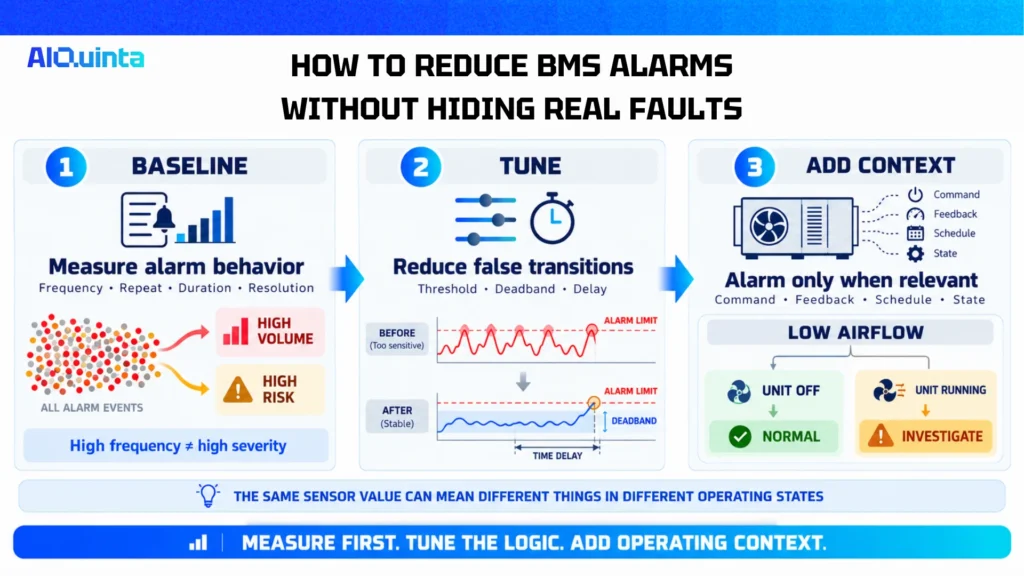
Reducing nuisance alarms should start with evidence rather than suppression.
Establish the alarm baseline
Export alarm history and identify which points create the largest share of activity.
Useful measures include alarm events per day, repeat alarms by point, standing alarms, alarms per asset, acknowledgement time, time to resolution and alarms that repeatedly return after being cleared.
The purpose is to separate high-volume symptoms from high-risk conditions.
A point that produces 500 events may need threshold tuning. A point that appears only twice per year may still deserve the highest priority if the consequence is severe.
Tune thresholds, delays and deadbands
For analog values, a single threshold is often insufficient.
If an alarm activates at 24°C and clears at exactly 24°C, normal sensor noise can cause repeated transitions. A deadband creates separation between the alarm and reset condition.
Delay timers address another problem. A low-pressure condition that lasts two seconds during startup may be expected. The same condition persisting for ten minutes may indicate a failure.
Current alarm-system research continues to show that deadband configuration involves a trade-off between false alarms, missed alarms and detection delay. Wider filters are therefore not automatically better. They need to match the physics and operating requirements of the equipment.
Use operating context before generating alarms
The same sensor value can have different meaning in different operating modes.
Low airflow is relevant when an AHU has been commanded to run. It may be normal while the unit is scheduled off.
A closed valve may indicate failure when cooling is demanded but normal operation when no cooling is required.
This is why reliable alarm logic depends on equipment relationships, commands, feedback, schedules and operating state. Enterprises planning more advanced analytics should first establish a reliable Building Data Foundation and consistent BMS data normalization.
Alarm Prioritization in Buildings should follow consequence
Many BMS environments inherit priorities from templates created during commissioning.
That creates a structural problem. An alarm can be technically severe but operationally low risk because redundant equipment remains available. Another alarm can look minor at the point level while affecting a high-value space, process or tenant.
Priority should therefore consider several dimensions together:
- Consequence of inaction: Could the condition create safety, service, equipment, comfort or energy impact?
- Time to consequence: Does the team have minutes, hours or days to act?
- Asset criticality: Is this a central chiller or a non-critical terminal unit?
- Redundancy: Is backup equipment available and operating?
- Operating mode: Is the equipment expected to be running?
- Evidence quality: Is the alarm supported by reliable telemetry or an unstable point?
This makes HVAC alarm management more useful than a simple severity hierarchy. The priority reflects the operating situation, not merely the point that crossed a threshold.
Root-cause grouping can turn Alarm floods into workable incidents
One physical fault can generate many downstream alarms.
A failed chilled-water pump may create pressure alarms, flow alarms, chiller conditions and temperature deviations. Treating each alarm as an independent incident forces operators to reconstruct the causal chain manually.
Research on alarm systems has examined this propagation problem because faults in connected systems can create alarm sequences far beyond the original failure. Historical alarm relationships can therefore help identify likely root causes.
This is where contextual analytics and AI can add value.
The role of AI should not be to replace hard safety rules or deterministic fault logic. A better architecture keeps primary detection in the BMS or FDD layer and uses higher-level intelligence to correlate evidence, retrieve maintenance history, inspect manuals, summarize related events and recommend the next action.
The distinction between building analytics, FDD and AI agents matters here. Deterministic systems remain better suited to defined physical limits. AI becomes more useful when the problem shifts toward contextual reasoning and workflow coordination.
Do not convert every alarm into a work order
Connecting a BMS to a CMMS can close a major operational gap. IFMA guidance notes that tuned BAS alarms can generate maintenance work orders, while BACnet industry material describes alarm-driven BAS and CMMS integration.
But automation creates another failure mode.
If 2,000 nuisance alarms become 2,000 automated work orders, the organization has moved alarm fatigue from the control room into the maintenance queue.
The correct sequence is:
detect → validate → classify → prioritize → enrich → assign → resolve → verify
Only conditions that require maintenance action should create maintenance work.
The work order should carry enough context to reduce diagnostic effort: asset ID, original alarm, related signals, operating state, alarm history, probable cause, relevant procedure and response target.
After the technician closes the job, the result should feed back into the alarm-management process. A repeated false alarm may indicate a bad sensor. A recurring mechanical failure may justify a different priority. A successful repair can provide evidence for future diagnostics.
This creates a connected fault, alarm and maintenance workflow rather than three isolated systems.
Where AI helps BMS Alarm management and Where it should stop
AI is most useful after basic alarm engineering works.
Good use cases include grouping related alarms, summarizing alarm histories, retrieving OEM instructions, comparing current behavior with previous incidents, adding asset context and routing validated issues to the correct workflow.
AI is less suitable for independently deciding that a safety-related alarm can be ignored or changing protection thresholds without engineering control.
The same principle applies when adding AI to an existing BMS. The BMS should remain the deterministic control layer. AI can operate above it as a supervised reasoning and workflow layer.
Enterprises should also fix data quality before asking AI to rank operational risk. A model cannot reliably reason from stale sensors, inconsistent equipment mappings or missing feedback points.
For a broader architectural view, AI in building management systems should be treated as an intelligence layer built on trustworthy controls and operational data.
How enterprises should measure Alarm Management performance
Alarm count alone is a weak KPI.
A lower count can mean better rationalization, or it can mean important alarms have been disabled.
A stronger scorecard combines volume with response quality:
| KPI | What it reveals |
|---|---|
|
Alarm events per operating hour |
Overall operator load |
|
Repeat alarms by point |
Chattering or unresolved conditions |
|
Standing alarm duration |
Issues that remain open |
|
Mean acknowledgement time |
Visibility and prioritization |
|
Mean resolution time |
Maintenance effectiveness |
|
Percentage linked to defined actions |
Alarm quality |
|
Repeat occurrence after closure |
Whether root cause was actually fixed |
For multi-building portfolios, governance matters as much as local tuning. Sites should share alarm definitions, priority logic, ownership rules and reporting standards while allowing legitimate differences in equipment and operating requirements.
That same standardization problem appears when evaluating AI building management software for multi-site portfolios. Portfolio intelligence only works when local signals can be interpreted consistently.
Common BMS Alarm Management mistakes
- The first mistake is suppressing high-volume alarms before determining why they occur.
- The second is giving every abnormal condition an operator-facing alarm.
- Another is using one priority model across all equipment without considering redundancy, business impact or operating mode.
- Organizations also connect the BMS to the CMMS too early and automate low-quality alarms into low-quality work orders.
- A newer mistake is applying AI scoring before stabilizing sensors, alarm logic and asset relationships. AI can improve triage, but it cannot compensate for unreliable source evidence.
- Finally, many alarm projects are treated as one-time cleanup exercises. Buildings change. Equipment is replaced, schedules change, tenant requirements shift and temporary overrides become permanent. Alarm performance therefore needs ongoing review.
Conclusion: Move from alarm volume to decision quality
BMS alarm management succeeds when an alarm represents a condition that deserves attention, carries the context required to judge its importance and leads to a defined response.
The sequence matters. First fix data quality and alarm engineering. Then rationalize thresholds and priorities. Connect validated alarms to maintenance. Add contextual analytics and AI only where they reduce investigation effort or improve workflow execution.
Structured extraction is not only a document automation task. In building operations, extracting equipment IDs, timestamps, alarm states, operator actions, work-order outcomes and recurring fault patterns turns raw alarm history into governed operational context.
That context can support a larger enterprise AI capability spanning diagnostics, maintenance knowledge, portfolio decisions and controlled automation.
The practical objective is therefore not to build a quieter BMS.
It is to build one where the alarms that remain deserve action.
FAQs
What is BMS alarm management?
BMS alarm management is the process of designing, prioritizing, routing, reviewing and improving alarms generated by a building management system. Effective alarm management aims to ensure operator-facing alarms correspond to conditions requiring awareness, investigation or action.
What causes nuisance alarms in HVAC systems?
Common causes include thresholds that are too tight, missing deadbands, short transient conditions, unstable sensors, communication interruptions, inappropriate alarm delays, duplicate points and alarm logic that ignores equipment operating state.
How should alarm prioritization in buildings work?
Priority should reflect the consequence of inaction, time available to respond, asset criticality, redundancy, operating mode and evidence quality. The alarm tag alone should not determine urgency.
Turn Enterprise Knowledge Into Autonomous AI Agents
Your Knowledge, Your Agents, Your Control
Your Knowledge, Your Agents, Your Control
Related Articles








Latest Articles