
AI Agents & Human Agency: Closing the Leadership Gap
- Publised August, 2026
-
Duc Nguyen (Dwight)
While AI handles execution, organizations struggle to adapt. Learn how top firms empower human agency, avoid skill atrophy, and drive economic value with AI.
Table of Contents
Toggle
Key Takeaways
-
The biggest risk is skill atrophy, not just job loss: Blindly delegating cognitive tasks to AI degrades human judgment, making critical thinking the most valuable economic asset in an automated workplace.
-
The Transformation Paradox is stalling growth: Employees are adopting AI faster than organizational structures can support, creating a bottleneck where old metrics punish new workflows.
-
The “New Agency Equation” redefines roles: AI agents act as the execution engine, while human workers transition to directors, setting the intent, ensuring quality, and owning the final outcomes.
-
“Frontier Firms” bridge the gap: Only 19% of users work in environments where individual AI capability and organizational readiness are aligned to capture unprecedented business value.
-
Leaders must rearchitect work: Success requires redesigning operating models, shifting performance evaluations from output volume to strategic direction.
The Core Challenge: Why Rushing AI Adoption Often Backfires
Before exploring the economic potential of AI agents, we must address the most significant counterargument against widespread enterprise adoption: the risk that delegating cognitive work to AI destroys human expertise.
The immediate assumption among many executives is that deploying AI will instantly streamline operations and reduce overhead. However, the strongest argument against rapid AI integration is the phenomenon of skill atrophy. When employees outsource complex problem-solving to algorithms, their intrinsic ability to evaluate information, apply critical thinking, and detect systemic errors degrades. If humans lose the capability to audit the machine, the entire production system becomes vulnerable to compounding errors, ultimately destroying business value rather than creating it.
Furthermore, there is a legitimate pushback regarding organizational friction. Deploying advanced technology without changing the underlying business model creates a clash between new capabilities and old metrics. If an organization measures employee performance by hours billed or manual tasks completed, introducing an AI that does the work in seconds does not reward the employee; it actively penalizes them.
Only when we account for these fundamental risks—skill degradation and structural friction—can we begin to look at the data supporting AI’s positive economic impact. When integrated correctly, AI does not replace human agency; it demands more of it.
The Risk of Skill Atrophy in the Workforce
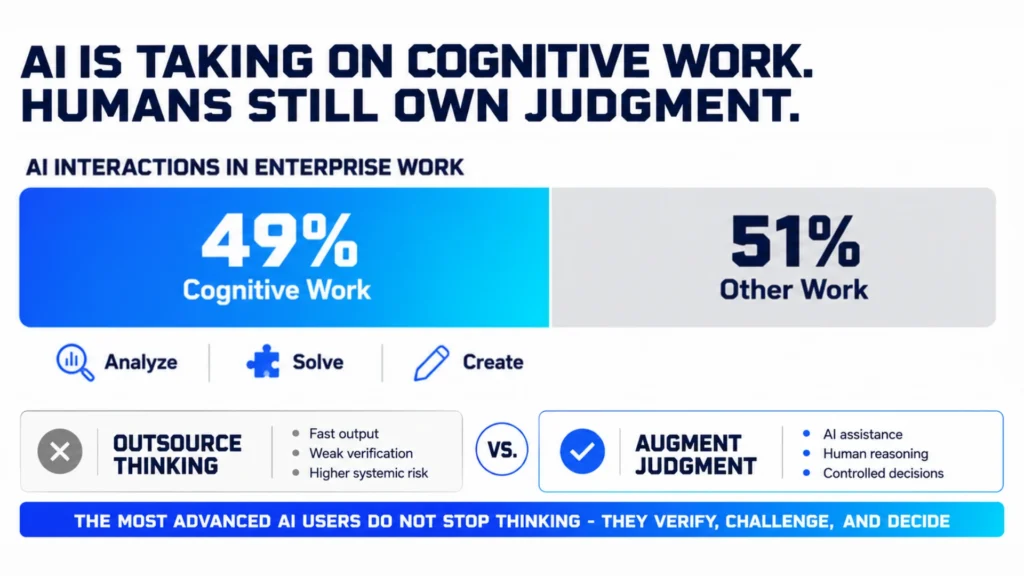
Data indicates that 49% of AI interactions in modern enterprise environments involve cognitive work—analyzing information, solving problems, and thinking creatively. While this shifts the burden of heavy lifting, it also creates a vulnerability. The most advanced users—often referred to as “Frontier Professionals”—mitigate this by refusing to outsource their thinking. They intentionally pause before assigning tasks to AI, deliberately completing certain work manually to keep their cognitive skills sharp. In an AI-driven economy, the human ability to verify quality (prioritized by 50% of advanced users) and apply objective critical thinking (46%) are the ultimate safety nets against systemic failure.
The Transformation Paradox: When Workers Outpace Their Organizations
The primary bottleneck to realizing AI’s economic value is not the technology, nor is it employee reluctance. It is the organizational structure itself.
Based on surveys of 20,000 workers across 10 countries, a clear “Transformation Paradox” emerges: Employees are ready to reinvent how they work, but the systems around them—metrics, incentives, and corporate norms—continue to enforce the old way of doing business. Approximately 65% of AI users fear falling behind if they do not adapt quickly, yet 45% admit it feels safer to focus on current, traditional goals rather than risk redesigning their workflow. Shockingly, only 13% of users report being rewarded for attempting to reinvent their work processes with AI.
Think of this like installing a high-performance sports car engine into a horse-drawn carriage. The engine (the employee equipped with AI) has the potential to move incredibly fast, but the wooden wheels and frame (the organization’s outdated operating model) cannot handle the speed and will eventually break apart.
Unpacking the "Messy Middle"
When mapping individual AI capability against organizational readiness, the data reveals a fractured workforce:
The Blocked (10%): Highly skilled individuals trapped in rigid, outdated corporate structures.
The Stalled (16%): Workers with low AI capability receiving limited organizational support.
The Emergent Zone (approx. 50%): The “messy middle” where both individual practice and corporate policies are clashing and still taking shape.
Organizational factors—such as management support and talent practices—account for twice the reported economic impact of individual effort alone. A highly skilled worker in a poorly aligned company will generate less value than a moderately skilled worker in a company built to support AI workflows.
The New Agency Equation: Redefining Human Work
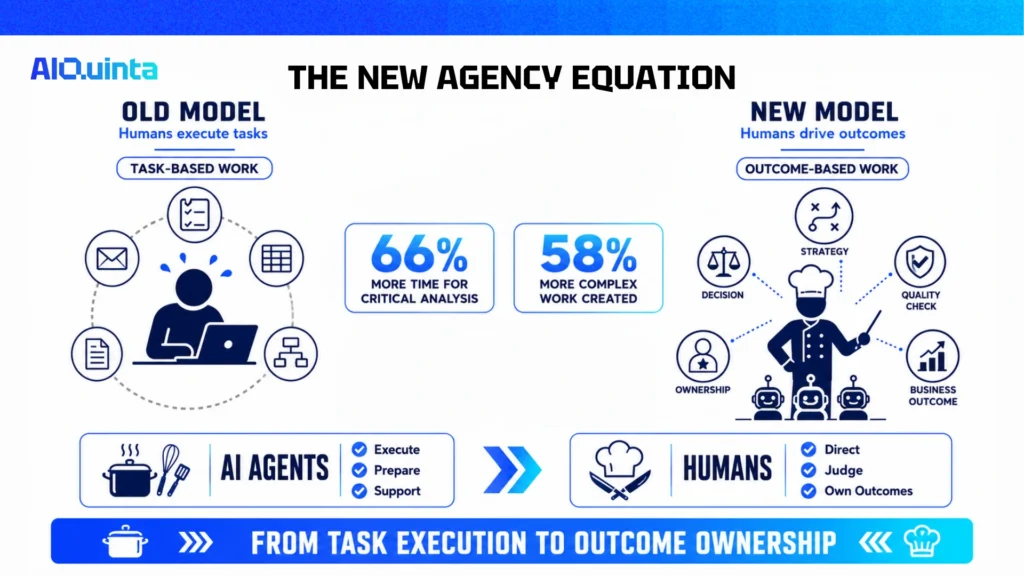
Once the risks are managed and organizational friction is reduced, we arrive at the “New Agency Equation.” As AI agents take on the routine execution of tasks, human workers are not displaced; instead, their agency expands. They are given more room to direct the work, make strategic calls, and take ownership of the final business outcomes.
To understand this without technical jargon, imagine a high-end restaurant. The AI agents are the prep cooks—they chop the vegetables, measure the ingredients, and simmer the stock. They handle the repetitive, time-consuming execution. The human worker becomes the Executive Chef. The chef does not need to chop onions all day; instead, their job is to design the menu, taste the sauces to ensure quality, and direct the kitchen’s overall flow.
In the corporate world, this translates to employees spending significantly more time on high-value work. Surveys show 66% of AI users report that AI allows them to dedicate more time to critical analysis, and 58% are producing complex work they simply did not have the bandwidth to create a year ago.
Shifting from Task-Based to Outcome-Based Value
Historically, a worker’s economic value was tied to the tasks they could manually execute within an eight-hour day. As AI takes over task execution, the definition of human value shifts. The question is no longer, “What tasks define my job?” but rather, “What business outcomes am I now positioned to drive?” Humans stay involved by setting clear intent, defining the quality bar, and acting as the final layer of accountability.
Blueprint of a "Frontier Firm": Aligning Capability with Culture
Organizations that successfully bridge the gap between employee potential and structural readiness are classified as “Frontier Firms.” In these environments, leaders have actively rearchitected the operating model. Currently, only 19% of AI users find themselves in this highly productive “sweet spot,” where individual capability and organizational readiness reinforce one another to drive maximum economic output.
Frontier Firms operate as “Learning Systems.” They recognize that static business models are obsolete. The companies that can rapidly prototype new AI workflows, analyze the outcomes, and integrate those learnings back into the company culture will outpace competitors.
Cultivating "Frontier Professionals"
Within these forward-thinking firms, a distinct class of workers emerges: Frontier Professionals, who make up about 16% of the AI user base. These individuals do not just use AI as a faster search engine. They use AI agents for multi-step workflows.
Instead of navigating complex software terminology, think of it this way: A standard user asks an AI to draft an email (a single step). A Frontier Professional asks an AI to review last quarter’s sales data, identify the three lowest-performing regions, generate a strategy document to address the shortfalls, and then draft customized emails to the regional directors (a multi-step workflow). These professionals understand which tasks to delegate and which require strict human supervision, constantly balancing agent intensity with human oversight.
Rethinking Leadership: Rearchitecting the Daily Grind
The job of modern leadership is to dismantle the Transformation Paradox. Only 26% of AI users currently feel their leadership is clearly and consistently aligned on AI strategy.
To turn human agency into unprecedented economic value, leaders must step in and redesign the system. This requires:
-
Redefining Performance Metrics: Stop measuring output by volume or hours logged. Reward employees who successfully automate routine tasks, even if their initial attempts involve trial and error.
-
Establishing AI Governance: Provide clear guidelines on what data can be fed into AI and what tasks must remain strictly human to ensure compliance and quality control.
-
Fostering a Culture of Experimentation: Make AI-driven reinvention safe. If employees fear that automating their workload will make them redundant, they will hide their efficiencies. Leaders must guarantee that saved time is reinvested into higher-level strategic work, not rewarded with layoffs.
Conclusion
The integration of AI agents into the workforce presents a profound economic opportunity, provided organizations first confront the realities of skill atrophy and structural friction. The data is definitive: the bottleneck is no longer the technology, but the operating model. By transitioning away from task-based management and empowering employees to direct and evaluate AI output, organizations can unlock the “New Agency Equation.” Leaders who fail to rearchitect their systems will watch their top talent become blocked or stalled, while Frontier Firms—those that align human intent with machine execution—will capture the vast majority of future market value.
Resources
FAQs
What is the biggest risk of integrating AI agents into a company?
The primary risk is human skill atrophy. If employees blindly rely on AI to perform complex cognitive tasks, they lose their ability to critically evaluate information and ensure quality control, leaving the company vulnerable to systemic errors.
How does AI change the definition of an employee’s value?
AI shifts human economic value from execution to direction. Instead of being valued for how many tasks they can manually complete, employees are valued for their ability to set clear intentions, oversee AI-driven workflows, and guarantee high-quality business outcomes.
How should leaders change performance metrics to support AI adoption?
Leaders must move away from volume-based or hours-based metrics. Instead, they should reward strategic outcomes, critical thinking, and the successful redesign of workflows, ensuring employees feel safe and incentivized to innovate without fear of job redundancy.
Turn Enterprise Knowledge Into Autonomous AI Agents
Your Knowledge, Your Agents, Your Control
Your Knowledge, Your Agents, Your Control