


Enterprise AI Maturity 2026: The Economic Advantage
- Publised July, 2026
-
Duc Nguyen (Dwight)
Most enterprises buy AI, but few build the data and workflow foundations for it. Learn how 2026’s leading enterprises capture 160% ROI on AI investments.
Table of Contents
Toggle
Key Takeaways
-
The investment paradox: The strongest argument against enterprise AI is that rapid procurement without infrastructure leads to capital waste. Only 9% of organizations have achieved autonomous workflows despite a 110% increase in AI spending.
-
The readiness gap: 70% of employees are prepared for AI, but only 27% of business leaders report their organizations are structurally ready to support it.
-
The data chasm: Just 7% of enterprises possess “AI-ready data.” The rest rely on siloed, reporting-focused data that stalls advanced AI deployment.
-
The economic moat: Organizations that redesign workflows and build semantic data layers see massive economic advantages, including 160% ROI and up to a 1.6x uplift in profit margins over industry peers.
The Counter-Intuitive Reality of AI Economics
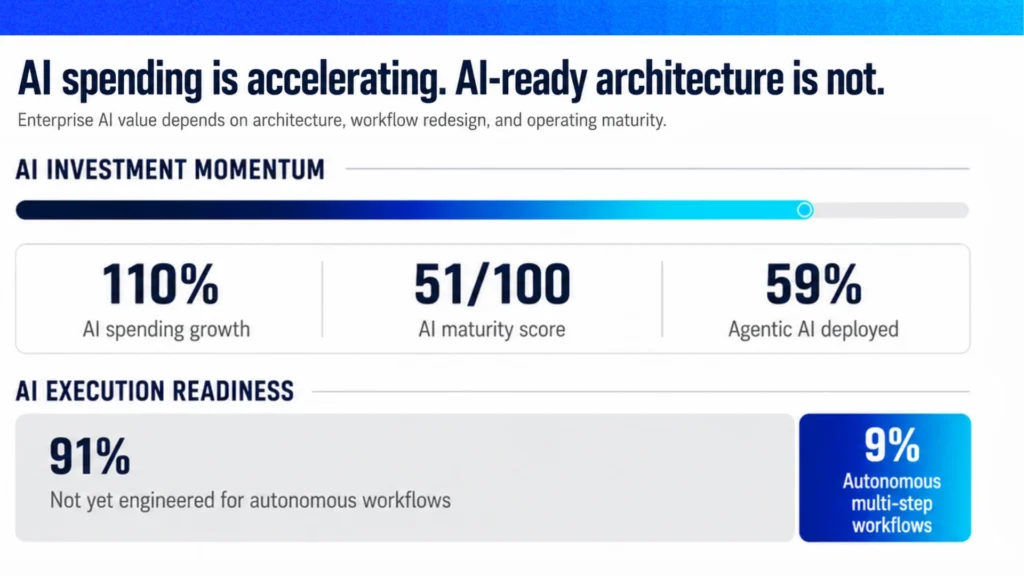
The strongest counter-argument against the current surge in enterprise artificial intelligence is that rapid software procurement without fundamental architectural changes destroys capital. Market data indicates a 110% year-over-year increase in enterprise AI spending, pushing the global AI maturity score to 51 out of 100 in 2026. However, beneath this aggressive investment lies a severe execution crisis.
Organizations are buying AI capabilities they cannot fully utilize. While 59% of companies have moved beyond basic pilots to deploy agentic AI, a mere 9% have successfully engineered autonomous, multi-step workflows. Automating a broken, inefficient process does not fix the process; it simply makes it fail faster. Think of this approach like attaching a modern jet engine to a wooden horse-drawn carriage. The problem is not the engine’s power, but the carriage’s inability to handle the speed and physics of flight.
Only after acknowledging this widespread infrastructure failure can we analyze the subset of enterprises—often categorized as “Pacesetters” or “Reinventors”—that are genuinely capturing economic value. These organizations prioritize structural redesign over superficial software deployment, yielding average returns on investment (ROI) of 160% and a 1.6x profit margin uplift compared to their peers.
The Three Horizons of AI Transformation
Enterprise economic value is driven by organizational readiness, not individual adoption. Organizational readiness accounts for 48% of the difference between companies that capture financial value from AI and those that do not, making it nearly twice as impactful as personal employee readiness.
Companies currently fall into three distinct horizons of AI maturity.
Horizon 1: Enablement
In this phase, organizations provide employees with access to general-purpose AI tools to assist with existing tasks. The focus is entirely on individual productivity. While individuals may draft emails or code faster, the organization’s overarching operating model remains static. Only 13% of companies in this horizon report meaningful enterprise value.
Horizon 2: Automation
Companies in this tier use AI to scale and automate existing cross-functional workflows. The limitation here is that the workflows themselves were designed for human execution, not machine intelligence. Progress is visible, but the economic ceiling is low because the fundamental business logic has not evolved.
Horizon 3: Reinvention
A mere 11% of organizations operate in the Reinvention horizon. Instead of asking, “How can AI help us do our current tasks faster?” these organizations ask, “How does AI completely eliminate the need for this task, or allow us to create a new economic model?” They creatively redesign roles, workflows, and decision rights to leverage the technology’s full potential. Almost half (48%) of leaders in this tier report substantial enterprise value, proving that deep workflow redesign is a prerequisite for high economic returns.
The Data Readiness Chasm
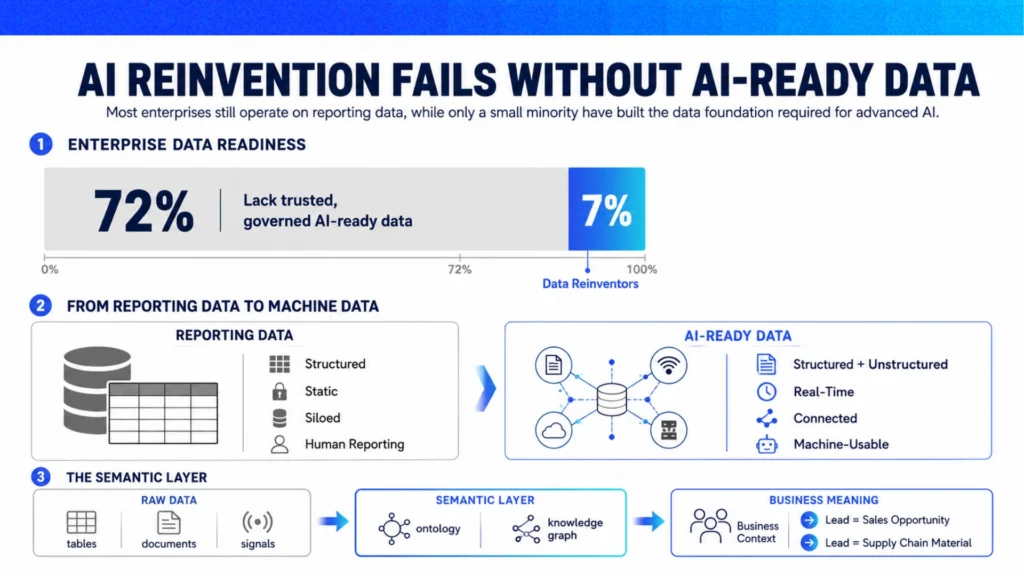
You cannot execute a Horizon 3 Reinvention strategy without AI-ready data. Currently, 72% of enterprises lack trusted data overlaid with standardized governance. Furthermore, only 7% of organizations have reached the elite status of “Data Reinventors.”
Reporting Data vs. Machine Data
Historically, enterprise data properties—accuracy, completeness, and consistency—were built for structured, tabular formats consumed by human data scientists for traditional reporting. This data is largely static and siloed.
Advanced AI exposes the limitations of this legacy architecture instantly. Agentic AI requires data designed specifically for machines. This means moving beyond structured databases to include unstructured data (documents, process diagrams, code) and real-time signals. If traditional data is a spreadsheet, AI-ready data is a living nervous system.
Context and The Semantic Layer
Deploying advanced AI without context is like hiring a genius-level executive but refusing to tell them what your company actually sells. To solve this, Data Reinventors build a semantic layer.
A semantic layer acts as a translator between raw data and business logic. It utilizes domain ontologies and knowledge graphs so that when an AI system sees the word “lead,” it understands the contextual difference between a heavy metal in a supply chain context and a potential customer in a sales context. By capturing the “why” and “how” behind business operations, organizations convert tacit, expert-driven human knowledge into reusable enterprise intelligence.
Workflow Orchestration: The Pacesetter Advantage
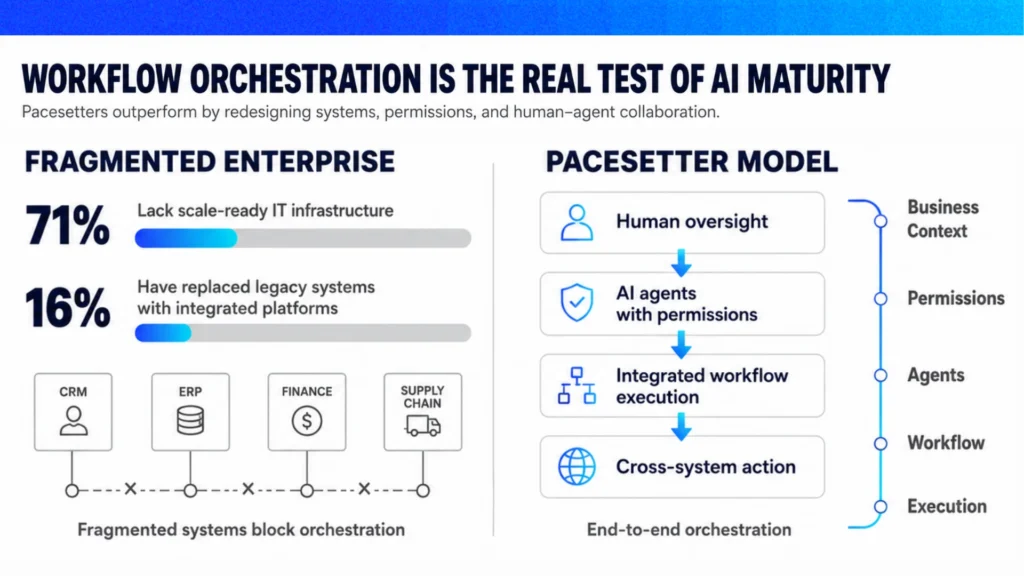
The ultimate test of AI maturity is the ability to orchestrate complex, multi-step workflows autonomously. “Pacesetters” (the top 21% of organizations in AI maturity) recognize that fragmented legacy systems are the enemy of orchestration.
The Cost of Fragmentation
Currently, 71% of businesses lack the underlying IT infrastructure to facilitate scale, and only 16% have successfully replaced legacy systems with integrated platforms. When data sits in silos, AI operates in a vacuum. The software can generate a localized insight, but it cannot trigger a downstream action across a different department’s software environment.
Human and Agent Collaboration
Pacesetters redesign the workforce by establishing strict permissions and business contexts for AI agents, allowing them to handle end-to-end workflows rather than isolated tasks. Humans are elevated to roles requiring strategic judgment, exception handling, and oversight. This orchestrated collaboration results in Pacesetters outperforming industry averages by 5.6x in productivity and 2.7x in scalability.
Strategic Blueprint for Economic Value
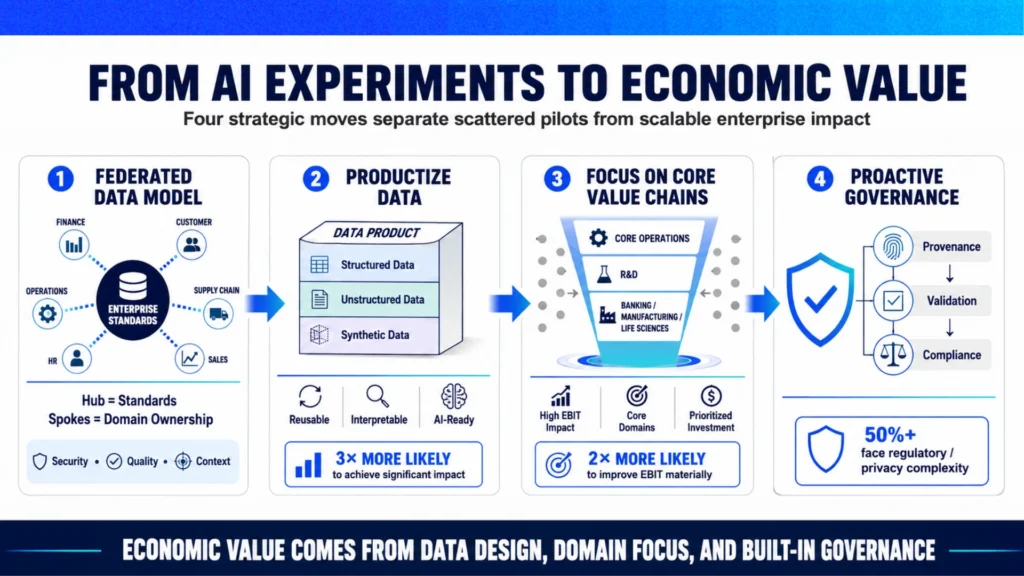
To transition from disjointed AI experimentation to enterprise-wide economic impact, organizations must adopt a rigid, sequential strategy.
Establish a Federated Data Model
Centralizing all enterprise data into a single cloud environment is financially and operationally impractical for most large organizations. Instead, implement a federated, hub-and-spoke data model.
-
The Hub: Sets common enterprise standards for security, quality, and engineering patterns.
-
The Spokes (Domains): Own the contextual value and quality of their specific data.
-
Analogy: Think of this as a national library system. The central index (the hub) knows exactly where every book is and enforces the rules of borrowing, but the actual books remain housed in local community branches (the domains) where they are most needed.
Productize Your Data
Stop treating data as a byproduct of business operations and start treating it as an internal product. Engineer reusable data products that package structured, unstructured, and synthetic data in a way that is easily interpretable by both humans and AI. Data reinventors are three times more likely to intentionally build these reusable data assets.
Shift Focus to Core Value Chains
Avoid spreading AI pilots thinly across the organization to create a false sense of innovation. Data Reinventors are nearly twice as likely as their peers to concentrate their AI resources strictly on core industry domains—such as research and discovery in life sciences, or core operations in banking. Target the areas that directly impact EBIT margins.
Implement Proactive Governance
Do not treat AI governance as an afterthought. Pacesetters build governance, testing, and risk auditing into their architecture before deployment. Over 50% of organizations struggle with regulatory complexity and data privacy risks. By embedding provenance, validation, and compliance checks directly into data workflows, enterprises can scale quickly without triggering catastrophic risk events.
| Attribute | Traditional AI Adopter | Enterprise AI Pacesetter |
|---|---|---|
|
Strategy |
Spreads isolated pilots across departments |
Concentrates heavily on core economic value chains |
|
Data Architecture |
Siloed, static, reporting-focused data |
Federated, context-rich AI data products |
|
Workflow Focus |
Automates existing human tasks |
Redesigns end-to-end autonomous workflows |
|
Governance |
Bolted on after deployment (reactive) |
Built into the foundational layer (proactive) |
|
Economic Outcome |
Marginal individual productivity gains |
Up to 160% ROI and 1.6x margin uplift |
Conclusion
The 2026 economic landscape proves that artificial intelligence is not a plug-and-play solution. Organizations that merely purchase AI software while ignoring their fragmented data architectures and legacy workflows will experience accelerated failure. True economic advantage—realized through massive ROI and margin expansion—belongs exclusively to enterprises that treat AI as a structural reorganization. By establishing federated data models, building semantic context layers, and completely redesigning how workflows operate, businesses transition from participating in the AI hype to dominating the AI economy.
Resources
- McKinsey & Company: From adoption to impact: Three horizons of AI transformation
- ServiceNow: Enterprise AI Maturity Index 2026
- Accenture: AI-ready data – New rules of data for the advanced AI era
FAQs
What does “AI-ready data” actually mean?
Traditional enterprise data is structured and formatted for human analysts to run reports. AI-ready data is designed for machines. It includes structured data, but also unstructured formats (like manuals and process diagrams), real-time signals, and a “semantic layer.” This layer provides business context so the AI system understands the exact meaning, relationships, and operational intent behind the data.
Why is AI investment increasing if ROI is generally low?
Organizations view AI as an existential requirement for future competitiveness, driving a 110% year-over-year increase in spending. However, the low average ROI is a symptom of poor execution. Companies are heavily funding software procurement but underfunding the necessary underlying infrastructure, data modernization, and workflow redesign required to extract financial value from that software.
Why do companies fail when automating workflows with AI?
Many companies apply AI to automate workflows that were originally designed around human limitations and manual hand-offs. Applying high-speed AI to a highly inefficient process does not fix the root inefficiency. High-performing enterprises completely redesign the workflow from the ground up, utilizing AI to execute autonomous, multi-step operations and removing the legacy steps altogether.
Turn Enterprise Knowledge Into Autonomous AI Agents
Your Knowledge, Your Agents, Your Control
Your Knowledge, Your Agents, Your Control