
Human Resource Management in AI Era: The Success Formula
- Publised July, 2026
-
Duc Nguyen (Dwight)
Human resource management in AI needs more than automation. Learn the formula for trusted data, governance, AI agents, and better workforce decisions.
Table of Contents
Toggle
Key Takeaways
- AI will not fix HR if the enterprise has poor workforce data, fragmented policies, unclear job architecture, and weak governance.
- The real formula is not “automate HR.” It is: structured knowledge + trusted data + human judgment + governed AI agents.
- Recruitment is the most common HR AI entry point, but the bigger value sits in skills intelligence, workforce planning, performance enablement, and employee self-service.
- AI in HR carries high risk because it affects hiring, promotion, pay, monitoring, and termination decisions.
Introduction
AI is forcing HR to answer a harder question than “Which tasks can we automate?” The real question is: how should an enterprise redesign the way it understands, develops, moves, and protects its workforce when AI can analyze context, generate recommendations, and execute workflows at scale?
The counterargument is serious. HR is not a low-risk automation domain. A bad AI answer in marketing may create an off-brand sentence. A bad AI answer in HR may affect a candidate’s chance of getting hired, an employee’s promotion path, a manager’s performance decision, or the company’s legal exposure. The U.S. Equal Employment Opportunity Commission states that AI used in employment decisions can still violate discrimination laws, including through disparate impact, and lists recruiting, screening, monitoring, productivity assessment, promotion, and termination as activities where AI can be involved.
Still, ignoring AI is not a defensible strategy. HR teams face rising demand for faster hiring, better skills visibility, consistent employee support, proactive retention, and stronger workforce planning. Traditional HR systems record transactions. They do not always explain what talent the company has, which skills are missing, which policies apply, or which workforce moves will reduce business risk.
The formula for success in human resource management in the AI era is not “replace HR with AI.” It is:
Structured workforce knowledge + integrated HR data + human judgment + governed AI agents = scalable people intelligence.
That formula turns HR from an administrative service center into an enterprise decision function.
Why AI in HR is often misunderstood?
Most AI in HR discussions start with automation: resume screening, job description writing, onboarding chatbots, training recommendations, and employee surveys. These are valid use cases. SHRM reports that among organizations using AI for HR, talent acquisition leads adoption at 64%, followed by learning and development at 43%, and performance management at 25%.
But automation alone is a shallow business case.
A recruitment chatbot can answer candidate questions, but it cannot fix a weak job architecture. A performance review assistant can summarize feedback, but it cannot solve poor goal design. A workforce analytics dashboard can show attrition risk, but it cannot explain whether the risk comes from workload, pay compression, weak managers, poor onboarding, or limited career paths.
This is where many AI HR programs stall. They add tools on top of fragmented HR knowledge.
The enterprise issue is not a lack of AI features. It is a lack of structured context. HR knowledge often lives across policy PDFs, intranet pages, payroll systems, HRIS records, manager notes, job descriptions, learning platforms, engagement surveys, exit interviews, and spreadsheets. AI cannot support strategic HR decisions if it cannot access trusted, current, and governed knowledge.
This is why HR should treat AI as a knowledge and workflow architecture, not just software automation. A governed AI for Human Resources model should retrieve HR policies, benefits information, procedures, and guided workflows from a trusted knowledge base rather than relying on generic model output.
The New Role of HR: From Process Owner to Workforce Intelligence Architect
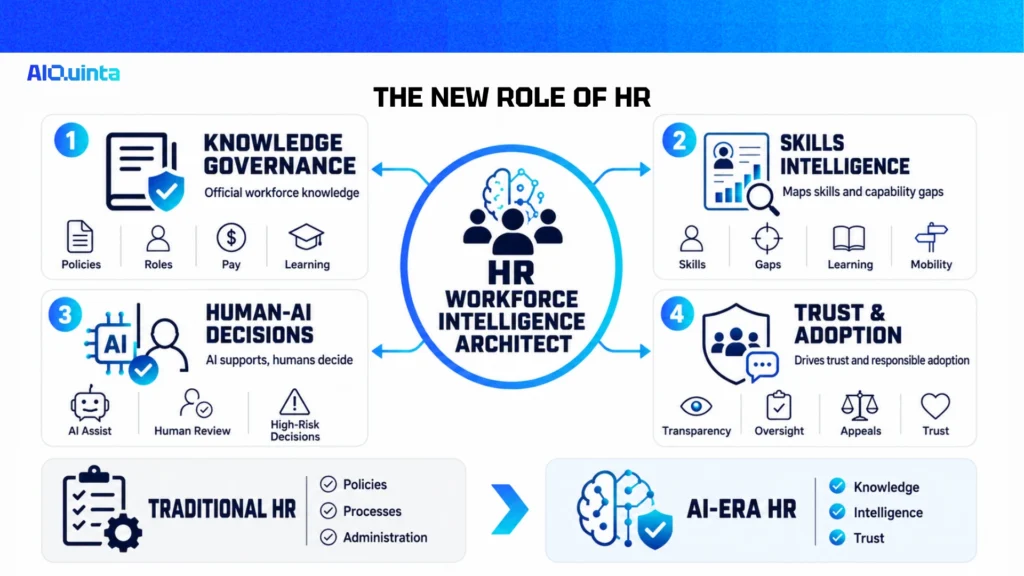
In the AI era, HR’s strategic role expands across four layers.
Workforce knowledge governance
HR must define which knowledge is official, current, and usable by AI. This includes policies, job families, competency models, salary bands, promotion criteria, learning pathways, interview rubrics, onboarding playbooks, and employee relations procedures.
Without this layer, AI produces inconsistent answers. For example, one employee may receive a leave policy answer based on an outdated PDF, while another receives a different answer from a manager’s local spreadsheet. That is not productivity. It is controlled chaos with a chatbot interface.
Skills and role intelligence
AI can help HR map skills, infer capability gaps, recommend learning paths, and support internal mobility. But skills intelligence only works when the enterprise defines skills with enough structure.
A weak model says: “This person is good at communication.”
A useful enterprise model says: “This person has demonstrated stakeholder management in regional ERP rollout projects, but lacks evidence of change management experience in unionized environments.”
That level of context requires structured extraction from resumes, project histories, performance notes, training records, and manager feedback.
Human-AI decision design
HR must set decision boundaries. Some decisions can be automated, some can be AI-assisted, and some must remain human-led.
A safe rule: use AI to surface evidence, detect patterns, explain options, and draft recommendations. Use humans to make consequential decisions about hiring, promotion, compensation, discipline, and termination.
This aligns with the broader direction of high-risk AI governance, where human oversight, documentation, traceability, and risk mitigation matter
Change adoption and trust
AI adoption in HR is also an employee experience issue. Competitor content often mentions resistance to change, but few articles treat it as an operating risk. Employees will resist AI if they believe it is being used to monitor them, replace them, or make hidden decisions about their future.
HR must communicate what AI is used for, what it is not used for, what data it can access, who reviews outputs, and how employees can challenge or correct errors.
The Enterprise Formula for AI-Ready HR
A practical AI HR operating model has five components.
| Component | What it means | Enterprise impact |
|---|---|---|
|
Trusted knowledge base |
Policies, procedures, job architecture, benefits, and HR rules are structured and governed |
Consistent answers, lower HR service load, fewer policy errors |
|
Data integration |
HRIS, payroll, learning, performance, engagement, and workforce planning systems connect through controlled access |
Better workforce visibility and decision support |
|
AI memory layer |
AI can reuse approved context, past decisions, and workflow history |
Less repeated work, faster employee support, better continuity |
|
Human oversight |
HR defines which decisions require review, audit, and escalation |
Lower bias, privacy, and compliance risk |
|
Agentic workflows |
AI agents execute repeatable HR tasks inside clear rules |
Faster service, better manager support, scalable HR operations |
The technical foundation matters. A memory layer in enterprise AI systems gives AI access to approved knowledge, past decisions, workflow history, and feedback loops. This is important in HR because context changes over time. Policies update. Employees move roles. Managers change. Skills evolve.
For data access, HR needs controlled data integration with clear boundaries. AI should not freely scrape every employee document or message. It should retrieve only the data it is allowed to use for the specific task.
High-Value HR AI Use Cases That Go Beyond Automation
HR policy and employee support
A governed HR agent can answer employee questions about leave, benefits, travel policy, hybrid work, expense claims, onboarding steps, and internal procedures. The business value is not only faster response time. It is consistency.
Example: an employee asks, “Can I carry unused leave into next year if I transfer departments?” A basic chatbot may hallucinate or quote a generic policy. A governed HR agent should retrieve the current policy, check location and employment type, identify exceptions, and escalate if the case requires HR review.
Recruitment and structured candidate evaluation
AI can support job description drafting, candidate communication, interview planning, and resume summarization. But enterprises should avoid using AI as an opaque ranking engine.
Better approach: use AI to extract structured evidence from resumes and interviews, then compare that evidence against a transparent rubric. The recruiter and hiring manager still make the decision.
This reduces manual effort without turning hiring into a black box.
Learning and internal mobility
AI can map employees to learning paths, suggest internal roles, and identify skill gaps. The risk is oversimplification. Employees are not keywords. A strong system should combine role requirements, verified skills, manager input, project history, learning records, and career goals.
This is where human expertise and AI memory become useful. Human experts define what good performance looks like. AI memory helps preserve and reuse that expertise across teams.
Performance management support
AI can help managers prepare feedback, summarize progress, identify goal misalignment, and reduce recency bias. But AI should not replace performance judgment.
The correct model is “AI-informed, manager-owned.” AI provides evidence. Managers provide context, accountability, and empathy.
Workforce planning and retention intelligence
AI can help HR forecast attrition risk, identify workload pressure, detect skills shortages, and model redeployment options. This is a strategic use case because it links people data to business capacity.
Example: a manufacturing enterprise sees rising overtime in maintenance, delayed work orders, and higher technician attrition. HR, operations, and finance can use AI to connect workforce data with operational signals and decide whether to reskill, hire, redesign shifts, or automate administrative work.
Why Structured Extraction Is a Strategic HR Capability
Structured extraction is often treated as a document automation task. In HR, that framing is too narrow.
Structured extraction means converting messy human resource information into usable workforce intelligence. It can extract:
- Skills from resumes, project records, and training histories
- Policy rules from HR manuals and benefits documents
- Competency evidence from performance reviews
- Risk signals from exit interviews and engagement comments
- Role requirements from job descriptions and workforce plans
- Compliance obligations from contracts and local labor rules
The outcome is not just faster document processing. The outcome is a reusable HR knowledge layer.
For example, extracting skills from 5,000 resumes is useful. But the larger value appears when those skills connect to job families, learning paths, internal mobility, workforce planning, and succession risk.
A knowledge graph can help here by connecting people, roles, skills, policies, teams, locations, and workflows into a structured enterprise memory. That makes AI more accurate because it understands relationships, not just text fragments.
Risks and Limitations Enterprises Must Not Ignore
Bias can scale through automation
AI can repeat historical bias if training data reflects past unfairness. Resume screening, interview scoring, performance prediction, and promotion recommendations need bias testing, documentation, and human review.
Privacy risk increases with data connectivity
HR data is sensitive. AI access must follow strict role-based permissions, logging, and purpose limitation. More data does not always mean better AI. It can mean more exposure.
Explainability matters more in HR than in most functions
Employees and candidates need to understand how AI affected a process. If HR cannot explain the recommendation, the enterprise should not rely on it for consequential decisions.
Stale knowledge creates wrong answers
HR policies change. Benefits change. Local labor rules change. AI systems need update workflows, source control, review owners, and expiration dates for knowledge.
Over-automation damages trust
Employees do not want to feel managed by a machine. AI can support managers, but it cannot replace trust-building conversations, coaching, conflict resolution, or ethical judgment.
Decision Criteria: Where Should HR Start?
Start with use cases that are repetitive, knowledge-heavy, low-risk, and easy to validate.
Good first use cases:
- HR policy Q&A from approved sources
- Onboarding guidance
- Benefits explanation
- Job description drafting with human review
- Interview question generation based on approved rubrics
- Learning path recommendations
- Internal HR knowledge search
Avoid starting with:
- Automated candidate rejection
- Fully automated performance scoring
- Employee mood surveillance
- Termination recommendations
- Pay decisions without transparent human review
- Any use case where HR cannot explain the output
The priority should be business value with low governance debt. HR should prove the operating model before scaling into higher-risk decisions.
Conclusion
Human resource management in the AI era is not a software upgrade. It is an operating-model shift.
The strongest enterprises will not use AI only to automate HR administration. They will use AI to build a governed workforce intelligence layer that connects knowledge, skills, policies, employee experience, and business planning.
Structured extraction is a key part of that shift. It is not only document automation. In HR, it converts scattered resumes, policies, feedback, role data, learning records, and workforce signals into decision-ready knowledge. That knowledge then powers AI agents, manager support, employee self-service, and strategic workforce planning.
The practical takeaway: HR should not start by asking, “Which AI tool should we buy?” It should ask, “What workforce knowledge must we structure, govern, and reuse so AI can support better people decisions at scale?”
FAQs
What is human resource management in the AI era?
Human resource management in the AI era means using AI to improve HR service delivery, workforce analytics, recruitment, learning, performance support, employee experience, and workforce planning. The goal is not to replace HR, but to help HR make faster, fairer, and more evidence-based decisions.
What is the formula for success in AI-powered HR?
The formula is: structured workforce knowledge + integrated HR data + human judgment + governed AI agents. Without trusted knowledge and oversight, AI can create inconsistent answers, bias risk, privacy exposure, and employee distrust.
Which HR processes should enterprises automate first with AI?
Start with low-risk, high-volume tasks such as HR policy Q&A, onboarding guidance, benefits support, job description drafting, interview preparation, employee knowledge search, and learning recommendations. Avoid starting with automated hiring rejection, pay decisions, termination recommendations, or opaque performance scoring.
Turn Enterprise Knowledge Into Autonomous AI Agents
Your Knowledge, Your Agents, Your Control
Your Knowledge, Your Agents, Your Control