

What is an AI-Native Company? The New Business Model
- Publised May, 2026
-
Duc Nguyen (Dwight)
An AI-Native Company is reshaping business economics by using AI at the core of products, operations, data, and growth. Learn how this model works.
Table of Contents
Toggle
Key Takeaways
- AI-native companies do not just add AI to existing work. They build the business around AI from the start.
- The strongest economic value comes from faster execution, lower coordination cost, better use of data, and more flexible pricing.
- Data becomes the main business asset because AI needs trusted company knowledge to make useful decisions.
- Human teams still matter, but their role shifts from manual execution to judgment, governance, and strategy.
- The biggest risk is not slow AI adoption. It is adopting AI without clean data, clear rules, and measurable business outcomes.
What is an AI-Native Company?
An AI-native company is not a traditional company with AI tools added on top. It is a company designed so AI sits at the center of how value is created, delivered, measured, and improved. AI is not only used to write content, answer support tickets, or help employees work faster. It becomes part of the company’s operating system.
Think of a normal company as a restaurant where staff take orders, pass notes to the kitchen, check inventory, update the menu, and report sales at the end of the day. An AI-native company is closer to a smart kitchen that sees demand in real time, adjusts the menu, predicts missing ingredients, supports staff, and learns which dishes sell better. Humans still own the concept, taste, quality, and customer experience. But the system handles much of the sensing, routing, and repeat work.
This matters because AI changes business economics. When a company can learn faster, serve customers with fewer delays, and turn data into decisions, it can scale with less friction. The advantage is not only speed. It is a new cost structure.
Why AI-Native Companies Are Becoming Economically Important
Traditional companies often grow by adding people, systems, meetings, reports, and layers of management. This creates control, but it also creates drag. Information moves slowly. Teams wait for approvals. Data sits across many tools. Decisions rely on monthly dashboards or quarterly reviews.
AI-native companies challenge this model. They aim to make the company more responsive, like a business that can read signals and act while the market is still moving.
From manual coordination to intelligent coordination
In many organizations, a lot of work is not real value creation. It is coordination. People forward updates, summarize meetings, check data, prepare reports, follow up with customers, assign tickets, and translate one team’s needs to another team.
AI-native companies use AI agents and connected data systems to reduce this coordination cost. A support issue can become a product insight. A sales objection can become a new marketing message. A usage drop can trigger a customer success workflow. The point is not to remove people from the company. The point is to remove slow handoffs from the system.
From fixed teams to flexible capacity
Traditional growth often means hiring more people for each function: more sales reps, more support agents, more developers, more analysts. AI-native companies can add capacity in a different way. They use AI to handle repeatable work, then keep human experts focused on judgment-heavy work.
For example, a small team may use AI to qualify leads, draft proposals, create product tests, monitor customer feedback, and build internal tools. The same team can manage more output without growing at the same pace as a traditional company.
This creates a major economic shift: growth becomes less tied to headcount.
The Core Architecture of an AI-Native Company
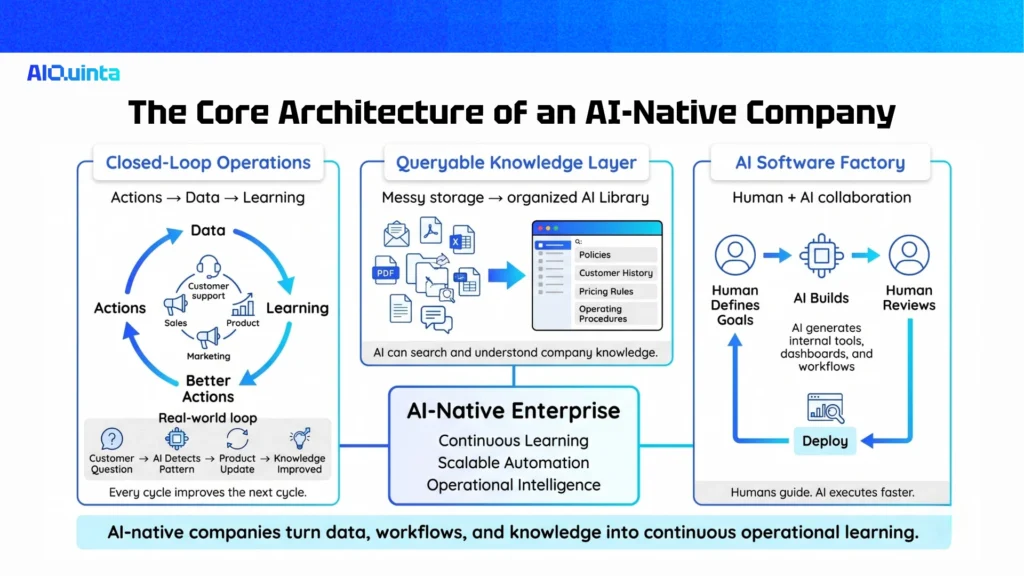
An AI-native company needs more than a chatbot. It needs a business architecture that lets AI see what is happening, understand context, act within rules, and improve over time.
A closed-loop operating model
A closed-loop business is one where actions create data, data creates learning, and learning improves the next action.
In a traditional business, a campaign may run for weeks before the team reviews results. A customer issue may appear many times before product teams see the pattern. A sales team may hear the same objection again and again before marketing updates its message.
In an AI-native model, these loops become faster. The system can collect customer emails, support tickets, product usage, sales calls, and operational data. It can then detect patterns and suggest or trigger the next action.
A simple example:
- Customers keep asking the same question.
- The support AI detects the pattern.
- The product AI checks whether the issue relates to a feature gap.
- The content AI suggests an FAQ update.
- The product team reviews whether a product fix is needed.
- The result becomes new knowledge for the next customer interaction.
This is where AI creates compound value. Each cycle improves the next cycle.
A queryable knowledge layer
AI is only useful when it can access the right company knowledge. If the company’s knowledge is scattered across emails, PDFs, call notes, spreadsheets, support tools, and private chats, AI will struggle.
A queryable knowledge layer means company knowledge is organized so AI can search, understand, and use it. This includes customer history, product rules, policies, operating procedures, pricing logic, past decisions, and lessons learned.
For a non-technical example, imagine the difference between a messy storage room and a well-run library. Both contain information. But only one lets people find the right answer fast. AI needs the library, not the storage room.
This is why data becomes a strategic asset. Software screens can be rebuilt. Workflows can be changed. But years of customer context, operational know-how, and business rules are hard to replace.
A software factory
AI-native companies also change how products and internal tools are built. In the old model, humans wrote most of the code and AI helped around the edges. In the new model, humans define what should be built, what success looks like, and what rules must be followed. AI handles more of the execution.
This does not mean humans stop building. It means the bottleneck moves. The scarce skill is no longer only writing code. It becomes writing clear requirements, defining strong tests, reviewing outputs, and spotting edge cases.
A useful comparison: in the past, building a small internal tool was like hiring a construction crew. Now, for simple use cases, it is more like giving clear instructions to a skilled workshop that can build the first version fast. The leader still needs to inspect the work, check safety, and decide whether the tool solves the right problem.
The Role of Data Ownership
AI-native advantage depends on data ownership. If a company depends only on public models and generic tools, its advantage will be thin. Competitors can access similar tools.
The durable advantage comes from private business knowledge: customer behavior, operating history, process rules, product feedback, supplier patterns, service records, and expert decisions. When this data is clean, connected, and governed, AI can use it to produce better answers and better actions.
This is why the data layer must evolve from a record-keeping system into a reasoning system. A record-keeping system tells you what happened. A reasoning system helps explain why it happened, what should happen next, and what risks need human review.
For enterprise leaders, this is a board-level issue because data quality now affects revenue, cost, speed, and competitive defense.
Risks Leaders Must Manage
AI-native companies can move faster, but speed can scale mistakes. A weak workflow done by one person creates limited damage. A weak workflow run by AI across thousands of cases can create a much larger problem.
Misaligned metrics
If an AI support agent is measured only on speed, it may close tickets too fast and hurt customer satisfaction. If a sales AI is measured only on conversion, it may push discounts that reduce margin. Leaders must define the right success metrics.
Poor governance
AI needs rules. Leaders must define what AI can do alone, what needs approval, and what must be logged. High-risk actions should stay under human control.
Bad or outdated knowledge
If AI uses old policies or messy documents, it may give confident but wrong answers. Companies need a habit of updating, archiving, and validating knowledge.
Hidden cost
AI is not free. Computing cost, data storage, integration, monitoring, and governance all matter. AI-native companies need cost controls, usage tracking, and clear ROI measures.
How to Build an AI-Native Roadmap
A practical roadmap should start small, prove value, then scale.
Step 1: Choose one high-value workflow
Pick one workflow with clear pain and measurable output. Do not start with the most complex process. Start where the data is available and the economic case is clear.
Step 2: Connect the data
Map the data needed for the workflow. This may include CRM records, support tickets, call notes, product usage, policies, or transaction history. Clean and structure the data before expecting AI to perform well.
Step 3: Define rules and decision rights
Decide what AI can recommend, what it can execute, and what requires approval. Write these rules in plain business language.
Step 4: Measure business impact
Track cost saved, time reduced, revenue uplift, error reduction, customer experience, and employee capacity. AI-native work must tie back to business outcomes.
Step 5: Expand the loop
Once one workflow works, connect it to adjacent workflows. For example, support insights can feed product development. Sales objections can feed marketing. Forecast changes can feed supply planning.
Conclusion
AI-native companies are not important because they use more AI tools. They are important because they change the economics of how a company works.
They reduce coordination cost. They turn data into a stronger asset. They shift pricing toward usage and outcomes. They help small teams create more output. They also push large enterprises to rethink how decisions, workflows, and products are built.
The winning model is not “AI replaces people.” The winning model is “AI handles repeatable coordination while people own judgment, strategy, and accountability.”
For enterprise leaders, the next move is clear: do not chase AI adoption for its own sake. Build the data foundation, define the rules, choose one high-value workflow, and prove measurable business impact. That is how AI-native thinking turns from hype into operating advantage.
FAQs
What does AI-native mean?
AI-native means a company is designed around AI from the start. AI supports products, operations, data, customer experience, and decision-making. It is not just an extra tool added to old workflows.
Why is data important for AI-native companies?
AI needs trusted business context to make useful decisions. Clean, connected, and well-governed data helps AI understand customers, operations, policies, and past decisions. This makes the company’s private knowledge a competitive advantage.
How can an enterprise start becoming AI-native?
Start with one workflow that has clear data, high coordination cost, and measurable business value. Connect the needed data, define governance rules, deploy AI into the workflow, and measure the economic impact before scaling.
Turn Enterprise Knowledge Into Autonomous AI Agents
Your Knowledge, Your Agents, Your Control
Your Knowledge, Your Agents, Your Control