
Tool Calling for AI Agents: End-to-End Execution Flow
- Publised May, 2026
-
Duc Nguyen (Dwight)
Learn how tool calling works for LLM agents, from tool selection and schema validation to execution, governance and enterprise deployment.
Table of Contents
Toggle
Key Takeaways
Tool calling enables LLM agents to invoke external APIs, databases, code, and services based on natural language instructions.
The end‑to‑end flow typically includes planning, function selection, parameter extraction, execution, result parsing, and re‑prompting.
Good tool‑calling architectures minimize hallucination, enforce access controls, and keep the user in the control loop.
What is Tool Calling in AI Agents?
Tool calling is the process where an AI model requests the use of an external capability. That capability may be a function, API, database query, file operation, search engine, CRM action, ticketing workflow, or internal enterprise system.
The model does not usually run the tool directly. It returns a structured request that tells the application what tool to call and what parameters to pass.
A basic tool call usually includes:
- Tool name: the function or system the agent wants to use.
- Arguments: structured inputs, often in JSON format.
- Tool call ID: a reference used to match the request with the tool result.
- Tool result: the output returned after execution.
- Final response: the answer or action summary generated after the model receives the result.
This is why tool calling sits between language understanding and business execution. The model interprets intent. The application turns that intent into controlled action.
Why Tool Calling Matters for Enterprise AI Agents
Tool calling matters because enterprise AI agents need to work with live systems, private data, and real business workflows, not just generate text.
- Access real-time business data
Agents can retrieve updated information from CRMs, ERPs, databases, knowledge bases, and internal systems. - Connect to private enterprise knowledge
Tool calling lets agents use company-specific documents, policies, customer records, and operational data without relying only on model memory. - Move from advice to action
Instead of only suggesting next steps, agents can create tickets, update records, generate reports, schedule meetings, or trigger workflows. - Support repeatable business processes
Agents can follow structured workflows across departments such as sales, finance, operations, customer support, and manufacturing. - Improve control and governance
Each tool can have clear permissions, validation rules, approval steps, and audit logs. - Reduce hallucination risk
When agents call trusted systems for facts, they are less likely to invent outdated or incorrect information. - Enable enterprise-scale automation
Tool calling gives AI agents a controlled execution layer, making them more suitable for production use than prompt-only chatbots.
Tool Calling vs Function Calling vs API Calling
Tool calling, function calling, and API calling are often used as if they mean the same thing. They overlap, but they are not identical.
| Term | Meaning | Who Decides the Call? | Main Purpose |
|---|---|---|---|
|
API Calling |
A software system calls an external service or system through an API. |
Developer, backend system, or app logic |
To connect systems and exchange data |
|
Function Calling |
An AI model generates a structured request to call a specific function with the right parameters. |
AI model |
To let AI trigger predefined business logic safely |
|
Tool Calling |
An AI agent selects and uses a tool to get data, take action, or extend its capability. |
AI model or AI agent |
To help AI agents work with external tools and systems |
In many current AI documents, “Tool Calling” and “Function Calling” are almost used interchangeably. OpenAI even explicitly states that function calling “also known as tool calling.”
How Tool Calling Works for LLM Agents: The End-to-End Execution Flow
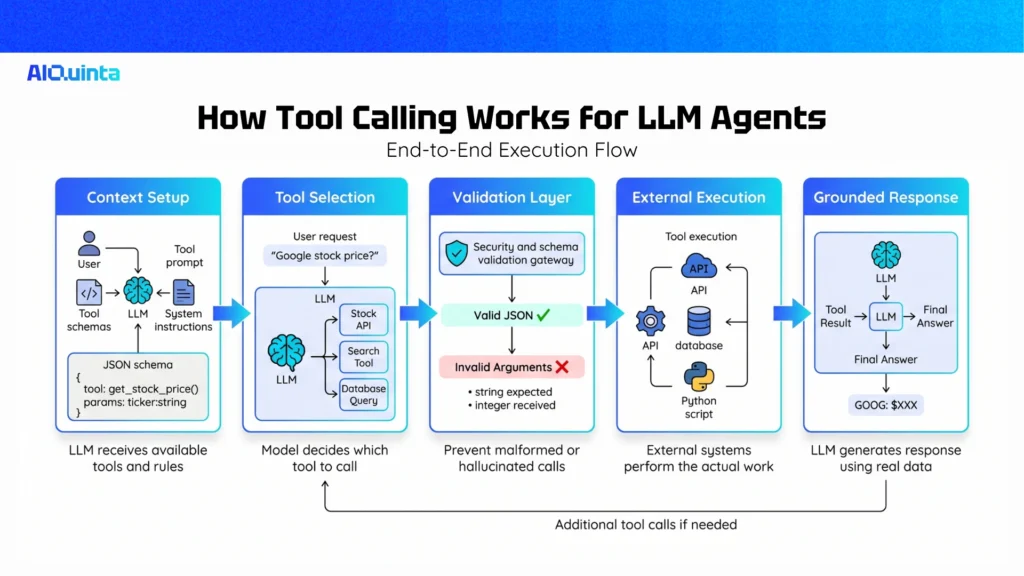
Context Preparation and Schema Definition
Before the user even submits a prompt, the system environment must be configured. The orchestration layer provides the LLM with the user history, system prompts, and, most importantly, the tool schemas.
A schema is a strict JSON description of the available tools, defining their names, descriptions, and the exact data types required for their parameters. If a model does not have access to these schemas within its context window, it cannot format its output correctly.
Model Reasoning and Tool Selection
The user submits a query (e.g., “What is the current stock price of Google and what was its high yesterday?”). The LLM analyzes the request against the provided tool schemas.
If the model determines its internal knowledge is insufficient or outdated, it triggers a tool call. Modern LLMs are capable of parallel tool calling, meaning the model can generate a response containing multiple tool requests simultaneously to reduce latency.
Output Validation and Interception
The LLM outputs a tool_call object containing the requested function names and generated arguments. At this stage, the orchestration platform intercepts the model’s response.
This is a critical checkpoint. The system must validate that the generated JSON matches the expected schema perfectly. If the model has hallucinated an argument or provided an integer where a string was expected, the validation layer must catch the error and either prompt the model to correct itself or terminate the sequence to prevent malformed data from hitting backend systems.
External Execution
Once the parameters are validated, the host environment executes the external call. This is where the actual computation or data retrieval occurs. The system might execute a Python script, run a SQL query, or authenticate against a Salesforce API. Because this execution happens outside the LLM, the host environment remains secure and isolated from the model’s non-deterministic logic.
Result Integration and Final Inference
The output from the external system (e.g., the JSON response from the stock market API) is captured by the orchestration layer. This data is appended to the conversation history as a new message, specifically marked as a tool response.
The entire context—including the original prompt, the tool request, and the tool result—is fed back into the LLM. The model performs a final inference pass, grounding its response in the newly acquired factual data to generate a natural language answer for the user. If the task is complex, the LLM may determine that a subsequent, sequential tool call is necessary, restarting the loop.
Enterprise Strategies: Securing the Agentic Workflow
Securing an LLM that simply answers questions is vastly different from securing an agentic AI that can autonomously query databases and modify records. Because agents operate dynamically, security cannot be a static perimeter check; it must be embedded within the execution flow.
Establish Strict Task Boundaries
An agent must operate within explicitly defined boundaries enforced at the authorization layer, not merely via natural language prompts. If an agent’s objective is to retrieve data, the infrastructure must mathematically prevent it from executing a POST or DELETE request, regardless of what the LLM attempts to generate.
Implement Least-Privilege Access Profiles
Agents inherit the permissions of the identities they use. A common enterprise failure is providing an agent with a broadly scoped API key.
Utilize dedicated service identities for specific agent roles.
Scope tool access using strict allowlists.
Implement time-bounded, short-lived tokens for external API authentication rather than persistent credentials.
Continuous Monitoring and State Tracing
Traditional application logging is insufficient for agentic workflows. A single log entry will not explain why an agent chose a specific path. Monitoring must trace the full reasoning chain: identifying which tools were called, the sequence of execution, the exact parameters injected, and the model’s underlying rationale for selecting that specific tool.
Overcoming Latency and Token Overhead
Tool calling introduces significant overhead. Every time the execution loop restarts, the entire conversation history, including all tool schemas and previous outputs, must be sent back to the model.
To optimize this process:
Prune Schemas: Only inject tool schemas that are strictly necessary for the immediate task. Do not force the model to process 50 APIs when only two are relevant to the user’s domain.
Semantic Caching: Implement a caching layer to store the results of frequent, identical tool calls. If an agent needs the same static dataset multiple times in an hour, route the request to the cache rather than triggering a full execution loop.
Graceful Degradation: Design the orchestration layer to handle timeouts natively. If a tool fails to respond within the allotted threshold, the system should either return a partial answer using the data it successfully retrieved or halt the workflow with a clear diagnostic error, preventing the LLM from entering an infinite retry cycle.
Future‑proofing and customization
“Tool calling” is a fast‑evolving space; the best implementations anticipate changes.
Trends and extensions:
Tool‑learned schemas: Some frameworks let the model propose or refine tool schemas over time, subject to human review.
Multi‑agent orchestration: Where one agent delegates sub‑tasks to other, specialized agents, each with their own tool sets.
Conclusion
Tool calling is the execution layer that allows AI agents to move beyond conversation. It connects natural language reasoning with real business systems.
But the key point is this: the LLM does not become powerful because it can call tools. It becomes useful when tool calling is governed, validated, observable, and tied to business workflows.
For enterprise AI, the winning architecture is not “give the model more tools.” The better model is controlled execution: clear tool definitions, strong schemas, permission layers, private knowledge access, human approval for sensitive actions, and full auditability.
That is how tool calling becomes more than a technical feature. It becomes the foundation for AI agents that can support real enterprise operations.
FAQs
What is tool calling in AI agents?
Tool calling is the process where an AI model requests an external tool, function, API, database, or system to complete a task. The model usually returns a structured request, while the application validates and executes the tool.
What is the difference between tool calling and function calling?
Function calling is a specific pattern where the model returns a structured function request. Tool calling is broader. A tool can be a function, API, database query, search system, file reader, workflow, or MCP server.
Why is tool calling important for enterprise AI?
Tool calling lets AI agents access private data, retrieve live information, trigger workflows, and perform controlled actions. It is essential for moving from simple chatbots to enterprise-grade AI agents.
Turn Enterprise Knowledge Into Autonomous AI Agents
Your Knowledge, Your Agents, Your Control
Your Knowledge, Your Agents, Your Control
Related Articles
Latest Articles