

 Duc Nguyen (Dwight)
Learn the essentials of creating AI agents with our expert guide. This step-by-step tutorial covers development, security and deployment for building autonomous AI.
Table of Contents
Toggle Beyond Conversation: Unlike standard LLMs that generate text, AI Agents are “digital employees” capable of perceiving, reasoning, planning, and executing complex workflows autonomously.
The Lifecycle of Value: Successful deployment isn’t just code; it requires a six-step lifecycle focusing on business objectives, data integrity, and architectural resilience.
Accessible Innovation: Modern enterprise frameworks (like LangChain) have lowered the barrier to entry, allowing companies to build bespoke agents without massive proprietary infrastructure.
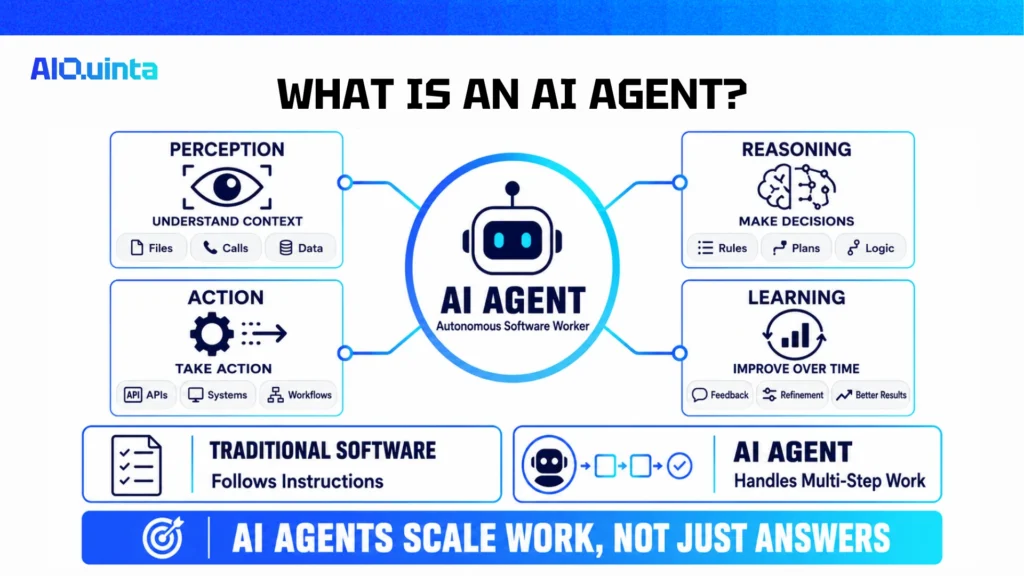
At its core, an AI agent is an autonomous software system designed to perform specific roles within your organization. Unlike a traditional script, an agent perceives its digital environment, makes decisions based on corporate logic, and takes action to achieve a goal.
Why it matters to the C-Suite: Think of agents not as software, but as scalable workforce augmentation. They allow your teams to offload complex, multi-step processes—like reconciling invoices, triaging customer support tickets, or conducting market research—affordably and at infinite scale.
The distinction is crucial for setting expectations.
Chatbots (Passive): Rely on rigid scripts or static knowledge. They require human prompts to function and often hit “dead ends.”
AI Agents (Active): Possess “agency.” They can plan a sequence of actions, adapt when they encounter errors, and use tools (like your CRM, ERP, or email) to finish a job.
To build an agent that drives ROI, you need to understand its four strategic pillars:
Perception: How the agent ingests context—whether it’s reading a JSON file, listening to a customer call, or analyzing sensor data from a factory floor.
Reasoning: The cognitive engine (usually an LLM) that analyzes the situation, references your business rules, and formulates a plan.
Action: The integration layer where the agent executes. This means API calls, database updates, or triggering workflows in other software.
Learning: The ability to refine performance over time through feedback loops, ensuring the agent gets smarter the more it interacts with your business.
The process of AI agent development involves a structured approach to ensure the final product is effective, reliable, and aligned with its intended purpose.
Don’t build an agent looking for a problem. Start with the business pain point.
Strategy: Define clear KPIs. Are you trying to reduce support ticket resolution time by 30%? Are you automating the first pass of legal contract review?
Scope: meaningful boundaries ensure the agent stays focused and effective (and prevents “hallucinations“).
Your agent is only as good as the data it feeds on.
Strategy: Treat data as a product. Gather high-quality, proprietary data from your internal silos. Clean, normalize, and label it.
Enterprise Tip: Use synthetic data to stress-test your agent against edge cases (e.g., fraudulent transactions or complex customer complaints) before it goes live.
This is where architecture meets strategy.
Strategy: Choose between building from scratch (high control, high cost) or leveraging acceleration frameworks.
The Core: Select an LLM that balances cost and intelligence.
Avoid monolithic code. Build for change.
Strategy: Adopt a modular design where “Tools,” “Memory,” and “Reasoning” are separate components. This allows you to swap out the underlying LLM or add new integrations without rebuilding the entire agent.
This is the implementation phase where the agent is “trained” on your business logic.
Strategy: Use advanced prompt engineering to encode your company’s standard operating procedures (SOPs) into the agent’s instructions.
Action: Connect the agent to your APIs. If it can’t click the button, it’s just a consultant, not an employee.
Launch is just the beginning.
Strategy: Move from “Sandbox” to “Production” with a human-in-the-loop phase.
Governance: Implement rigorous monitoring for accuracy, latency, and cost. If an agent starts drifting from its KPIs, you need instant observability to correct it.
Consider a customer refund agent for an online retailer.
Business Goal
Reduce the time required to process standard refund requests while maintaining policy compliance.
Agent Workflow
Tools
get_customerget_orderget_delivery_statusget_payment_statussearch_refund_policycheck_refund_eligibilitycalculate_refund_amountcreate_refund_requestsend_customer_messageGuardrails
Evaluation Metrics
This design separates language-based judgment from deterministic financial controls.
Building from scratch offers control but requires substantial engineering and operational ownership.
A custom implementation may be appropriate when:
An enterprise agent platform may be more suitable when:
The decision should compare total operating responsibility, not only initial development cost.
AIQuinta helps enterprises create and manage AI agents powered by their own knowledge, data, policies, and business systems.
With governed knowledge management, enterprise integration, task execution, access control, and operational oversight, organizations can move from AI answers to controlled business action.
Your knowledge. Your agents. Your control.
Ready to build your workforce of the future?