

What is Loop Engineering? 5 Core Components and How to build
- Publised June, 2026
-
Duc Nguyen (Dwight)
What is loop engineering? Learn how AI loops automate repeated tasks, improve productivity, and support enterprise AI workflows.
Table of Contents
Toggle
Key Takeaways
- Loop engineering means designing repeatable AI workflows, not writing one prompt at a time.
- It helps AI agents keep working toward a goal with checks, feedback, and next actions.
- The business value is speed, lower manual effort, better process quality, and higher AI return on investment.
- It is not magic. Poor loop design can increase cost, create errors, and waste AI usage.
- Enterprises should start with simple loops, clear success rules, cost controls, and human review.
What is Loop Engineering?
The strongest counterargument is simple: loop engineering may sound like another AI buzzword. Many teams already use automation, checklists, workflows, and feedback loops. So why create a new term?
The useful difference is this: loop engineering applies those ideas to AI agents.
Loop engineering is the practice of designing a repeated process where an AI agent can receive a goal, take action, check the result, and decide what to do next. Instead of asking an AI tool one question, waiting for an answer, and writing the next prompt yourself, you design a system that keeps the work moving.
A simple example:
You do not tell an AI assistant, “Write one email.”
You tell it:
“Review these customer tickets, group common issues, draft replies, check each reply against company policy, flag risky cases, and repeat this every morning.”
That is closer to loop engineering.
In plain language, loop engineering is like building a smart assembly line for knowledge work. A normal prompt is one worker doing one task. A loop is a small process that keeps checking, improving, and moving to the next step.
Why Loop Engineering Matters for Business
The main risk is that companies may adopt loop engineering before they understand the cost model. A loop can make an AI agent work many times in a row. That can consume more tokens, more tool calls, and more compute. In business terms, a bad loop is like leaving a machine running overnight without a production target.
Still, the economic upside is clear.
Loop engineering matters because many business tasks are not one-step tasks. They require repeated action, review, and adjustment. Examples include:
- Checking supplier documents
- Reviewing customer support cases
- Updating product content
- Finding errors in reports
- Drafting code and testing it
- Monitoring data quality
- Preparing weekly business summaries
- Comparing policy changes with internal documents
Prompt engineering helps with one interaction. Loop engineering helps with an operating process.
This is why the idea has gained attention. Business Insider reported that loop engineering is being discussed as a shift from manual prompting to recurring systems that guide AI agents until a task is complete. The same report also noted a key business caution: loops can become expensive because they may use many AI interactions.
For enterprises, the goal is not to replace people with uncontrolled automation. The goal is to reduce repeated manual work while keeping judgment, governance, and cost control in place.
Loop Engineering vs Prompt Engineering
| Aspect | Prompt Engineering | Loop Engineering |
|---|---|---|
|
Core Idea |
Focuses on how to ask the AI for a better answer in a single interaction |
Focuses on designing a repeatable workflow |
|
Role of Prompts |
Prompts are the main driver of output |
Prompts are one part of a larger system |
|
Dependency |
Depends on a person to guide each next step |
Can continue working through defined steps with minimal manual input |
|
Broader Context |
Single interaction focus |
Part of agentic workflow design that may include multiple loops, tools, approvals, and business rules |
Common Types of AI Loops
Goal-Based Loops
A goal-based loop keeps working until a defined outcome is reached.
Example:
“Create a product page, check SEO gaps, revise the copy, and stop when the page meets the checklist.”
This is useful for content, software, research, and business analysis.
Scheduled Loops
A scheduled loop runs at a set time.
Example:
“Every Monday morning, review open customer tickets and summarize the top five recurring issues.”
This is useful for weekly reports, finance checks, operational dashboards, and management updates.
Review Loops
A review loop checks work from another AI or human.
Example:
“One AI drafts a proposal. Another AI checks it against brand rules, pricing policy, and missing proof points.”
This reduces manual review time, but it does not remove the need for human judgment in sensitive cases.
Monitoring Loops
A monitoring loop watches for changes.
Example:
“Check the inventory file each day. Flag any item with low stock, rising demand, or delayed replenishment.”
This is useful when speed matters and manual checking is costly.
The Five Core Components of an Economic Loop
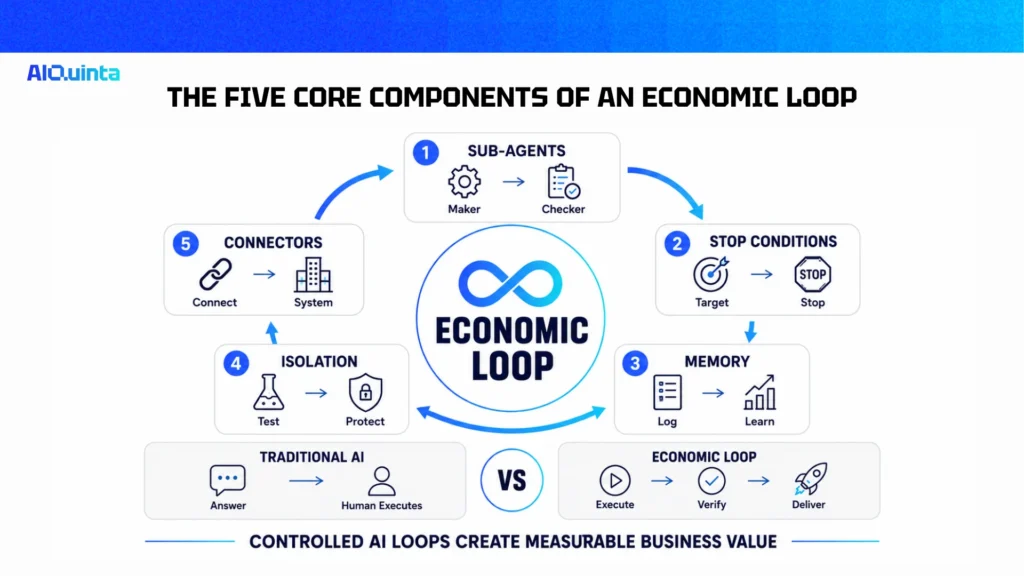
To construct a loop that produces reliable returns rather than endless bills, architects combine five specific components. Without these boundaries, the system is indistinguishable from a money-burning experiment.
Sub-Agents (The Maker and the Inspector)
A fundamental rule of system economics is that an agent cannot grade its own work. If the same AI that writes the code also checks the code, it will suffer from hallucinated success—confidently approving its own mistakes. To fix this, a loop requires a “maker-checker” split. This is analogous to a restaurant kitchen: the chef (the maker) cooks the meal, but the head waiter (the inspector) verifies the order matches the ticket before it goes to the customer. Using a smaller, cheaper model to rigorously inspect the output of the expensive, larger model is the most effective way to secure quality control while reducing operating costs.
Verifiable Stopping Conditions (The Hard Brake)
A loop without a stopping condition is a financial liability. “Improve this feature” is an unbounded instruction that will consume resources indefinitely. A measurable goal, such as “reduce load time to under 50 milliseconds while passing all existing safety checks,” provides a concrete termination point. Once the system achieves the metric, it stops. Furthermore, the loop must include failure exits: if no measurable progress is made after three attempts, or if the budget limit is reached, the system must escalate the issue to a human rather than endlessly spinning its wheels.
State and Memory (The Factory Ledger)
If an automated system forgets what it just tried, it will repeat the same costly mistake. Loops require an external memory file—a ledger that records what approach was attempted, why it failed, and what remains open. This is like a shift-change log in a factory. When a new automated run begins, it reads the log to pick up exactly where the previous run left off, preventing redundant labor and wasted expenditure.
Isolation Worktrees (The Testing Floor)
You would not test a new robotic assembly arm directly on the live production line. Similarly, loop engineering isolates the AI’s workspace. By confining the agent to a separate branch or environment, its trial-and-error process cannot damage the main infrastructure. It is only allowed to merge its work after the autonomous inspector approves it, protecting the enterprise’s core assets from experimental collateral damage.
Connectors (The Delivery Trucks)
A loop that only suggests changes is merely an expensive advisory tool. To realize actual ROI, the loop must be connected to enterprise systems—allowing it to autonomously update tickets, submit code changes, or deploy configurations. Connectors are the delivery trucks that move the finished product out of the factory and into the real world, turning theoretical work into tangible business value.
How to Start with Loop Engineering
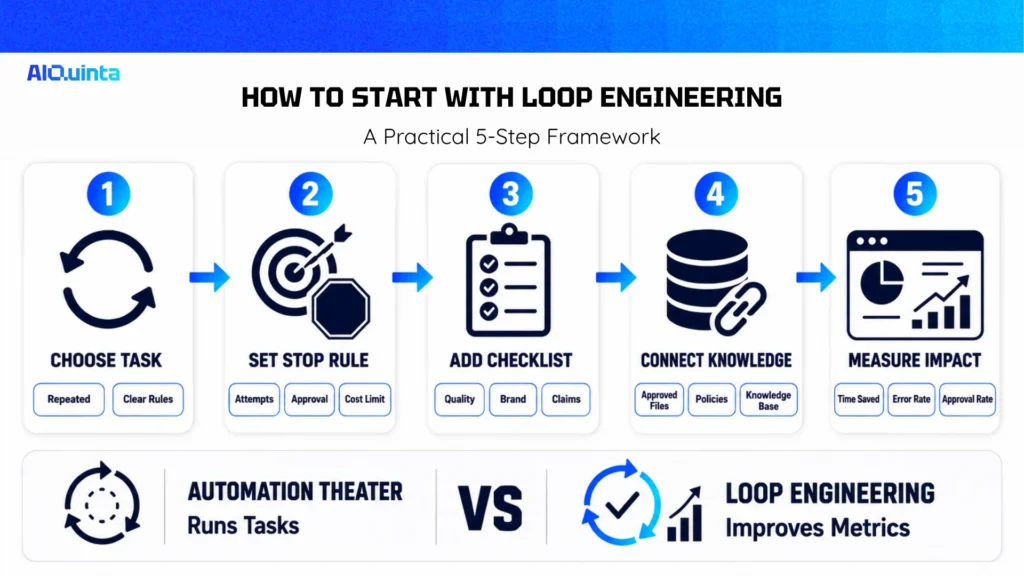
Step 1: Choose a Repeated Task
Pick a task that happens often and follows clear rules.
Good examples:
- Weekly report summary
- Ticket classification
- Document checking
- SEO content review
- Data quality scan
Avoid starting with tasks that need deep judgment or unclear ownership.
Step 2: Define the Stop Rule
A loop must know when to stop.
Examples:
- Stop after three attempts.
- Stop when the checklist passes.
- Stop when a human approves.
- Stop when missing data is found.
- Stop when cost limit is reached.
A stop rule protects cost and quality.
Step 3: Add a Quality Checklist
The checklist should be simple.
Example for a blog loop:
- Keyword included in H1
- Meta description written
- H2 structure clear
- FAQ included
- No unsupported claims
- Tone matches brand
Step 4: Connect Trusted Knowledge
Do not let the loop rely on memory alone.
Connect it to approved files, policy pages, product data, or internal knowledge bases.
Step 5: Measure Business Impact
Track results before and after.
Useful metrics:
- Time saved
- Cost per completed task
- Error rate
- Human review time
- Output approval rate
- Customer response time
- Rework rate
If the loop does not improve a real metric, it is not strategic. It is just automation theater.
Measuring the ROI of Autonomous Pipelines
When an enterprise adopts loop engineering, the financial return is calculated through defect prevention and labor reallocation. It is universally understood in software economics that fixing a defect in production costs exponentially more than fixing it during the initial build phase. Because a loop continuously validates its own work against strict tests before finalizing a task, it dramatically reduces the volume of errors that reach production.
By moving the validation process from the end of the development cycle to the inside of the autonomous loop, companies shift their testing left. This reallocation allows human engineers to spend their highly compensated time designing better system architectures and defining stricter verification standards, rather than manually hunting for syntax errors.
However, enterprises must actively budget for the human cost of managing comprehension debt. A sound economic strategy dictates that any task automated by a loop must still have its load-bearing decisions thoroughly documented and reviewed by a senior employee. The temporary dip in raw velocity caused by this review process is the insurance premium paid to guarantee the long-term maintainability of the enterprise’s intellectual property.
Common Mistakes to Avoid
The strongest warning is that loop engineering can create the illusion of progress. More AI activity does not mean more business value.
Avoid these mistakes.
Mistake 1: No Cost Control
- A loop without cost limits can run too many steps.
- Fix: Set a maximum number of cycles, documents, agents, and tool calls.
Mistake 2: No Human Review
- Some outputs need judgment.
- Fix: Create review rules for high-risk or high-value work.
Mistake 3: Weak Context
- The AI cannot perform well with poor input.
- Fix: Use approved knowledge sources and update them often.
Mistake 4: No Audit Trail
- If no one can explain the output, trust drops.
- Fix: Log sources, decisions, edits, and exceptions.
Mistake 5: Automating the Wrong Work
- Not every task deserves a loop.
- Fix: Prioritize tasks with clear volume, cost, and business impact.
Conclusion
Loop engineering is the shift from asking AI one question at a time to designing repeatable AI workflows that can act, check, improve, and stop.
The concept is still early, and some of the language may change. The business logic will remain. Companies do not need more random prompting. They need AI systems that fit real workflows, use trusted knowledge, control cost, and improve measurable outcomes.
For enterprise teams, the best starting point is not a complex multi-agent system. It is one high-value repeated task with a clear goal, trusted context, quality checks, cost limits, and human review.
Used this way, loop engineering can help companies move from AI experiments to AI operations.
FAQs
What is loop engineering in simple words?
Loop engineering means designing a repeatable AI process. The AI does a task, checks the result, improves it, and continues until it reaches a goal or stop rule.
Is loop engineering the same as prompt engineering?
No. Prompt engineering focuses on writing better instructions for one AI response. Loop engineering focuses on building a repeated workflow where prompts, checks, tools, and feedback work together.
Why is loop engineering important for enterprises?
It helps enterprises reduce repeated manual work, improve consistency, speed up decisions, and get more value from AI investments. It is useful when tasks happen often and follow clear business rules.
Turn Enterprise Knowledge Into Autonomous AI Agents
Your Knowledge, Your Agents, Your Control
Your Knowledge, Your Agents, Your Control