
AI Agent for SERP Analysis: Signals, Gaps, Actions
- Publised June, 2026
-
Duc Nguyen (Dwight)
How an AI agent for SERP analysis works. Learn to decode live ranking signals, identify semantic content gaps and automate strategic actions.
Table of Contents
Toggle Key Takeaways
- SERP analysis should not stop at keyword difficulty. It must include intent, content depth, page structure, authority, freshness, entity coverage, and AI visibility.
- The strongest use case is not replacing SEO experts. It is reducing manual research time and helping teams make faster content decisions.
- The best AI agent for SERP analysis works as a repeatable workflow: define keyword, collect SERP data, classify intent, identify gaps, prioritize actions, and monitor changes.
- Human review remains critical because agents can misread intent, overvalue surface-level patterns, or recommend content that does not match business goals.
What is an AI Agent for SERP Analysis?
SERP analysis is the process of studying search results to understand why pages rank, what intent Google rewards, and what content is needed to compete.
An AI agent improves this process in three ways:
- It expands research by testing related queries and search variations.
- It analyzes ranking pages at scale, extracting signals such as structure, entities, authority, and content depth.
- It turns insights into actions, such as content updates, new sections, FAQs, or entirely new pages.
For enterprise AI solution providers, this is valuable because buyers search with complex intent and compare products, workflows, risks, and ROI before making decisions. A SERP analysis agent helps uncover those needs before content is created.
Why SERP Analysis is changing in AI Search
The old SERP was simpler. You reviewed the top results and built better content.
That still matters, but modern search includes AI Overviews, featured snippets, videos, forums, and other result types. Visibility is no longer limited to blue links.
Traditional SEO remains essential, but content must also be easy for AI systems to extract, cite, and summarize. As a result, SERP analysis now needs to examine intent, source selection, competitor strengths, and missing insights.
A Web search AI agent helps by looking beyond rankings and analyzing the full search landscape.
How an AI Agent for SERP Analysis Works
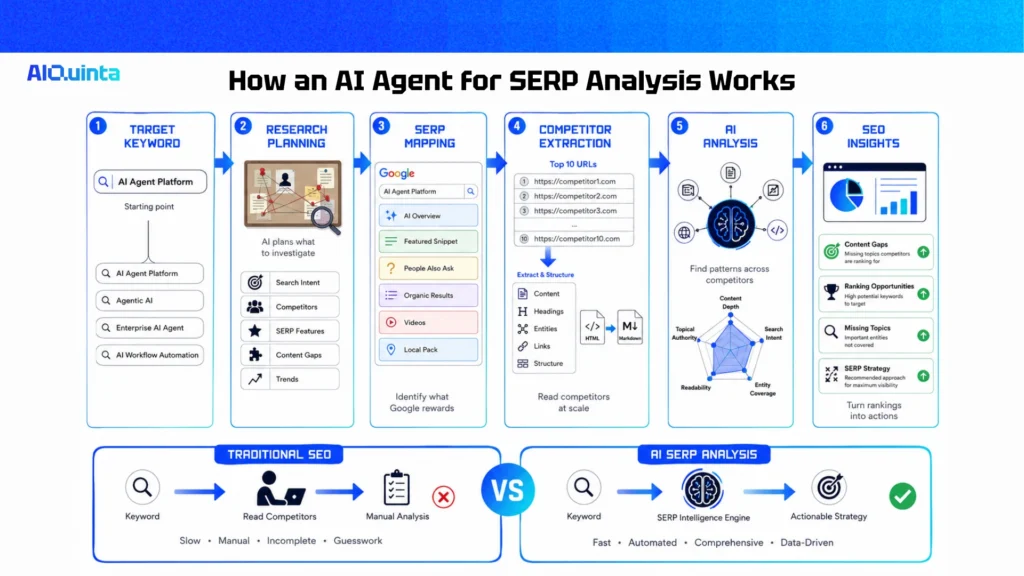
The mechanics of an AI agent for SERP analysis involve a multi-stage loop of planning, tool execution, extraction, and synthesis. This process requires an architecture that bridges natural language processing with robust web scraping protocols.
Query Decomposition and Strategic Planning
When the system receives a target keyword, the orchestrating agent first breaks down the assignment. Instead of firing a single query to a search engine, it maps out a full research trajectory. If tasked with analyzing commercial search intent for a SaaS product, the agent will plan parallel searches to investigate the main keyword, autocomplete variations, and recent industry news to establish a comprehensive baseline of relevance.
Tool Calling and API Execution
The agent does not browse the web like a human; it interfaces directly with SERP APIs. It pulls down the live composition of the search results, identifying exactly what Google is displaying. This includes mapping the presence of AI Overviews, Featured Snippets, People Also Ask (PAA) boxes, local packs, and standard organic links. By retrieving this structured data natively, the agent forms an immediate, mathematical understanding of the search intent profile.
Live DOM Scraping and Unblocking
Knowing the top 10 URLs is insufficient; the agent must read them. Moving beyond the SERP API, the agent utilizes web extraction tools equipped with proxy rotators and unblockers to bypass anti-bot measures. It scrapes the raw HTML of each ranking page, strips away the navigation and ad bloat, and converts the core content into clean Markdown. This allows the system to analyze the actual text, headings, and code structure of the competition as they exist today, not as they existed in a static database snapshot from three months ago.
Cross-Checking and Synthesis
Once the raw data is acquired, a synthesis agent evaluates the findings. It cross-checks the extracted entities against Google’s Knowledge Graph standards. It estimates word counts, scores the readability, maps the semantic relationships, and identifies where the current top-ranking content falls short. This multi-agent loop guarantees that the final analysis is grounded entirely in verified, live data rather than generative speculation.
The Core Signals an AI Agent Should Read
The strongest counterargument is that no agent can know exactly why a page ranks because ranking factors are not fully public. That is true. But an agent does not need perfect knowledge to be useful. It needs practical signals that support better SEO decisions.
- Intent signals: Intent is the first filter. The agent should identify whether results are informational, commercial, or comparison-focused and highlight the dominant pattern.
- Structure signals: Ranking pages often follow similar formats. The agent should detect common structures and reveal opportunities to add unique value.
- Depth signals: Depth is more than word count. The agent should evaluate examples, data, implementation details, visuals, and expert insights.
- Authority signals: Some pages rank because of domain strength. The agent should distinguish authority advantages from content advantages to uncover realistic opportunities.
- Freshness signals: AI and SEO topics change quickly. The agent should flag outdated statistics, old tool references, and missing coverage of recent developments.
- AI visibility signals: The agent should check whether a query triggers AI summaries or answer-style results. If so, content should be clear, well-structured, and supported by reliable sources.
From Signals to Gaps: What the Agent Should Find
Signals are inputs. Gaps are strategic findings.
A useful AI agent for SERP analysis should identify several types of gaps.
Content gaps
These are missing topics or subtopics. For this topic, content gaps may include how agents validate sources, how they avoid stale SERP data, how they manage hallucination risk, and how they turn competitor insights into briefs.
Entity gaps
Entities are important concepts, tools, platforms, people, methods, or standards connected to a topic. For this topic, entities may include SERP APIs, web crawlers, search intent, ranking signals, AI Overviews, RAG, query fan-out, schema markup, content gap analysis, and human-in-the-loop review.
If top competitors cover these entities and your content does not, your page may look less complete.
Format gaps
A SERP may reward certain formats. If competitors include comparison tables, examples, workflows, checklists, or FAQs, the agent should flag the missing formats.
For enterprise readers, format matters because they scan before they read. A clear table or workflow can communicate more value than five paragraphs of abstract explanation.
Experience gaps
This is where many AI-generated articles fail. They summarize the topic but do not show operational judgment.
An expert article should include field-level guidance: when to trust the agent, when to override it, which metrics to ignore, and how to review the final brief.
Action gaps
A content gap is useful only if it leads to an action. The agent should recommend what to create, update, remove, consolidate, or monitor.
Manual SERP Analysis vs AI-Agent SERP Analysis
| Area | Manual SERP analysis | AI-agent SERP analysis |
|---|---|---|
|
Speed |
Slow, page-by-page review |
Faster multi-page extraction |
|
Consistency |
Depends on analyst skill |
Repeatable workflow |
|
Intent mapping |
Manual judgment |
Assisted classification |
|
Gap detection |
Spreadsheet-heavy |
Automated comparison |
|
Action planning |
Often separate from research |
Built into the workflow |
|
Risk |
Human bias and missed patterns |
AI hallucination and weak context |
|
Best use |
Strategic review |
Scalable first-pass analysis |
The best model is not human versus AI. It is human plus AI.
The agent handles the heavy data work. The strategist validates intent, sharpens positioning, and checks whether the recommendation makes business sense.
Best Practices for Deploying a SERP Analysis Agent
Give the agent business context
Do not only give it a keyword. Add audience, market, product category, funnel stage, and target action.
Example: “Analyze ‘Web search AI agent’ for enterprise AI buyers. Prioritize content gaps related to agent capabilities, SERP analysis, source validation, and workflow automation.”
Ask for evidence, not only recommendations
The agent should show which pages support each finding. It should separate observed data from inferred strategy.
Force prioritization
A weak agent gives 30 recommendations. A strong workflow asks for the top five actions, ranked by impact and effort.
Keep a human approval layer
Human review should check facts, claims, tone, brand fit, and search intent. This matters more in AI and enterprise topics because inaccurate content can damage trust.
Monitor after publishing
SERP analysis is not a one-time exercise. Search results change. Competitors update pages. AI summaries shift. The agent should rerun analysis on priority keywords and flag when intent, ranking pages, or content gaps change.
Conclusion
An AI agent for SERP analysis is not just a faster keyword tool. It is a decision workflow.
Its value comes from connecting three layers: signals, gaps, and actions. Signals show what the SERP rewards. Gaps show where current content falls short. Actions show what the team should create, update, or monitor next.
The strongest counterargument is that AI agents can still make mistakes. They can misread intent, overfit competitor patterns, or produce confident but weak recommendations. That is why the best deployment model keeps humans in control of strategy and final approval.
For enterprise AI teams, the opportunity is clear. Use a Web search AI agent to reduce manual research, improve content briefs, detect SERP shifts faster, and build articles that serve both search engines and serious buyers.
The teams that win will not be the ones that publish the most AI content. They will be the ones that build the strongest research-to-action system.
FAQs
What is an AI agent for SERP analysis?
An AI agent for SERP analysis is a workflow system that studies search results for a target keyword, extracts ranking signals, compares competitor pages, identifies content gaps, and recommends SEO actions.
How does a Web search AI agent perform SERP analysis?
It starts with query planning, collects live search results, reads ranking pages, classifies intent, extracts signals such as headings and entities, compares competitors, and turns the findings into an action plan.
Is AI SERP analysis better than manual SERP analysis?
It is better for speed, scale, and consistency. Manual review is still better for strategic judgment, brand positioning, and final quality control. The strongest approach combines both.
Turn Enterprise Knowledge Into Autonomous AI Agents
Your Knowledge, Your Agents, Your Control
Your Knowledge, Your Agents, Your Control
Related Articles

Latest Articles