
The Ultimate Guide to Natural-Language Agent Harnesses (NLAHs)
- Publised April, 2026
-
Duc Nguyen (Dwight)
Discover how Natural-Language Agent Harnesses (NLAHs) and the Intelligent Harness Runtime (IHR) revolutionize AI agents with editable, modular control logic.
Table of Contents
Toggle
Key Takeaways
-
Paradigm Shift: Natural-Language Agent Harnesses (NLAHs) move AI agent control logic from opaque, hard-coded software scripts into portable, editable natural-language artifacts.
-
The Power of IHR: The Intelligent Harness Runtime (IHR) acts as the execution environment, interpreting natural language to manage states, tool access, and agent delegation.
-
Combating Context Rot: By relying on durable artifacts and file-backed memory architectures, NLAHs prevent the degradation of reasoning capabilities in long-horizon tasks.
-
Enhanced Performance: Benchmarks like SWE-bench and OSWorld show that modular, text-based harnesses drastically improve task success rates over traditional Python scaffolds.
-
Enterprise Agility: NLAHs democratize agent development, allowing non-engineers and domain experts to fine-tune AI orchestration loops without altering backend codebases.
Introduction
In the rapidly maturing landscape of enterprise artificial intelligence, the performance of an autonomous agent relies on far more than just the underlying Large Language Model (LLM). It depends heavily on harness engineering – the structural scaffolding that dictates how an agent reasons, utilizes tools, handles failures, and delegates sub-tasks.
Historically, this harness logic has been buried deep within rigid controller code (often complex Python scripts) and runtime-specific conventions. This legacy approach creates brittle architectures. When a reasoning loop needs adjustment, or an agent’s memory mechanism fails, developers must rewrite the foundational code. Consequently, agent architectures become difficult to transfer, challenging to benchmark, and nearly impossible to study as modular, scientific objects.
Enter Natural-Language Agent Harnesses (NLAHs). Recently pioneered by researchers from leading institutions, NLAHs propose a radical transformation: externalizing high-level control logic into readable, editable natural language. This guide explores the mechanics of NLAHs, the runtime environments that support them, and how enterprise AI solutions can leverage them to build more resilient, transparent, and scalable autonomous systems.
What Are Natural-Language Agent Harnesses (NLAHs)?
Defining the Concept
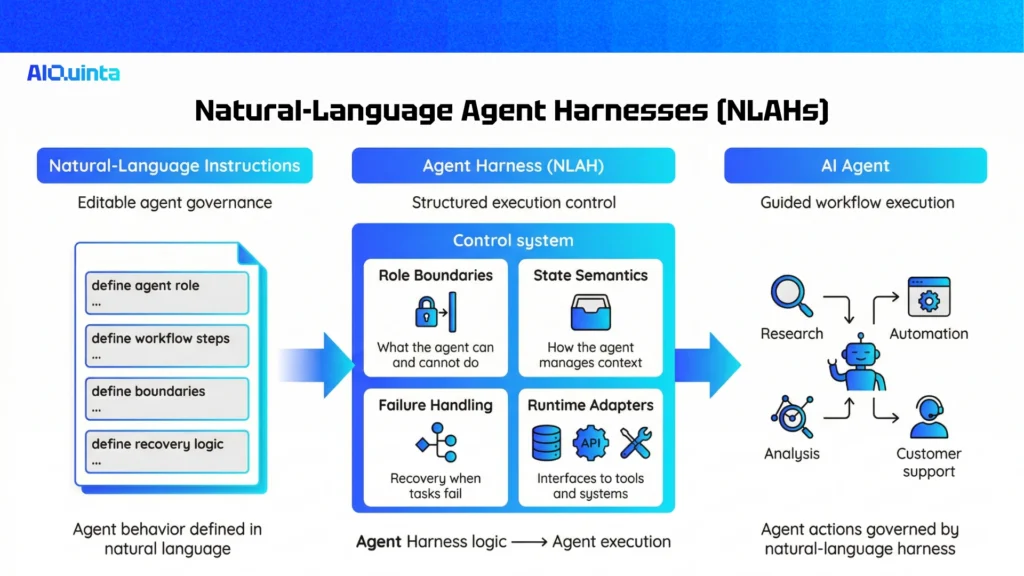
A Natural-Language Agent Harness (NLAH) is a structured representation of an AI agent’s control logic, expressed entirely in editable natural language rather than programming syntax. Instead of writing code to dictate an agent’s “reason-act” loop, error-handling protocols, or role boundaries, system architects write comprehensive natural-language instructions that govern the agent’s overarching workflow.
These harnesses bind natural-language instructions to explicit contracts and artifact carriers. They define:
-
Role Boundaries: Exactly what the agent is authorized (and not authorized) to do.
-
State Semantics: How the agent should remember past actions and store current context.
-
Failure Handling: The step-by-step logic the agent should follow when a tool fails or a reasoning path hits a dead end.
-
Runtime Adapters: The interfaces through which the agent interacts with external environments, databases, and APIs.
The Shift from Hard-Coded Scaffolds to Natural Language
Traditional agent systems rely on orchestrators like LangChain or AutoGen, where the logic of how the agent thinks is hard-coded into the pipeline. If you want an agent to reflect on its mistakes (a self-reflection loop), you must write the iterative loop in Python.
NLAHs decouple the task logic from the execution runtime. By keeping the harness in natural language, organizations can swap out, version-control, and A/B test different reasoning strategies just as easily as they might edit a prompt. This moves the industry away from runtime-specific conventions and toward a highly modular, transparent method of building autonomous ecosystems.
The Architecture: How NLAHs Work
For a natural-language document to actively control a software system, it requires a specialized execution engine. This brings us to the second critical component of this paradigm: the Intelligent Harness Runtime (IHR).
The Intelligent Harness Runtime (IHR)
The IHR is a shared, underlying environment designed specifically to interpret and execute NLAHs. Rather than compiling the natural language into an intermediate code representation, the IHR interprets the harness logic directly.
The IHR typically features:
-
An In-Loop LLM: The cognitive engine that continuously reads the NLAH to determine the next procedural step.
-
A Robust Backend: Infrastructure equipped with tool access, sandbox environments, and the ability to spin up child agents for sub-delegation.
-
A Runtime Charter: A foundational set of policies that separates the shared runtime mechanics (e.g., how to execute a function) from the task-family harness logic (e.g., when to execute a function).
Explicit Contracts and Durable Artifacts
One of the most significant challenges with standard LLMs is “context rot”—the tendency for an agent to lose track of its initial goals, constraints, or accumulated knowledge over a long series of interactions. An LLM operating in a vacuum is merely a stateless function.
NLAHs solve this by relying on Explicit Contracts and Durable Artifacts. The natural-language harness mandates that the agent must “write its thoughts down” into persistent, structured files (such as a manifest.json or dedicated state root directories). The filesystem itself becomes the memory architecture. Before the agent takes its next action, the IHR forces it to read the explicit contract and verify its current state against the durable artifacts stored in the filesystem.
Managing State Through Filesystems
Instead of relying solely on the LLM’s context window (which degrades over time), NLAHs offload state management to the local environment. By explicitly defining state conventions within the natural text (e.g., “Store the results of every database query in the /memory/active_session/ directory before proceeding to synthesis”), the agent builds a reliable, auditable trail of its own logic. This file-backed memory ensures that even in complex, multi-day reasoning tasks, the AI retains a perfect understanding of its progress.
Traditional Agents vs. NLAH-Driven Agents
To understand the value proposition for enterprise environments, it is helpful to compare the traditional approach with the new NLAH framework.
| Feature | Traditional Hard-Coded Agents | NLAH-Driven Agents (with IHR) |
|---|---|---|
|
Control Logic |
Buried in Python/Node.js scripts. |
Externalized in editable natural language files. |
|
Memory Architecture |
Relies heavily on in-memory arrays and context windows. |
Utilizes file-backed durable artifacts (state roots). |
|
Modification Speed |
Slow; requires software engineering, testing, and redeployment. |
Fast; requires editing a text document and updating the prompt/harness. |
|
Accessibility |
Restricted to developers and software engineers. |
Accessible to domain experts, data analysts, and product managers. |
|
Auditability |
Low; debugging requires tracing through complex code execution. |
High; logic is readable, and state is saved as explicit filesystem artifacts. |
Why Enterprise AI Needs NLAHs
Adopting Natural-Language Agent Harnesses provides enterprise organizations with distinct strategic advantages, directly addressing the scaling bottlenecks of autonomous systems.
Extreme Modularity and Transferability
Because the harness is a distinct artifact from the runtime code, it is incredibly portable. An enterprise can develop a highly effective “Financial Audit Reasoning Loop” NLAH and transfer it across different departments, or even switch out the underlying foundational model without having to rewrite the core control logic.
Preventing Context Rot in Long-Horizon Tasks
Enterprise tasks – such as comprehensive codebase refactoring, long-term market research, or continuous cybersecurity monitoring – require agents to operate autonomously for hours or days. By enforcing state updates via durable file systems, NLAHs ensure the agent does not hallucinate past actions or forget its initial instructions. This drastically reduces the hallucination rate in complex, multi-step workflows.
Democratizing Agent Development
When agent behavior is controlled by Python, only engineers can fix a malfunctioning agent. When agent behavior is controlled by an NLAH, a subject-matter expert (like a legal compliance officer or a financial analyst) can review the natural-language file, spot a flaw in the reasoning loop, and edit the text directly to improve the agent’s performance. This accelerates the alignment of AI systems with strict business logic.
Real-World Benchmarks and Performance: SWE-bench and OSWorld
The shift toward externalized, natural-language control is not merely theoretical; it has demonstrated significant, measurable improvements in top-tier AI benchmarking environments.
Recent controlled evaluations on industry-standard benchmarks like SWE-bench (assessing an agent’s ability to solve real-world software engineering issues) and OSWorld (evaluating multimodal agents performing computer-use tasks) reveal the superiority of NLAHs.
In these evaluations, researchers conducted module ablations and code-to-text harness migrations. They discovered that agents utilizing NLAHs and the Intelligent Harness Runtime consistently outperformed natively coded Python scaffolds. The primary driver of this success was the system’s ability to bypass brittle GUI loops and hard-coded failure states. When a traditional agent encounters an unexpected UI change or API error, the script crashes. When an NLAH-driven agent encounters the same issue, the natural language directives allow it to fallback, reflect, read its durable artifacts, and attempt alternative reasoning paths dynamically.
How to Implement NLAHs in Your Organization
For enterprise AI solution providers and organizations looking to integrate NLAHs into their technological stack, a systematic approach is necessary. Here is an actionable, three-step framework for adoption.
Step 1: Rethink and Map Your Control Logic
Before writing an NLAH, you must decouple your current agent logic from your codebase.
-
Audit current agents: Identify where your orchestration code dictates loops, memory storage, and tool calls.
-
Draft the logic in plain text: Translate these hard-coded loops into clear, procedural natural language. Focus on defining the role, the step-by-step reasoning constraints, and the exact protocol for handling unexpected errors.
Step 2: Adopt a Shared Runtime Environment (IHR)
You cannot execute an NLAH without a runtime capable of interpreting it.
-
Build or integrate an IHR: Your runtime must be separated from the task logic. It should feature an “in-loop” LLM that is dedicated solely to reading the NLAH and determining the agent’s next move.
-
Develop lightweight adapters: Ensure your runtime has adapters that translate the agent’s natural-language decisions into actual API calls, database queries, or command-line executions.
Step 3: Establish Clear Artifact Contracts
Transition away from ephemeral memory.
-
Define the State Root: Create a dedicated, secure filesystem environment where the agent operates.
-
Enforce the Contract: Write strict rules within your NLAH demanding that the agent updates specific files (e.g.,
progress.md,error_logs.json) at the end of every reasoning cycle. The IHR should block the agent from taking its next action until these durable artifacts are updated and validated.
Conclusion
As we push the boundaries of what autonomous AI can achieve in the enterprise sector, the limitations of hard-coded, inflexible orchestration are becoming readily apparent. Natural-Language Agent Harnesses (NLAHs), executed through an Intelligent Harness Runtime (IHR), represent a monumental leap forward. By externalizing complex harness engineering into portable, editable natural-language artifacts, organizations can achieve unprecedented transparency, drastically reduce context rot, and empower domain experts to directly shape AI behavior. The future of agentic architecture is not written in Python; it is articulated in plain, logical, and executable natural language.
FAQs
What is the primary difference between a prompt and an NLAH?
While a prompt usually provides an LLM with context or instructions for a single generation or a short conversation, an NLAH is a comprehensive, executable document. It dictates the entire architectural lifecycle of an agent, including its memory management, multi-step reasoning loops, failure recovery protocols, and how it interfaces with external tools over long-horizon tasks.
Does moving to natural language make the agent slower?
While there is a slight overhead introduced by the “in-loop” LLM interpreting the NLAH before taking action, the overall task completion rate and efficiency actually improve for complex tasks. This is because the agent makes fewer critical errors, recovers from failures more gracefully, and avoids the “context rot” that typically requires restarting the entire process.
How do NLAHs handle security and unauthorized actions?
Security is enforced at two layers. First, the NLAH contains explicit natural-language contracts outlining strict role boundaries and prohibited actions. Second, the underlying IHR and its runtime charter act as a sandbox. The runtime adapters validate the agent’s intended actions against the original charter before executing them, ensuring compliance and preventing malicious or unintended tool usage.
Turn Enterprise Knowledge Into Autonomous AI Agents
Your Knowledge, Your Agents, Your Control
Your Knowledge, Your Agents, Your Control