


 Duc Nguyen (Dwight)
Learn what a vector database is, how high-dimensional embeddings, HNSW indexing, and RAG architectures power modern enterprise AI and LLM memory.
Table of Contents
Toggle It enables semantic search, recommendations, and Retrieval-Augmented Generation.
Approximate nearest-neighbor algorithms drive low-latency performance at scale.
Enterprises use vector databases to unlock private knowledge bases for AI systems.
Governance, security, and observability matter as much as raw speed.
AI systems no longer rely only on keyword matching or rigid schemas. Large language models, recommendation engines, fraud detectors, and search platforms operate on meaning, not strings.
That shift created demand for a new data layer. Traditional relational systems cannot search millions of high-dimensional embeddings with sub-second latency. This is where vector databases step in.
This guide delivers an enterprise-ready explanation of what a vector database is, how it works, when to use one, and how to evaluate platforms with production realities in mind.
A Vector Database is a specialized data management system that stores information as mathematical representations called vector embeddings. These vectors encode semantic meaning extracted from text, images, audio, video, or sensor data by machine-learning models.
The system converts the query into a vector embedding, then performs a similarity search across billions of stored vectors.
An embedding is a list of floating-point numbers such as: [0.12, -0.44, 0.98, …]
Each dimension captures a latent feature learned by a model. Items that are semantically close appear near each other in vector space.
| Feature | Relational Database (SQL) | Vector Database (AI-Native) |
|---|---|---|
|
Data Structure |
Tables, Rows, Columns |
High-Dimensional Embeddings |
|
Search Method |
Exact Match / Keyword |
Similarity (Distance Metrics) |
|
Best For |
Transactions, Inventory |
AI Memory, Semantic Search, RAG |
|
Query Language |
SQL |
API / Vector-specific Queries |
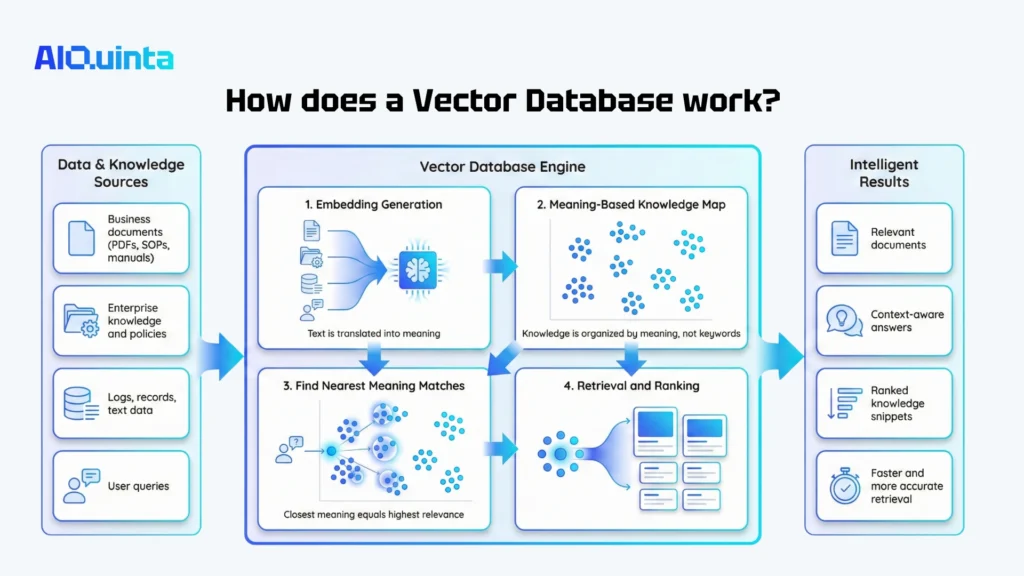
Input content becomes an embedding via an ML model.
The vector database stores that embedding with metadata.
A user query converts into another vector.
The engine finds the nearest neighbors using similarity metrics.
Results return ranked by semantic closeness.
Vector databases offer several key features and benefits that make them indispensable for modern AI applications.
Key Features:
Benefits:
Despite their advantages, vector databases present certain challenges:
Vector databases have become the “silent engine” behind almost every AI interaction you have today.
RAG (Retrieval-Augmented Generation): This is the #1 use case. Instead of an LLM relying only on its training data, it “looks up” facts in a vector database before answering. This eliminates hallucinations and allows AI to access your company’s private, up-to-date documents.
AI Agent Memory: In 2026, autonomous agents use vector stores to remember past conversations, user preferences, and task progress across different sessions.
Multi-Modal Search: You can search for a video using a text description, or find similar images by uploading a photo. Since both are converted to vectors in the same space, the database can bridge different media types.
Recommendation Engines: Beyond simple “customers who bought X,” vector-based systems understand the vibe of products, leading to much more accurate “Netflix-style” suggestions.
Vector databases form the strategic backbone of modern AI systems. They enable semantic understanding, real-time retrieval, and scalable RAG pipelines across private enterprise data.
Organizations that operationalize this layer gain faster insights, safer generative AI deployments, and differentiated customer experiences.
In the AI-first enterprise stack, vectors are not optional. They are infrastructure.
What are vector embeddings, and how are they generated?
Vector embeddings are numerical representations of data generated by machine learning models
What is the difference between a vector database and a traditional database
A vector database specializes in similarity search over embeddings, while traditional systems focus on exact matches and structured queries.
Is a vector database better than a SQL database?
Neither is “better” in a vacuum. SQL is superior for structured data and transactional integrity (like banking). Vector databases are superior for unstructured data and semantic retrieval (like AI search). Most modern enterprises use both in tandem.





A chatbot to answer your questions based on AIQuinta's published insights & enterprise knowledge
This is a Gen AI system. Responses are based on AIQuinta insights and should be verified.